
The World Cup quarter-final between France and Morocco hasn’t started yet and I have already witnessed a fight. Two people are in a comic roll on the floor outside a Carrefour as a growling dog tries to break free of its leash. Granted the scrap might have nothing to do with the football but it certainly sets the scene.
Don’t tell Donald Trump but the defining theme of this year’s World Cup is diaspora. An expanded format has welcomed former colonies such as Cape Verde and Haiti to the tournament, while the footprint of France is everywhere. Some 99 players at the World Cup were born in France and six are in the Moroccan squad.
This is part of a post-colonial story in which relations are currently cordial, helped by Emmanuel Macron recognising Morocco’s sovereignty over the Western Sahara. Morocco was a protectorate of France from 1912 to 1956 and roughly 1.7 million people of Moroccan descent live in the country.
Hundreds of thousands of them are based in Paris, where I’ve come to watch a match between a former colonial power and its former colony, which still treats French as its lingua franca. There is more than national history at stake. Morocco is also the last representative of Africa. Despite being home to 1.4 billion people, the continent has never produced a World Cup-winning nation. No pressure then.
***
The metro rumbles overhead in Barbès, shuttling Parisians in and out of a neighbourhood that has long been a home from home for African migrants. Near the Seine, PSG and France shirts abound to the point of absurdity.
At one point, someone wearing the No 10 of Kylian Mbappé walks past someone wearing the No 10 of Zinedine Zidane. But here at the foot of Montmartre most fans stand around in the red and green of Maroc, even if everyone wears the colours differently. Many women tie the shirt as a crop top to cope with the relentless heat. The men seem less bothered, going untucked or draping themselves in a flag. More than one undecided paints the French tricolore on their face while wearing a Moroccan kit.
There is no shortage of viewing spots. The football is on in the barbershop. It’s on in the boucherie. It’s on in the pêcherie. French terrace culture means you can watch it outside, next to a sex shop in Pigalle. Odds are that it’s being shown in there too. The fight I see before the game is no omen, because I find somewhere special.
For more than 70 years, the discount store Tati, founded by a Tunisian immigrant who had been demobbed from the Free French army, ran a brisk trade at the gateway to Barbès as a beloved fixture of the African migrant community, and in time as a favourite of the likes of Brigitte Bardot. After the store was closed down during Covid, the building became the location of the Union de la Jeunesse Internationale, a cultural centre designed to shine a light on diaspora life around the world.
Kept company by an old man dancing to Afrobeat in a Senegal shirt, I make it through a restless queue into a lobby wallpapered with pictures from the 1994 USA World Cup. I head to the library, where a small screen is set up in front of a breathtakingly diverse room of people. I am quite possibly the only white person in sight and sit down next to three young women who are evidently Moroccan fans.
Newsletters
Choose the newsletters you want to receive
View more
For information about how The Observer protects your data, read our Privacy Policy
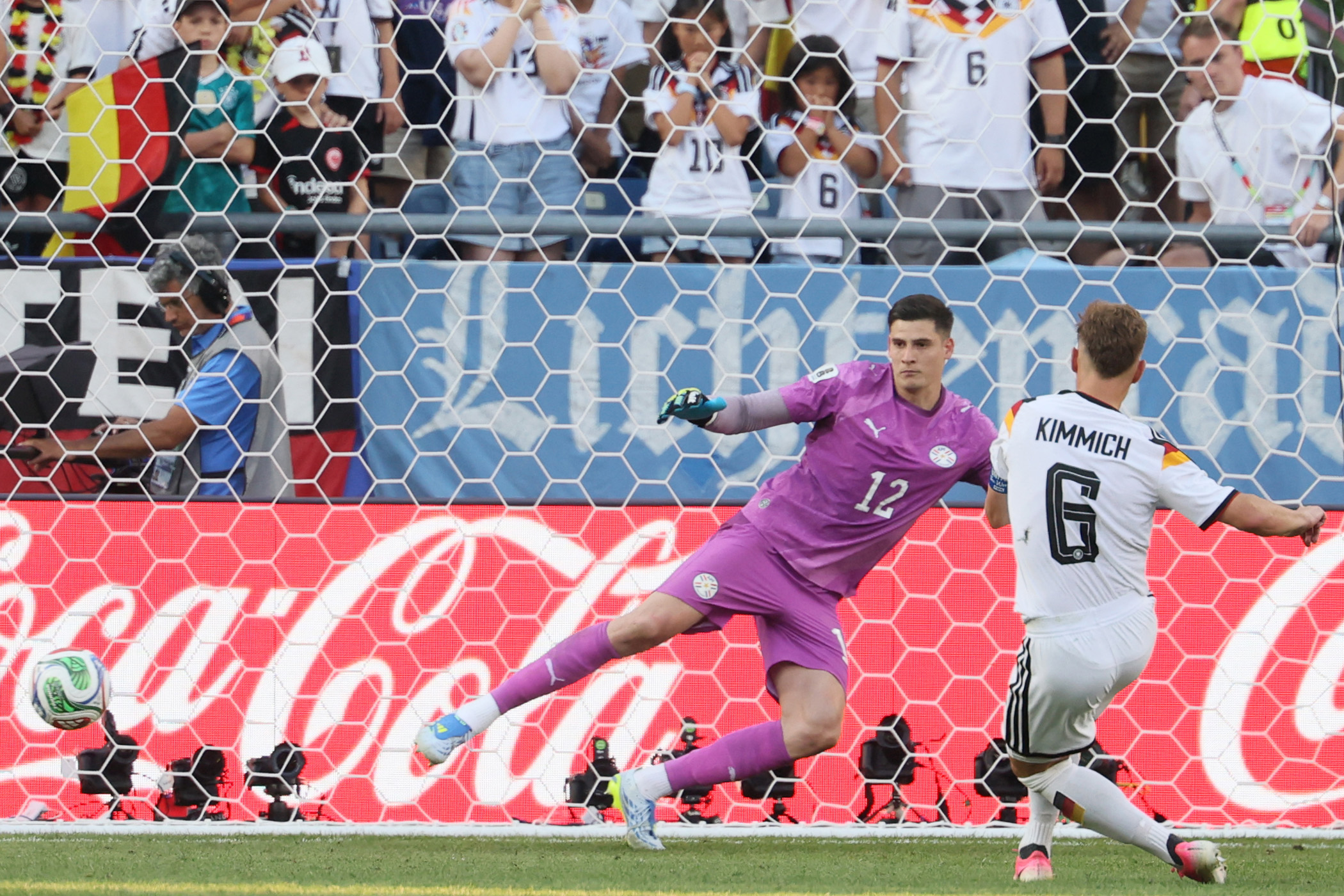
When Mbappé wins a penalty for France, the heart rate on my neighbour’s Apple watch spikes to 111bpm. When Mbappé’s effort is saved, the woman lets out an ululation as half of the room erupts. The other half groans. This is a place divided in its support, except for one moment of unity: a chorus of “Ah Shakira” when the Colombian pop star of Waka Waka fame appears on screen.
I am willing a Moroccan victory, but it is not to be. In the second half, I sit next to a French fan whose exhortations alternate between “Ooh la la” and “Allez”. But her anxieties are quelled by Mbappé’s first goal, leaping up in celebration with her long brown curls following behind her. The die-hard Moroccan fan near the door wills a response with shouts of “Vive le Maroc” and “Allahu Akbar”, but to no avail. It says a lot that there is a whole rotation of chants celebrating the keeper Yassine Bounou.
When Ousmane Dembélé scores a second for France, the Moroccan fans at the back can no longer watch. Two of them cover their faces with a headscarf to hide from the raucous French fans filming the scene. Even then, the rivalry in the room is nothing but friendly. The Moroccan Ultra bellows “Je suis Maroc”, only for a guy in a PSG shirt to stand up, wave his ID and shout “Je suis Français” in delight. A young girl sticks her thumbs down at her seatmate, a Muslim woman with Ève on the back of her shirt, and gets a tickle in return.
It would have been a great story if Morocco had beaten France. But it still wasn’t a bad night for Africa. Mbappé’s father is originally from Cameroon, his mother from Algeria. Dembélé’s father is originally from Mali, his mother from Mauritania. After the final whistle blows, everyone in Union de la Jeunesse Internationale is still dancing.
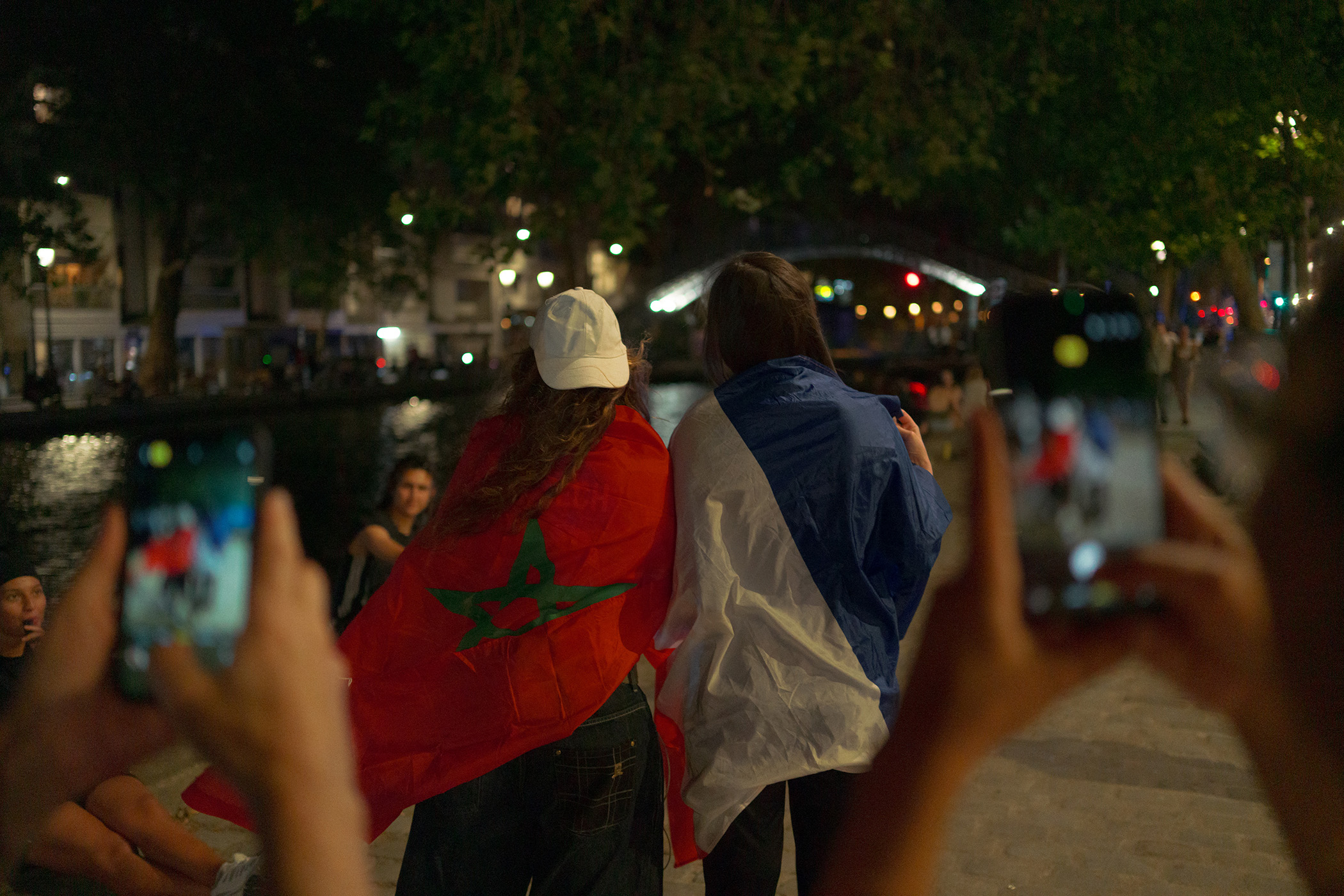
Out on the street, Paris does things the Parisian way. Car horns blare, riot police keep watch and the metro station becomes an impromptu mosh pit. In the traffic island at the western edge of Berbés stand two women, one Moroccan, one French, each carrying the flag of their nation, each as happy as the day is long. As fans stream past, they wave everyone on their way.
Photograph by Sophia Berger/AFP via Getty Images