At the 1968 Olympic Games football tournament Israel drew 1-1 with Bulgaria. (No women’s competition back then.) So they drew lots and Bulgaria won. Israeli officials thought this was “an immoral and even cruel system” and came up with an alternative. Fifa took it on in 1970.
Six weeks later, Hull City were playing Manchester United in the semi-finals of the Watney Cup at Boothferry Park and the match was drawn. For the first time in England and possibly anywhere else, the tie was decided by a penalty shootout.
George Best took the first and scored. The first player to fail was Denis Law. He didn’t miss: Ian McKechnie saved it. McKechnie then took a penalty himself and slapped it against the crossbar. Manchester United won and the shootout was part of football.
We’re now at the knockout stage of this World Cup: 31 matches and every one could go to penalties; 32 if you count the third-place playoff. Every team face the possibility of five shootouts.
There have been 35 shootouts so far in the men’s World Cup and here’s a surprise: England aren’t the worst. Spain have four losses and one win; England are tied with Italy and the Netherlands, each with three losses and one win.
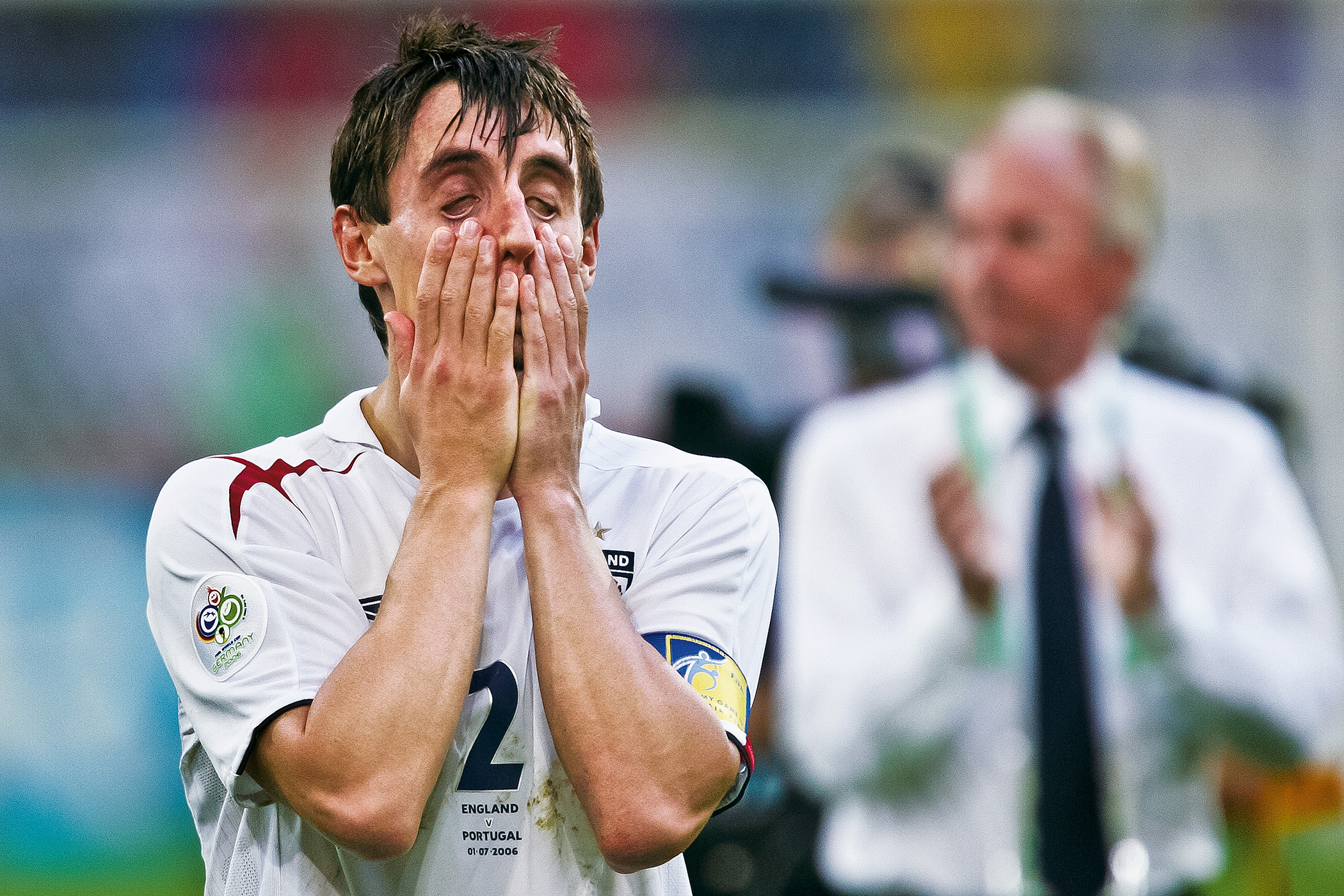
To understand the disastrous extent of England’s record in penalties, we must include the European championship. England lost to West Germany on penalties in the World Cup of 1990, then beat Spain the same way at Euro ’96. They lost to Germany on penalties in the next round, and went on to lose their next four shootouts: Argentina in 1998 (after David Beckham was sent off), Portugal in 2004 and 2006 (after Wayne Rooney was sent off) and then Italy in 2012.
The worst single shootout performance at a World Cup came from Switzerland at the 2006 edition after they failed with all their penalties against Ukraine; Oleksandr Shovkovskiy saved two of them. Perhaps the best goalkeeping performance in a shootout was by Manuel Neuer of Bayern Munich, who got his side through to the final of the 2012 Champions League after saving penalties from Real Madrid’s Cristiano Ronaldo and Kaká.
Penalty shootouts, just about acceptable in the early knockout rounds, seem increasingly preposterous as the tournament progresses. Three World Cup finals have been decided on penalties (winner first): Brazil vs Italy 1994, Italy vs France 2006 and Argentina vs France 2022. Two Women’s World Cup finals were decided the same way: USA vs China in 1999 and Japan vs USA 2011.
‘Football is a team game and penalties is not a team, it’s the individual’
‘Football is a team game and penalties is not a team, it’s the individual’
Sepp Blatter, former Fifa president
Every football match is essentially different from every other: every shootout is essentially the same. It’s instant made-for-TV drama, the theatre of cruelty. Fifa made a documentary called The Long Walk, describing the shootout as “football distilled, boiled down, reflecting its very own essence”.
This is wrong on more than one level. Sepp Blatter, former Fifa president and not a man famous for his good sense, for once said something pertinent: “Football is a team game and penalties is not a team, it’s the individual.”
Newsletters
Choose the newsletters you want to receive
View more
For information about how The Observer protects your data, read our Privacy Policy
The crucial point of the shootout is that any team can beat any other. Footballing talent is more or less factored out. To lose on penalties is no disgrace: when Gareth Southgate failed for England in 1996, he got more sympathy than abuse. Once you get to extra time, almost every team – consciously or not – plays for penalties: the bleak goalless expanse of extra time is the inevitable prelude to the factitious drama of penalties.
It’s just a lottery. Certainly that was the view of successive England managers: Glenn Hoddle, Sven-Göran Eriksson, Roy Hodgson. You can’t replicate it in training, it’s not a skill you can acquire: all you can do is hope for the best.
When Southgate became England manager, he took the opposite view and his England side beat Colombia on penalties in 2018. They practised endlessly. Goalkeeper Jordan Pickford picked up the ball after every Colombian kick and handed it to the advancing England penalty-taker: we have control. The taker took his time: just the opposite of Southgate 22 years earlier.
In World Cup shootouts, the side that go first have won 17 and lost 18. Other ways of breaking a tie have been suggested and some of them tried. The North American Soccer League had a series of five-second striker vs goalie contests starting from 35 yards. There have been proposals involving countback of corners, shots, cautions and sendings-off. Another idea is 15-second attacker vs defender and goalie from 32 yards. Yet another is to play short-handed in extra time: ice hockey drops from six-on-six to three-on-three. A five-a-side extra time would settle most ties by way of actual football.
But we’re stuck with penalties: the least satisfactory way of deciding a tie after a draw. It’s not football and it destroys the football that precedes it. Alas, television loves it.
Thank you for reading. Tell us what you think by writing to letters@observer.co.uk
Photograph by Tom Jenkins/Getty Images