
This article is part of the Rory Smith on Football newsletter – a guide to help understand what is happening on the pitch, off the pitch, and why all of it matters.
Throughout the tournament, Rory will be travelling across America, delivering daily commentary on the biggest World Cup ever direct to subscribers. Never miss a newsletter, subscribe now here.
When combined, the words “rooftop”, “party” and “Los Angeles” conjure a very specific mental picture. Cocktails almost certainly feature. A pool too, shimmering into infinity. A view of the hills, bathed in gold by the setting sun. A smattering of faces both familiar and cosmetically uncanny. Mouths moving as eyes rove, searching for someone, anyone, more important.
They do not, as a rule, make you think of multistorey car parks, squat and concrete, the dim lighting flickering like the prelude to a murder. They might occasionally feature lifts – you do have to get to the roof, after all – but they are probably not ones that judder violently with every passing floor, an ammoniac scent burning your eyes.
On Tuesday night, I went to this second type of rooftop party. There was a $15 cover charge and a somewhat disconcerting security check that was very clearly designed to establish whether I was carrying a gun. This was not a hugely promising first impression. All of the others more than made up for it.
The United States of America is a hyphenate nation. On the eve of the World Cup, I exchanged emails with an academic friend-of-a-friend: Andy Elrick, director of the Center for Sports Communication at Marist University.
He reminded me that for many Americans, being just American is often not enough. Everyone takes great pride in being a something-American: Italian-American or Mexican-American or Armenian-American. Most of the time, the emphasis is always on the second word; particularly in the current climate of fear stoked by the aggressive, often abusive, immigration policies of the second Trump regime, the part after the dash is what matters.
The World Cup has, over the past three weeks, flipped that around. For millions of fans, it has provided a welcome opportunity to accentuate the first couple of syllables, to reconnect with the country where they, or their parents, or their grandparents were born.
The experience of this tournament has not just been tourists discovering the real United States, of Waffle House and Target, or Americans discovering the carnival spirit that trails in the wake of the World Cup. It has also been a chance for the patchwork of Something-Americans to take pride in themselves.
That has been especially pronounced in Los Angeles. It is a city of intensely confusing human geography, a place of open but endless borders. Thai Town is right next to Little Armenia, Little Tokyo bleeds into Chinatown. Koreatown is a little further west, a few blocks north of El Salvador. It is a place that contains the world.
Newsletters
Choose the newsletters you want to receive
View more
For information about how The Observer protects your data, read our Privacy Policy
And so, over the course of 24 hours this week, I set out to sample the World Cup from three different countries. The rooftop – in Westlake, the skyscrapers of downtown LA twinkling in the background – was the first stop: a gathering of hundreds of Colombian fans to watch what turned out to be their team’s first victory of the tournament, a slender win against the Democratic Republic of Congo.
The top of the car park had been lined with food stalls selling arepas and empanadas and buñuelos; four giant screens had been installed across the roof, each of them helpfully on a slightly different time delay. There was a bouncy castle for children, stalls selling shirts – Colombian, Mexican and Argentinian – as well as novelty vueltiaos, Colombia’s more refined equivalent of the cowboy hat.
“I’m from the Valley,” said Halle, a mechanic from Van Nuys, an hour or so away on the other side of the Hollywood Hills. She had made the journey with a friend, Paloma, because the rooftop promised “better atmosphere, more people, something more Colombian”. Xavier, a Colombian-American who grew up in Massachusetts, confided quietly that really he had “come for the food. It’s a chance to feel Colombian, to speak Spanish, to be around my people. It feels like home.”
The following day, a smaller crowd watched Brazil’s victory over Scotland at the Brazilian Mall in Culver City, the attendance probably explained by the fact the game took place in the middle of the afternoon.
The idea, though, was basically the same: a couple of big screens, somewhat delicately hooked up to a feed from the Brazilian broadcaster Globo, with bubbling tureens of feijoada (black bean stew) being served outside. “There are more Brazilians in Venice,” said Letizia, who had brought her four-year-old son to watch. “I wanted him to feel Brazilian. If you go inside, it’s like Rio de Janeiro.” It was not entirely clear if she meant this as a compliment.
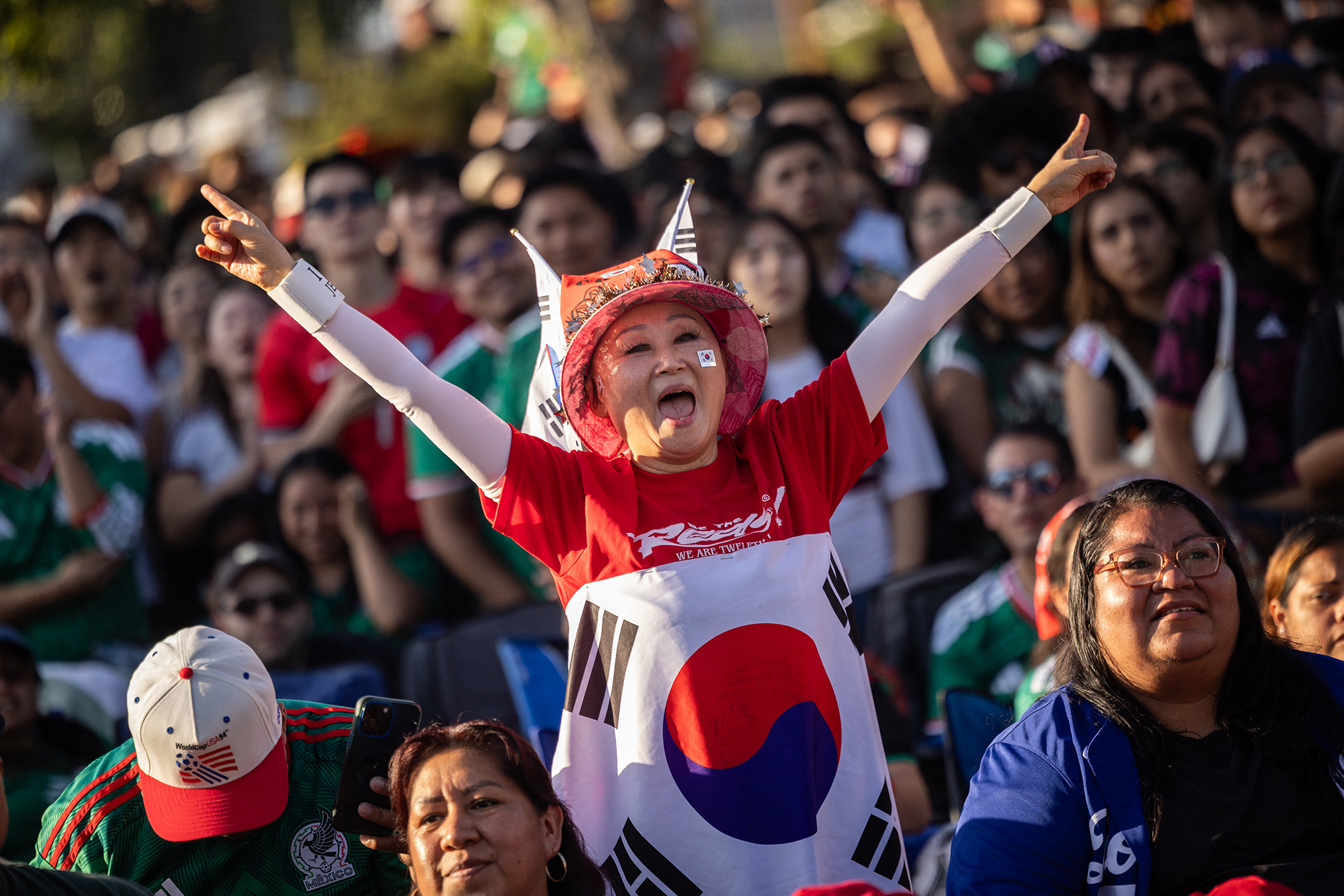
That evening, there was a substantially larger crowd at Liberty Park, in the heart of Koreatown, and a much more organised event for what would turn out to be South Korea’s final game of a bitterly disappointing tournament: pre-match entertainment from dancers inspired by KPop Demon Hunters, the game itself soundtracked by traditional drummers.
The 5,000 or so who had come down, though, had been drawn by much the same impulse as their Colombian and Brazilian fellow citizens: not so much an overwhelming desire to watch football, not in every case, but as a way to engage with their background and their community.
“It’s great to see how many people are here,” said Jacob, who had driven up from Orange County to watch the game with two friends. All three said the political reality of the United States, at the moment, had made being of Korean descent more complex than it used to be. “But this feels like a safe place to express it,” Jacob said.
Standing to one side of the screen, Kenjo Kumagai was following the game intently, a South Korean flag draped over his shoulders. In previous years, he has been one of the performers providing the pre-match entertainment, he said. This time around he was just here to watch. “It is a little bit of home that we can celebrate,” he said. The bottom of his flag had been adorned with the slogan of Kore, a local fashion house. It read: “Keeping Our Roots Eternal.”