Tabby Stoecker’s childhood memories of her grandfather are of him obsessing over sport. Although he passed away when she was five in 2005, she can still vividly recall visiting the Oxfordshire cottage where Michael Davie lived. There would always be sport on, particularly cricket. His wife, Anne Chisholm, describes the last year of his life being almost transformed by the fact that England had won the Ashes for the first time in 18 years.
He had, after all, spent years reflecting the more familiar scenes of English cricket as The Observer’s sports editor. “For most of the past two days, watching the fifth and final Test match has been like sitting through a long, pedestrian and highly familiar play,” he wrote from Melbourne in 1959. “Act 1: England collapse.”
Davie was a legendary journalist who spent the best part of four decades at this newspaper. He was part of a vanguard of sports writers and editors who helped revolutionise the genre, bringing “philosophers, poets and artists” to write on sport in the newspaper.
As well as spending time as the sports editor, he was also the news editor, deputy editor and the editor of the colour supplement when it was first introduced.
“He was a brilliant writer,” says Chisholm, who also worked at The Observer between 1967 and 1969.
“He was also a brilliant editor. He took as much pleasure in improving other people’s copy as he did out of writing his own, which is why people loved working for him.
“He began to teach me that sport really mattered. That it was part of life. I was slightly of the mindset that thought sport was a nice extra for people who were sporty. But he loved all sport. Being sports editor was his favourite job at The Observer.”
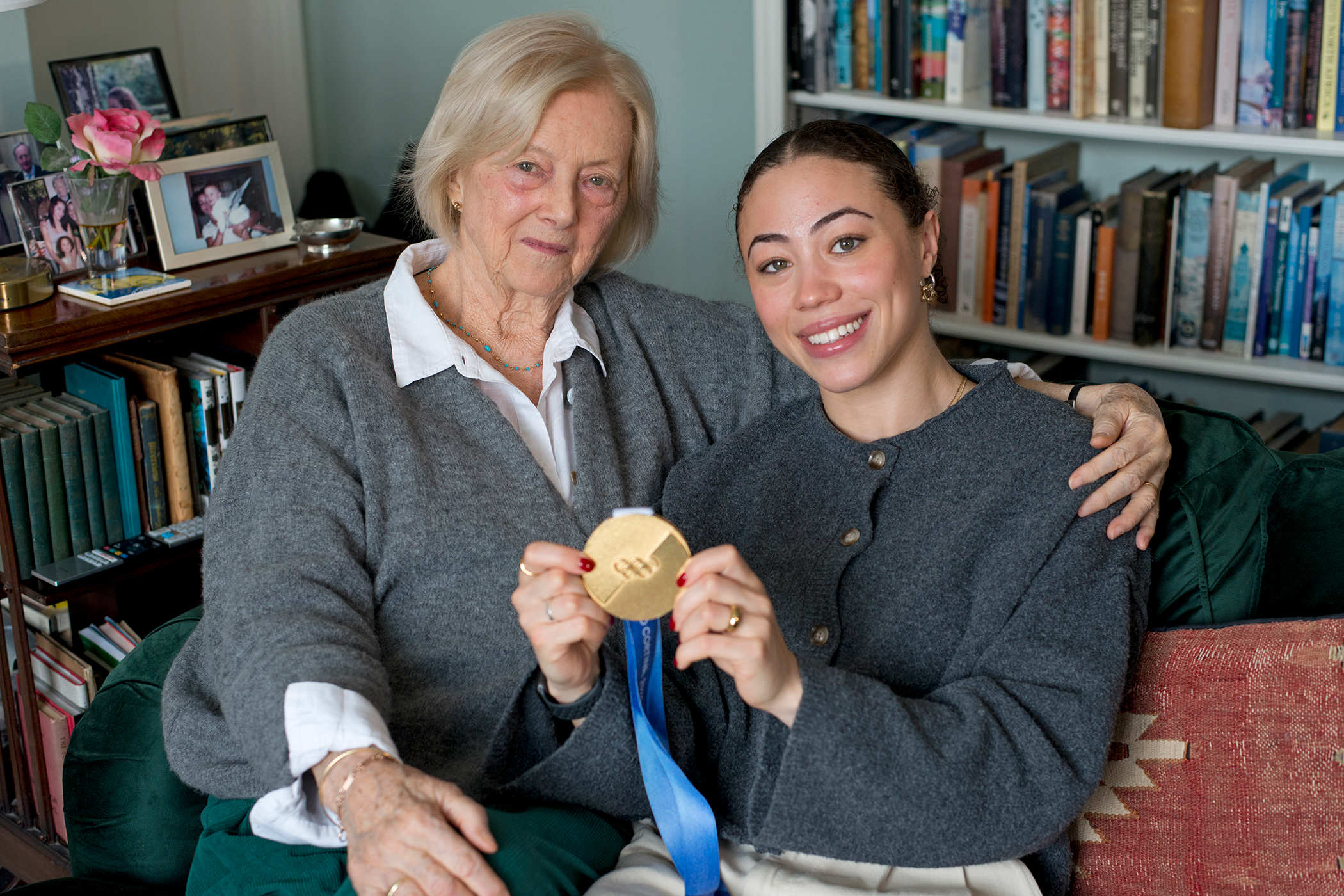
In 1956, Davie was again in Melbourne reporting on British Olympic hopes and Chris Brasher’s gold medal in the 3,000m steeplechase. Seventy years later, Stoecker, his granddaughter, won gold at the Winter Olympics in Milan in the mixed team skeleton.
Stoecker and Chisholm are speaking to The Observer at Chisholm’s flat in north London. A small side table is decorated with photographs of a young Stoecker, including one of her playing snakes and ladders with her grandfather. In the living room is Stoecker’s gold medal, which fortunately did not meet the same fate as some of the others from this year’s Games by rapidly falling apart.
‘Skeleton is an artform. It is a way of expressing herself and of presenting values like courage, application and discipline’
‘Skeleton is an artform. It is a way of expressing herself and of presenting values like courage, application and discipline’
Anne Chisholm
Davie’s belief that sport was something that transcended the sheer athleticism of its participants to become artworthy has carried through to his granddaughter.
“For Tabby, skeleton is creative,” says Chisholm. “It is an artform. It is a way of expressing herself and of presenting values like courage, application and discipline.”
She admits to being a bit puzzled as to why Stoecker decided to drop out of university and commit to skeleton full time. Stoecker came across the sport through a UK Sport Talent ID day after time spent doing gymnastics and circus skills. Her grandmother challenged her to consider the impact pursuing it might have on her life.
“She was giving me a perspective, to give me some balance, versus saying: ‘You shouldn’t do this,’” says Stoecker.
“It was very much: ‘I hear that you want to do it, and I trust you, but let’s think about the whole picture.’ At that age, it’s really useful to have people who you can rely on not just to pick you up, but also to keep your feet on the ground. Because as a young person going into a room and being told by a team of GB coaches: ‘We’re going to take you to the next Olympics,’ as a 17-year-old, you’re like: ‘OK, yeah.’”
“I felt slightly uneasy about that,” says Chisholm.
“I remember wondering whether it was the right thing to do or was it actually rather annoying of me – but I sent Tabby an interview with [Britain’s double Olympic skeleton champion] Lizzy Yarnold describing the excruciating back problems that she developed as a result of skeleton. I remember thinking: ‘I’m going to send this to Tabby, because she needs to know that there are risks and downsides.’”
“Were you cross?” Chisholm asks her granddaughter.
“No, not at all!” says Stoecker. “I remember thinking: ‘Goodness, I better look after my body here.’ Having not really done that type of training until I got selected for skeleton, I needed to be cautious and make sure I was doing everything properly. It is a big risk and it’s a very thankless sport until we get to the Olympics.”
“Well, that’s certainly true,” says Chisholm.
“You don’t earn any money,” adds Stoecker.
“No one really watches you. You could be the world champion for three years running and no one knows who you are. There is this whole other element to it, where I really had to do it because I believed in myself and because I loved it. There’s no other reason.”
As Davie wrote in a 1983 piece about the pleasures of listening to an Ashes series in Australia on the radio: “Excitement in sport, as in no other human activity, depends on ignorance.” He could have been writing about the experience of watching the mixed skeleton at the Winter Olympics. Introduced for the first time at this Olympics, it was one of the most gripping contests of the fortnight as the pairings took turns going down the track.
“My adrenaline was at an all-time high,” says Stoecker, reflecting on waiting for her racing partner Matt Weston to do his run.
“Knowing Matt was Olympic champion, and had laid down track record after track record, I had a lot of faith in him. Seeing the time go green and knowing that we really had done it, it just felt almost right. It felt like it was meant to be.
“Then you see the crowd and his face and our coach’s face and our team-mates’ faces and all of a sudden it hits you what you’ve just done. It was in those moments, hugging the people who had played such a massive part in getting us to that point, where it really sunk in what we’d achieved together.”
Newsletters
Choose the newsletters you want to receive
View more
For information about how The Observer protects your data, read our Privacy Policy
Back home in north London, Chisholm was watching on television with her brother and sister-in-law, feeling “quietly confident”.
“I was quite glad I was on the sofa rather than standing around with them,” says Chisholm. “Although I’d have loved to be there with the atmosphere.”
Stoecker had made the decision collectively with Chisholm that it would be best for her grandmother not to travel to Italy, as it would have been too much of a worry for the athlete.
“Tabby’s always said it is much better on the telly,” says Chisholm.
“Of course, my heart was in my mouth. When she started, I used to hardly be able to watch it. I was so worried that she’d hurt herself. Of course, the risk is part of the addiction, but I found it completely thrilling and extraordinary.”
Chisholm was less impressed by the red and pink “hideous” hats that Stoecker’s family had made so that Stoecker could spot them in the crowd. She did agree to sending a photo of her wearing a T-shirt and holding a banner while supporting from afar. Stoecker is effusive about the impact Chisholm has had on her life, and vice versa.
“My grandma has always championed incredible women,” says Stoecker.
“I’ve always been so inspired by her and the way that she’s able to tell stories, to bring people’s worlds to light in such magical ways, and to not shy away from the hard parts either. Getting to spend time with her, and for her to play such a massive role in raising me into the person I am now, I’ve felt so fortunate really.”
“She’s been an enormous blessing in my life,” says Chisholm.
Stoecker’s father died in a car accident when she was only one, leading to Chisholm becoming increasingly close with Stoecker’s mother.
“This sounds sad but I don’t mean it in a sad way,” says Stoecker.
“I feel so incredibly lucky that in losing one person who was meant to be super important in my life, I gained so many more. A lot of that is through my grandma. I feel so incredibly grateful that in such a tragedy, I ended up gaining a plethora of love and support from all these other people.”
“That’s a good way to put it,” says Chisholm.
“It’s why I’m so passionate about being joyful and living life to the fullest. Because I know life can be cut too short. It’s constantly with me, the knowledge that can happen to the best of people, so [you should] always seize every opportunity that you get and to live life in the most positive way.”
That attitude is clearly present in Stoecker’s decision to commit to skeleton, which has led her to the top of an Olympic podium.
“Year after year, my friends have said: ‘What’s Tabby doing now?’” says Chisholm. “And year after year, I’ve said: ‘Well she’s doing this thing called skeleton.’ The reactions ranged from comprehension to puzzlement. But now everyone gets it.”
Photograph by Sophia Evans/The Observer