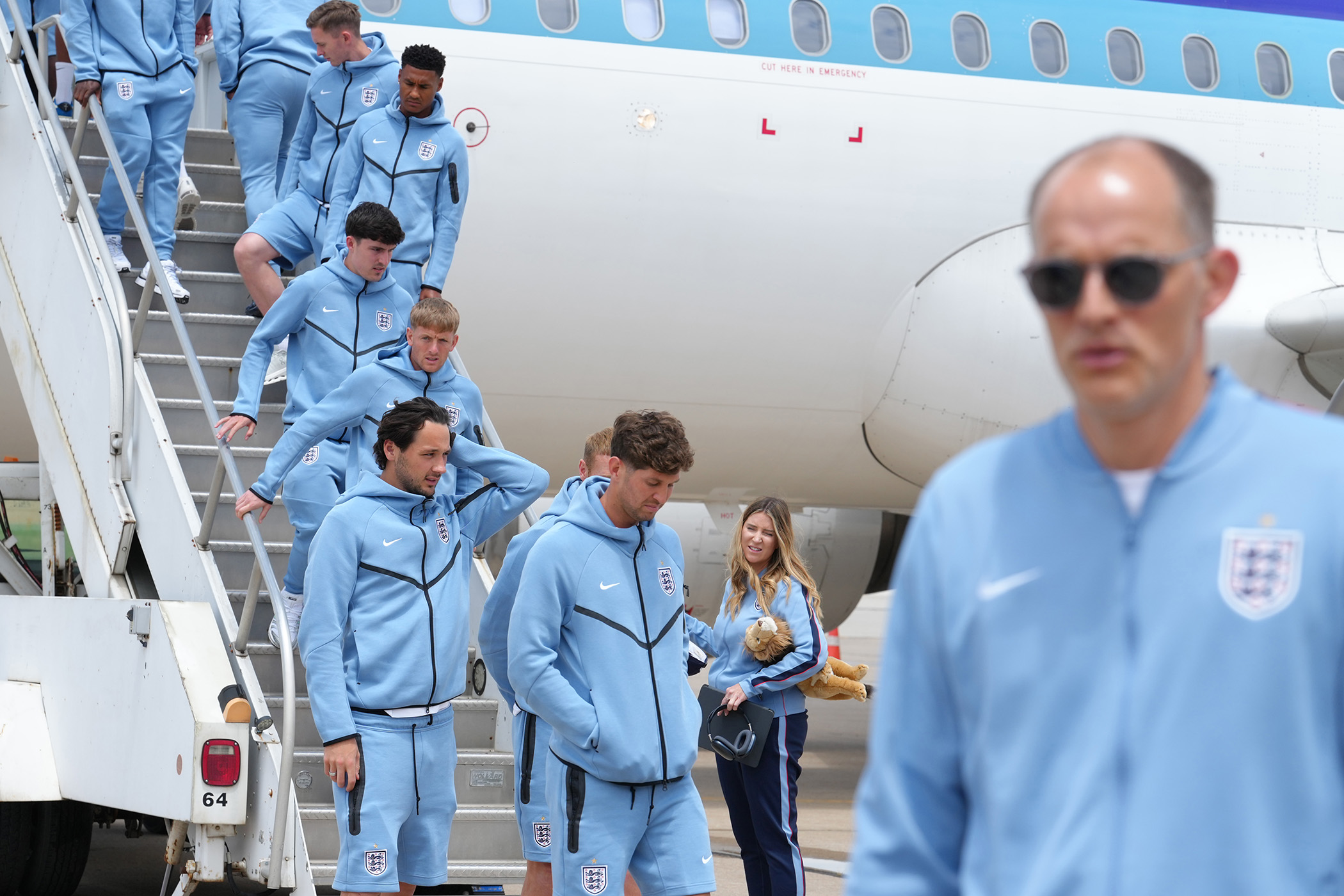

Theory, meet reality. Thomas Tuchel’s logic machine is about to collide with the drowning chaos of a World Cup, with the rabid national madness which consumes major tournaments, fraying them at the edges. The man who believes he has thought of every eventuality is about to be confronted by millions who will ardently question whether he has ever had a thought in his life, and who will tell talkSPORT he should be replaced by Sean Dyche or Nigel Farage.
The disconcertingly smooth and competent Costa Rica win has begun piquing public interest, a creeping yet familiar hope that beating Croatia on Wednesday would turbocharge. It is increasingly difficult to argue that optimism is not the logical outlook from here, this squad shrouded in an airy confidence and lightness derived from most players’ awareness that they compete in the world’s most physically and mentally burdensome sporting competition. Skull-crushing pressure is a constant in their lives. While more than half of the expected starting XI have played more than 4,000 minutes this season, they are also more used to existing at the upper limits of their bodies’ capabilities. The Premier League might not be at the sport’s aesthetic vanguard, but its pace and rhythms replicate the latter stages of a World Cup in a way no other league does.
Within a month, England’s three starting midfielders will probably play for Arsenal, Manchester City and Real Madrid, all having joined for £85m or more, physically imposing and technically exceptional. One of sport’s great cliches is that winning is a habit, and Morgan Rogers, Ezri Konsa, Ollie Watkins and Dean Henderson can call themselves European champions. Marc Guehi, Nico O’Reilly and James Trafford have won two domestic trophies since February, Bukayo Saka, Declan Rice, Eberechi Eze and Noni Madueke are fresh from lifting a first Premier League. This is good.
And the past week has announced Jude Bellingham’s return to the centre of attention and discourse, his natural habitat, a strutting psychodrama with extraordinary cheekbones. You sense that Tuchel has dedicated more time to plotting his management of Bellingham than any other player, a neurotic fear of the destructive power that errant egos possess probably forged on the Parisian frontlines with Kylian Mbappé and Neymar. He has taken every reasonable opportunity to bench or drop him, to signpost that he is neither invincible nor necessary, that he is at best the third-most valuable member of this squad, and that his position is perhaps most at risk. Jordan Henderson is in the squad as much as a Bellingham wrangler as a legitimate centre-midfield option, one of the few people he seems to unequivocally respect and listen to.
Tempering, perhaps even unsettling Bellingham without enraging him or his father or the wider Bellingham industrial complex could be Tuchel’s defining brushstroke of this tournament, although the player does inevitably seem to have matured slightly over the past two years.
For all Tuchel publicly casts them as equals, Rogers can still sometimes feel like a pawn in the Bellingham game, a motivational tool for his childhood friend as much as a ridiculously elite No 10 in his own right. And yet he does seem to work better with Kane than Bellingham – they have played 60 minutes or more together five times and England have won those matches a combined 16-0, including the 5-0 win in Serbia, the defining exhibition of “Tuch-ball” to date. Bellingham occupies a bizarre space for Tuchel, both the logical and riskier choice.
Rogers’s relationship with Ollie Watkins is an underrated asset, potentially strengthening his case to finish matches rather than start.
Croatia is perhaps England’s defining rivalry of the past two decades; the wally with a brolly, the World Cup semi-final, even the 1-0 Euro 2020 group-stage win which underpinned everything that followed. Victory in Arlington would almost guarantee England’s place in the last 32.
In 2026, Croatia are struggling to regenerate, trapped between eras and identities, a tribute act to themselves; Ivan Perišić is still starting at 37, Andrej Kramarić 35, Ante Budimir 34, Luka Modrić 40, while their greatest young talent, Luka Vušković, is still only 19. Zlatko Dalić masterminding second in 2018 and third in 2022 is one of the truly underrated achievements in modern management.
Yet this were built on a sense of unity and identity which he cannot seem to recapture. Not even he appears clear on what he will do on Wednesday, while Tuchel’s every move so far has aimed to make the opposition irrelevant, to force his players to focus on themselves, on the ultimate goal. In fact, the first sign that Tuchel will not be able to control everything was the news that equipment including the team’s boots and match balls were stolen from their Kansas City training base before the squad had even arrived. Local police confirmed two people had been taken into custody.
Newsletters
Choose the newsletters you want to receive
View more
For information about how The Observer protects your data, read our Privacy Policy
The England team is not materially different to Euro 2024 – six or seven regular starters should also line up against Croatia – so England’s fortunes will be decided by Tuchel’s ability to reframe the same problems, to find different solutions. After his remodelling, perhaps Bellingham is now the perfect tool to turn his theory into reality.
Photograph by Ed Zurga/Getty Images