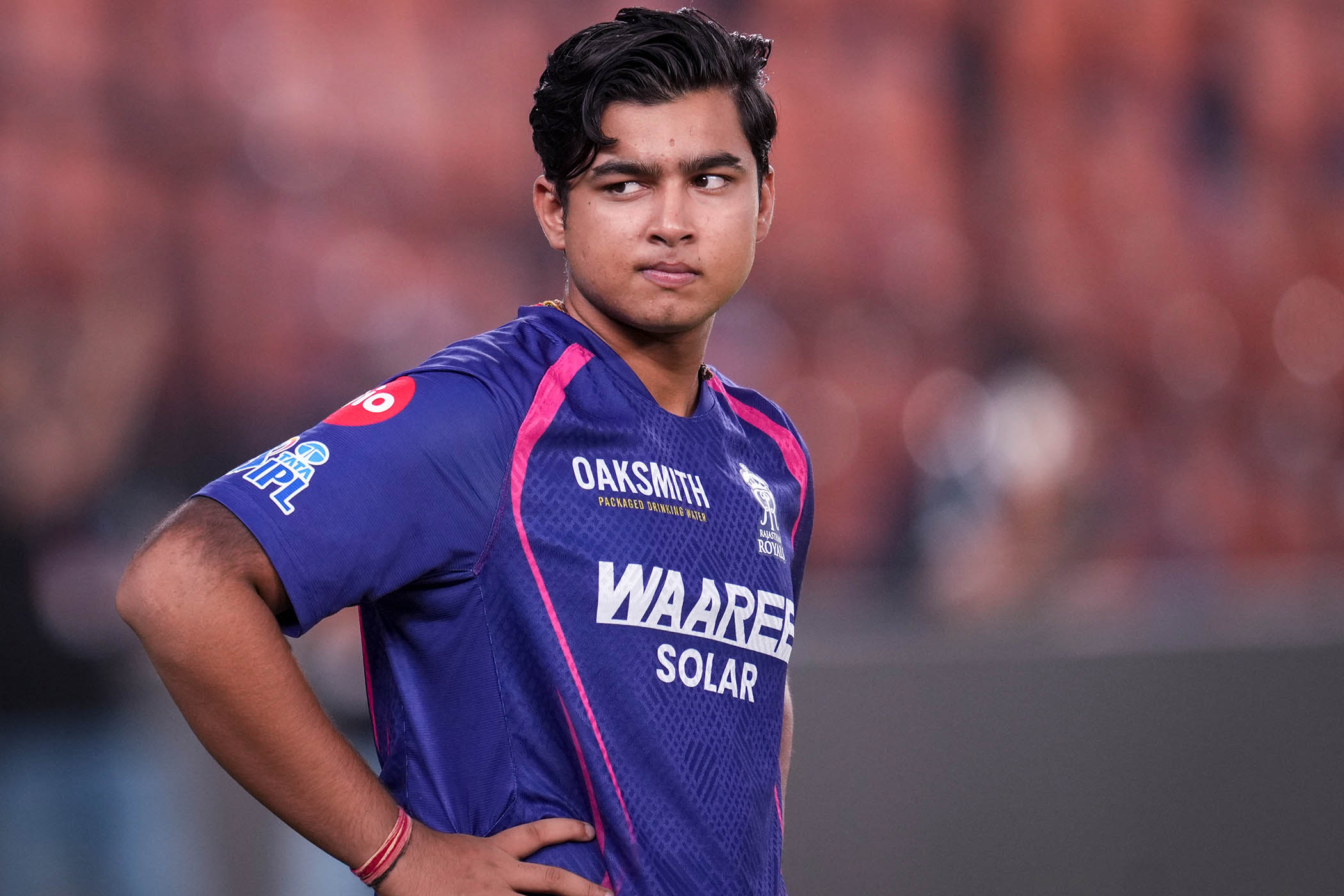



To watch Vaibhav Sooryavanshi is to believe, fleetingly, in magic; in a warping of the established limits of human endeavour; that perhaps there is something new under the sun. None of it makes sense. Anyone claiming there has been a comparable cricketer of his age – Sooryavanshi turned 15 on 27 March – is either mistaken or being disingenuous. Sachin Tendulkar might have debuted for India at 16, but at 14 he was still considered a fast bowler.
On Tuesday, Sooryavanshi dispatched two of Jasprit Bumrah’s first three balls for six, more maximums than Jos Buttler (who called Bumrah “the best player I’ve ever seen”), Chris Gayle, David Warner, Travis Head, Nicholas Pooran and Shreyas Iyer have managed in their Indian Premier League careers. Dale Steyn theorised after the match that: “Even the great Bumrah is thinking in the back of his mind: ‘Don't get it wrong; because if I get it wrong, this guy’s going to hit me for six’.”
Since his IPL debut last April, the boy king Sooryavanshi has cleared the boundary rope more times – 35 – than anyone else in the IPL, putting him well clear of Suryakumar Yadav’s 29. In fact, he has scored more senior T20 sixes (68 – more than one per over) than fours (62). His career T20 strike rate, across 20 matches, is 207.4, well clear of Estonia’s Sahil Chauhan on 184.23. To reiterate, he turned 15 less than a fortnight ago.
Signed by Rajasthan Royals for £110,000 as a 13-year-old, Sooryavanshi is the youngest scorer of an IPL century, which was also the second-fastest IPL century ever (35 balls, only behind Chris Gayle’s 30). He is the youngest scorer of a List A century, which became the fastest List A 150 ever (59 balls), beating AB de Villiers’s record. In February his remarkable 175 from 80 balls against England won India the U19 World Cup, after which he was named player of the tournament, six years before ageing out of the tournament.
The greatest flaw any coach has found so far was that he ate so many sweets they started rationing him. I watched him against England U19s at Hove last year, his first competitive match in this green and occasionally pleasant land, and he has this infectious calm, a sense of transcendental peace utterly at odds with being a teenager. Without his helmet, he looks soft and shy and unfinished.
Captains and coaches say all the right things – we want him to have fun, take the pressure off, finish his food tech GCSE – but opportunity tends to breed exploitation. Indian cricket does not have a players’ union and Sooryavanshi has only just become eligible for senior internationals.
Currently he cannot possibly be expected to stand up for himself, to know what he actually wants or needs. He is set to spend the next 20 years as the star attraction of a travelling circus that never sleeps or stops. He has gained a million Instagram followers in the past week, up to 3.3m. He has not played much red-ball cricket, but it is impossible to imagine the feline reactions and ursine power not translating. And this is where Test cricket is heading anyway, run rates rising and matches shortening, dictated by the format which commands the most eyeballs and investment.
India visit Ireland in June for two T20Is before a white-ball tour of England throughout July, followed by a three-T20I tour of Zimbabwe. Given they can select Yashasvi Jaiswal, Shubman Gill, Sanju Samson, Abhishek Sharma and Ishan Kishan, they do not need Sooryavanshi.
But it is hard to imagine anyone staving off the temptation to call him up, if only to see what he can do, to see if it scales, what record falls next. We know we shouldn’t open Pandora’s box. But don’t you want to see what’s inside? Imagine him facing an 82mph seamer on a flat July wicket at Trent Bridge. What if he’s already better than everyone else at this? What will he be able to do at 18, 21, 27? Is this cricket’s End of History moment, trapped in a ceaseless dopamine loop, constant content pulling faceless victims into the second tier? This is the game’s logical destination, a player capable of dispatching basically any ball or bowler, in any format.
And yet at points it can feel oddly gauche, as though thwacking as many runs as possible off as few balls as possible is not the point at all, that cricket’s big secret is that victory is just a byproduct of the actual Stuff That Matters.
How do both cricket and India, in a sporting culture fuelled by idols, handle something it has never seen before, a potential advancement in its human technology? If Sooryavanshi can already outwit Bumrah, what hope does anyone else have? The future is here, and it’s different and scary and beautiful. Are we ready?
Photograph by Kamal Kishore / AP
Newsletters
Choose the newsletters you want to receive
View more
For information about how The Observer protects your data, read our Privacy Policy