A hundred years ago this month, at 9pm on a Saturday, one of two emergency announcements appeared on the BBC’s only radio channel. “Some listeners… did not realise the humorous innuendoes underlying the imaginary news items,” the announcer said of a broadcast earlier that evening, “and have felt uneasy as to the fate of London.”
Listeners heard Big Ben had been destroyed by trench mortars, the Savoy hotel bombed, and the government minister for traffic hanged on a lamppost on Vauxhall Bridge Road. Other details were more absurd: a mob had been rallied by the Secretary of the National Movement for Abolishing Theatre Queues, while a later correction to the circumstances of the traffic minister’s demise seemed somewhat unnecessary: “Subsequent and more accurate reports show that it was not a lamppost but a tramway post that was used for this purpose.”
These words came from a renowned radio voice, a priest, Father Ronald Knox, who later that year became the Catholic chaplain at Oxford University. His programme, Broadcasting the Barricades, aired on 16 January 1926, and described a fictional communist revolution taking place on the streets of the capital with Knox as the radio announcer. Twenty minutes after the broadcast ended, John Reith, BBC managing director, called him over dinner to report a slew of agitated callers. Snow also disrupted the delivery of newspapers the next day, keeping rumours of revolt swirling until Monday morning.
The story then went international, making the pages of the New York Times on 18 January by “special cable”. A subsequent article in the paper described “harrowed ladies in remote country districts, who had never heard of Father Knox, heard his wireless conversation, and in great consternation barricaded themselves behind their bedroom doors. One impressionable Sheriff in a northern county telephoned to the Mayoress of Newcastle to ask what the Lord Mayor and constabulary were doing to stave off the Red ruin.”
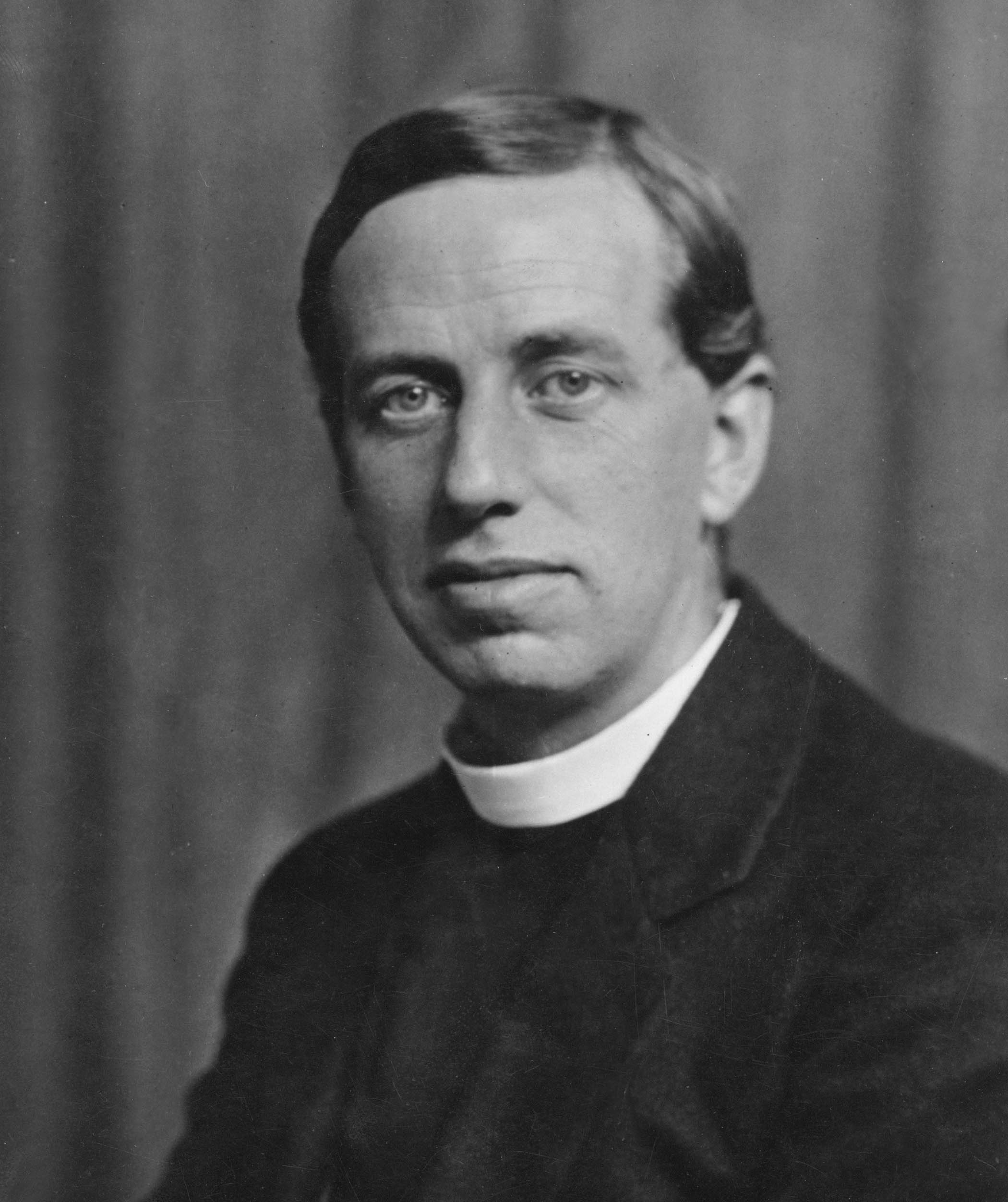
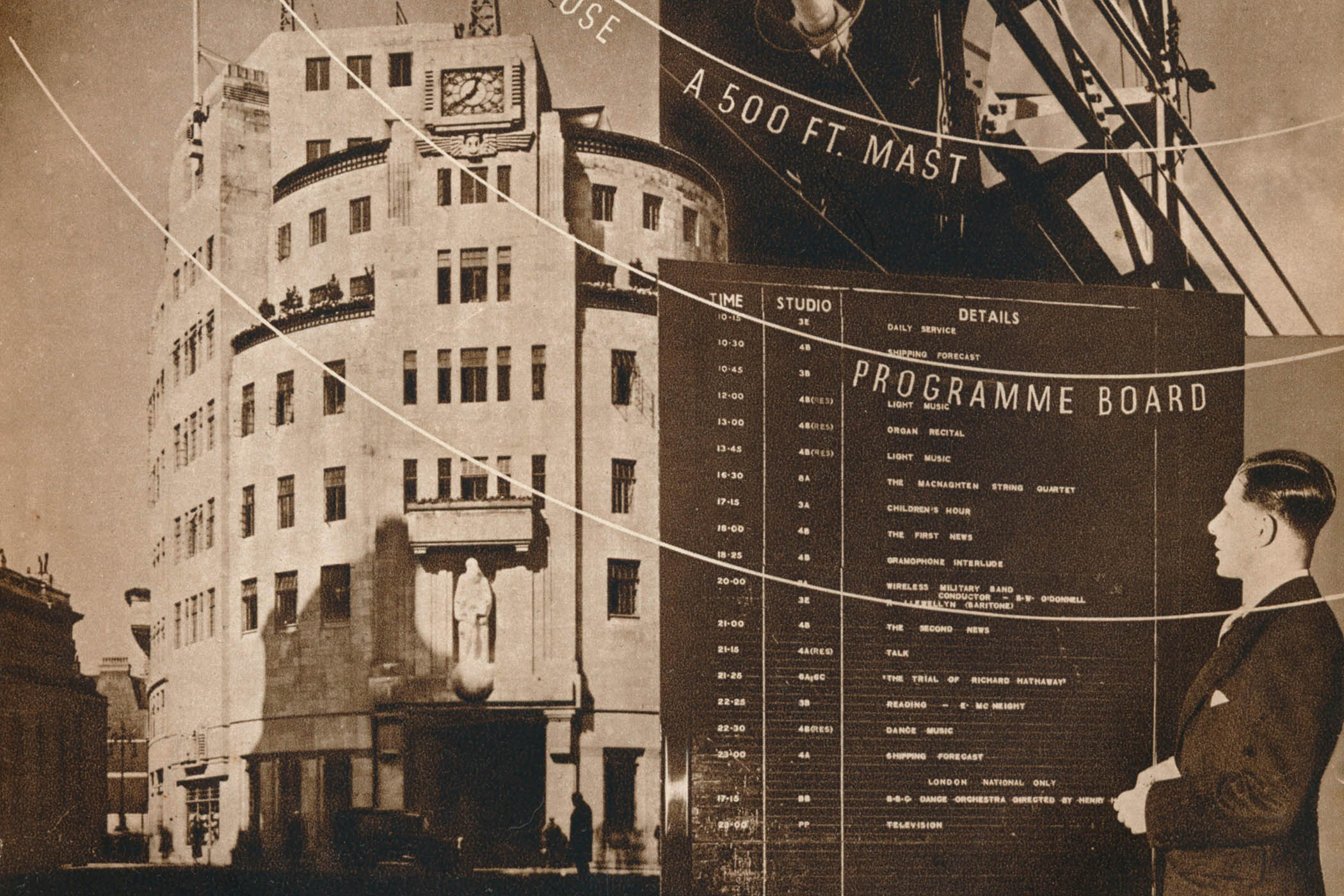
Father Ronald Knox. Main image: a pre-war poster advertising the BBC
More than four decades later, during an interview with Peter Bogdanovich, Orson Welles mentions Broadcasting the Barricades as an influence on his 1938 CBS Network production of The War of the Worlds, which notoriously terrified some listeners who believed aliens really had landed in New Jersey. “I got the idea from a BBC show,” he said, “when a Catholic priest told how some communists had seized London... I thought that’d be fun to do on a big scale.” Welles was only 10 when Knox’s programme aired, but the notoriety of the BBC Radio “hoax”, one of the earliest examples in broadcasting of fake news, had long lingered in the collective memory, and the story behind it, involving politics, the press and media audiences, remains relevant today.
The year 1926 began nervously in Britain. Tensions between trade unions and the government were building towards May’s general strike. Months earlier, police raids resulted in 12 communists being arrested on charges of sedition, while the Daily Mail’s publication of the Zinoviev letter in October 1924, four days before the second general election in 10 months, still cast a shadow. The sensational appearance of the letter, purportedly by the prominent Bolshevik Grigory Zinoviev, encouraging a communist takeover of Britain during the first Labour government’s rule, helped increase the Conservative majority. It was later found to have been forged.
Technology was simultaneously racing forward: the BBC’s new Daventry transmitter had only been beaming long waves since July 1925, but radio could now reach 90% of the country. In January 1926, the actual listening figures were closer to seven million, says Beaty Rubens, author of Listen In: How Radio Changed the Home, “but the awareness was immense… and we know from newspaper and periodical coverage, and the huge number of cartoons, that people were aware of radio and beginning to think about it. Even if you didn’t have a radio or thought you weren’t interested, you couldn’t ignore it any longer.”
But there was no guarantee that radio would succeed. The then BBC chairman Lord Gainford made regular statements about broadcasting’s durability – “because so many people were saying, ‘It’s a seven-day wonder,’” Rubens explains. Until the general strike, there had been a much “less highly controlled, strictly Reithian atmosphere” at the BBC’s base, on the top floor of the Institute of Electrical Engineers at Savoy Hill: experiments had been encouraged, such as the 1924 live duet between cellist Beatrice Harrison and a wild nightingale, and a segment on Children’s Hour in which a presenter blew a “silent” whistle for dogs at home.
“The BBC still had an exciting, even quite chaotic, ‘tech start-up’ vibe and could get away with all sorts of experimental and playful stunts,” Rubens says. “But after the general strike, it had a new sense of its responsibility and of the government breathing down its neck.”
Broadcasting the Barricades aired just before that shift. It was made in a studio in Edinburgh, where Knox often travelled for work. Rudimentary sound effects were created by Knox’s assistant, JCS MacGregor, who described how he made them in an article for the BBC’s in-house magazine: “An orange box to be hacked, torn and stamped to pieces, and a sack of broken glass to be dumped on the studio floor, convinced listeners from Land’s End to Berwick-upon-Tweed that the Savoy Hotel was... falling in ruins.”
Newsletters
Choose the newsletters you want to receive
View more
For information about how The Observer protects your data, read our Privacy Policy
Evelyn Waugh, a close friend, said Father Knox ‘could not take seriously the annoyance of people so egregiously lacking in humour’
Evelyn Waugh, a close friend, said Father Knox ‘could not take seriously the annoyance of people so egregiously lacking in humour’
The slot crucially ran after 7pm: this was an age when news was only allowed to be broadcast in the evenings. Newspapers helped fund the Post Office, which in turn funded radio licences, and restrictions had been placed to ensure papers would still be bought (this decision was overturned after the general strike, allowing the arrival of five daily bulletins). On the Monday morning after the broadcast, more than 20 national and regional titles featured front page reports and content on the “Wireless Scare”. “Humour and satire are dangerous implements when they are applied to mankind in the mass,” said the Irish Times. “It shows the risks inherent in broadcasting sensationalism even in the guise of sheer farce,” said the Liverpool Post and Mercury’s London correspondent.
Most reports featured an apology from an unnamed BBC spokesperson, who pointed out that letters of praise “outweighed” the protests. An editorial from the Daily Mail, even after the Zinoviev letter, targeted the skit’s creator later that week: “The [BBC] probably perceive by now that there are scarcely any limits to the foolishness of an advertising cleric.”
Father Ronald Knox was a well known public intellectual in the early 20th century, a headstrong Catholic convert who wrote intricately plotted detective fiction, newspaper columns, and later re-translated the Latin Vulgate Bible into English. The youngest of six children, his eldest brother, Edmund, was the editor of the satirical Punch magazine, his brother Dillwyn a formidable codebreaker in both world wars, and his sister Winifred a novelist, as was his niece later in the century, the Booker prize-winning Penelope Fitzgerald.
“The idea for this skit came to me while I was sitting at home listening to the results of the last election being broadcast,” Knox wrote in the Evening Standard three days after his programme aired. “I endeavoured to visualise the breathlessness there would be throughout the country during a revolution, and I tried to imagine the news bulletins during such a time of popular excitement.”
Knox’s transcript, retitled A Forgotten Interlude in his 1928 anthology Essays In Satire, reads like the work of an interwar Chris Morris. It’s peppered with extraneous historical detail, satirising the BBC’s desire to educate its listeners. “The crowd in Trafalgar Square is now proceeding... to sack the National Gallery,” he says at one point, adding quickly, “the National Gallery was first erected in 1838 to house the famous Angerstein collection.”
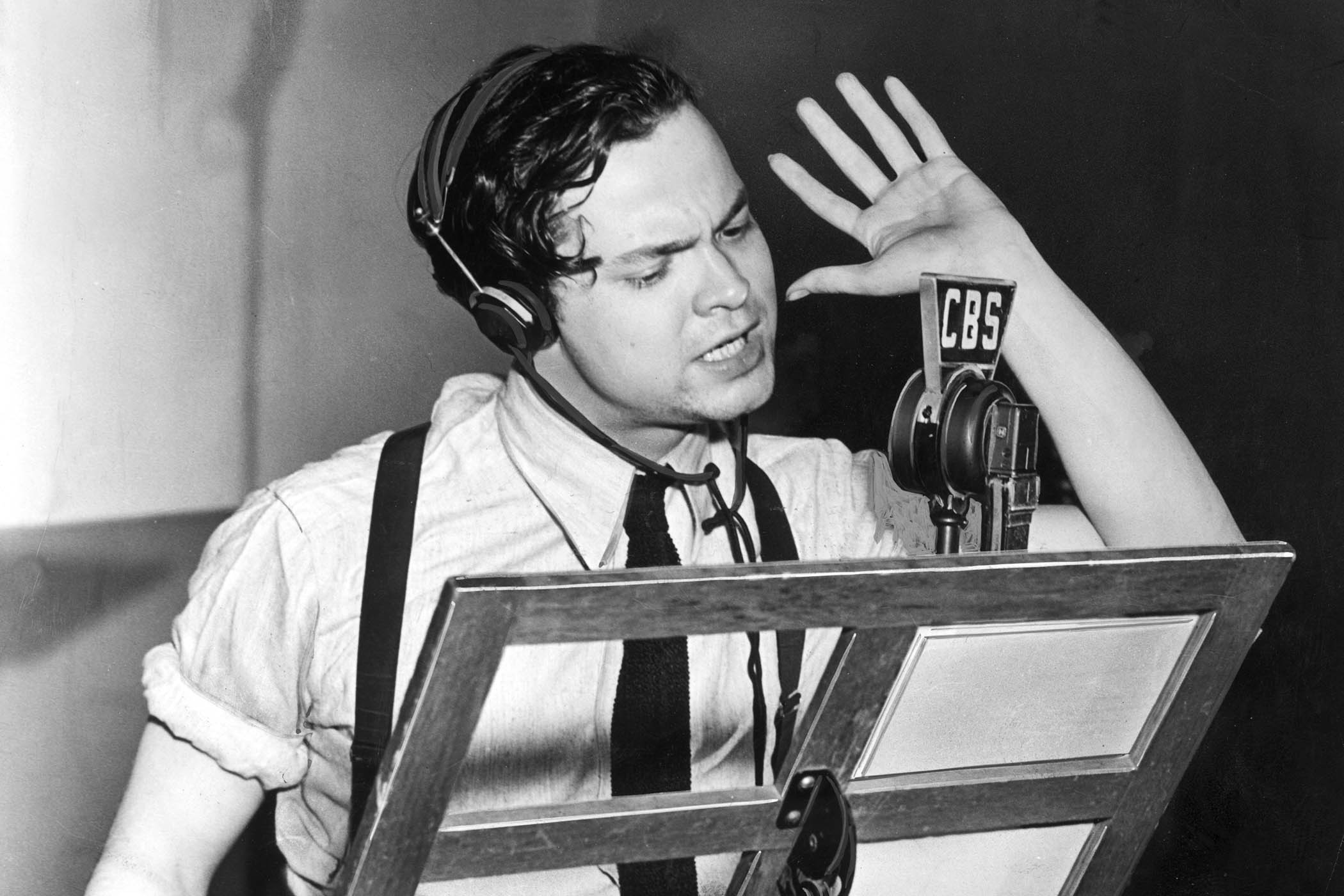
Orson Welles records his 1938 CBS radio production of The War of the Worlds
“Playfulness and humour were a family tradition, but he was also very interested in radio and in everyday life, in his faith,” says Dr Francesca Bugliani Knox, editor of Ronald Knox: A Man for All Seasons, and wife of Knox’s great-nephew. His radio appearances, she says, “showed a way of being involved with questions in society, which was quite new at the time, certainly not something that one would think a priest would be interested in.” She points out that he wrote a novel the previous summer, Other Eyes than Ours, published in 1926. A satire on spiritualism – a movement “which was very fashionable, maybe because of the end of the war, because of the idea that you could speak to the dead” – it features a priest building a homemade radio set, who claims to have made contact with the beyond. “He played with how, in the idea of the airwaves, there could be something similar to the work of the spirits,” says Bugliani Knox.
But, she adds, Broadcasting the Barricades “was not a satire on the BBC or on news, but about audience gullibility”. It didn’t please the Archbishop of Westminster. Evelyn Waugh was a close friend and devoted admirer of Knox, and wrote a biography of him published in 1959, two years after Knox’s death. Cardinal Bourne, Waugh writes, “took Ronald heavily to task”, although “[Ronald] could not take seriously the annoyance of people so egregiously lacking in humour”. He adds that the programme was “the first revelation to politicians of the gullibility of simple people by this new apparatus, a quality which was to be largely exploited in years to come”. Then comes a footnote: “In the United States, this broadcast was imitated some 10 years later in more fantastic terms, with even more fantastic results.”
The 1938 radio adaptation of HG Wells’s The War Of The Worlds – which aired as a Halloween edition of The Mercury Theatre on the Air, Orson Welles’s series of live dramas – has long been mythologised as provoking mass hysteria. But in 2013, Slate magazine referred to a CBS nationwide survey conducted the day after the show, in which “network executives were relieved to discover just how few people actually tuned in”.
Newspapers, however, were keen to criticise radio’s deleterious effects on its listeners after losing advertising revenue to networks during the Depression: their complaints vastly expanded the effect of the show. Welles’s theatre gained a sponsor, Campbell’s Soup, and extra funding to hire film stars. Welles himself gained a three-picture deal with RKO Radio Pictures, with unprecedented creative freedom: three years after the sensationalised radio broadcast came Citizen Kane. Adolf Hitler, who had annexed Sudetenland and invalidated the passports of all German Jews, made time to respond to the scandal. Already well versed in the potential of radio as a propaganda machine, he found in Welles’s production evidence of “the decadence and corrupt condition of democracy.”
Today, technology rapidly blurs the line between truth and artifice, news agencies ignite moral panic in print and online, and the most famous catchphrase of the US president, busy with Greenland, ICE and suing the BBC, is “fake news”. A century ago, Father Ronald Knox’s 20-minute show revealed so much about the world to come.
Photographs by Getty/BBC/Alamy