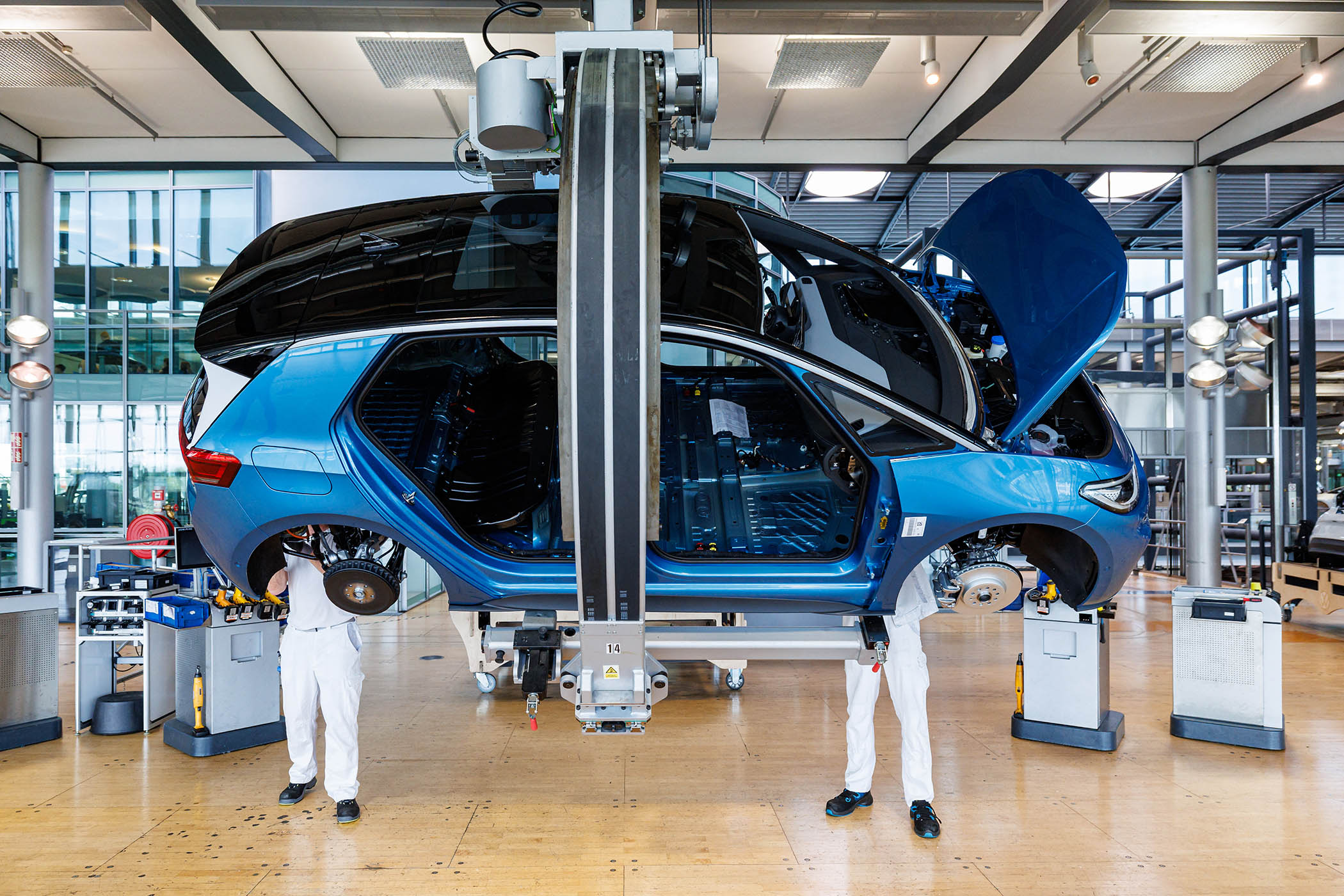
If Volkswagen proceeds with its plan to shed as many as 100,000 jobs – nearly one worker in six – it will not only underline how dire the outlook is for Germany’s car industry in the face of fierce Chinese competition but may also sound the death knell for the vaunted postwar German model of stakeholder capitalism. So large a downsizing would exceed those of General Motors and IBM that defined ruthless 1990s American capitalism, breaching Germany’s longstanding consensus-based social contract.
No firm has embodied that model more completely than the Wolfsburg-based giant. Worker representatives fill nearly half of VW’s supervisory board seats. The state of Lower Saxony has a 20% ownership stake. Two decades ago, VW even supplied the supposed cure for German sclerosis: Peter Hartz, the firm’s HR chief, lent his name to reforms that overhauled Germany’s workforce regulations and powered an export boom. His subsequent resignation in a bribery scandal that revealed a rotten cosiness between management and works council should have been taken as a warning.
Unlike the first China shock, which undercut western companies with cheap goods, this second shock threatens western industrial champions with high-value things that are not just cheaper but better
Unlike the first China shock, which undercut western companies with cheap goods, this second shock threatens western industrial champions with high-value things that are not just cheaper but better
In truth, VW lost its halo in Dieselgate – the 2015 emissions fraud that cost tens of billions and distracted management during a decade when the focus should have been beating China in electric cars. Unlike the first China shock, which undercut western competition with cheap goods, this second shock threatens western industrial champions with high-value things that are not just cheaper but better. German cars are target No 1.
So to survive, the German model is contemplating abandoning the consensus approach that was once seen as its greatest strength. As VW becomes the Wolf of Wolfsburg, it may seem crueller in its treatment of workers than Detroit ever did. The unions are promising to fight the plan, but given the depth of VW’s troubles, it could be their last stand.
Brexit critic chosen to lead OBR
After the head of the Office for Budget Responsibility quit for accidentally (in effect) leaking the budget, Whitehall needed a safe pair of hands. On 23 June, Rachel Reeves named her choice: Jonathan Haskel, a respected Imperial College economist who spent six years setting interest rates on the Bank of England’s Monetary Policy Committee.
Haskel is more intriguing than a mere steady hand. His work has focused on the one thing every British politician wants more of: productivity. How might this affect how he goes about the job?
On one hand, he is an expert on the economic cost of Brexit. His signature finding is that business investment, rising nicely until 2016, abruptly flatlined – leaving the economy, by his latest reckoning, about £29bn or 1.3% smaller.
On the other, in Capitalism Without Capital, a terrific book that he co-authored with Stian Westlake (who went on to head the Royal Statistical Society and now the Economic and Social Research Council), Haskel made the case that the British economy (along with other advanced economies) is significantly richer than the official data suggest. The national accounts barely notice some of its most valuable assets – intangibles including design, branding, training and organisational know-how. As a result, productivity is chronically understated.
Choosing him signals that Britain’s economic establishment recognises that its official data needs an upgrade. Haskel might be better deployed fixing the Office for National Statistics, which actually produces the data. Even so, in the OBR chair a more expansive view of productivity could allow a future chancellor more headroom. Before Team Burnham cracks open the bubbly, however, it should remember that at the Bank of England, Haskel was a hawk, sceptical (not least due to Brexit) about the economy’s growth prospects.
Newsletters
Choose the newsletters you want to receive
View more
For information about how The Observer protects your data, read our Privacy Policy
Alan Greenspan embodied the Fed’s independence from politics
For a young economics journalist, an interview with Alan Greenspan (officially, he never gave interviews) was like having an audience with God, or perhaps the Wizard of Oz. I was led through an endless warren of corridors inside the Federal Reserve Bank building to where the legendary Fed chairman waited in a big leather armchair within a vast wood-panelled office stacked with piles of economics books and academic papers, peering through his thick-rimmed spectacles as he received questions that he didn’t quite answer in ways that only added to his mystique.
Greenspan, who died last week aged 100, mostly avoided straight-talking during his 19-year reign at the Fed. His preference for speaking obliquely added to a wise-man aura that somehow made people trust that the economy was safe in his hands – which mostly it was. “I have learned to mutter with great incoherence,” he once told Congress. “If I seem unduly clear to you, you must have misunderstood what I said.”
The business channel CNBC would track the thickness of his briefcase as a leading indicator as to whether interest rates would change
The business channel CNBC would track the thickness of his briefcase as a leading indicator as to whether interest rates would change
His monetary policy meetings were keenly anticipated; lacking verbal clues, the business channel CNBC would track the thickness of his briefcase as a leading indicator of whether interest rates would change. His most famous phrase, “irrational exuberance”, was his way of saying there was possibly a stock market bubble. Yet his libertarian beliefs, honed at the feet of Ayn Rand, stopped him using what levers the Fed had to try to stop it getting too big. Not tackling asset-price inflation was arguably his one failure.
Greenspan embodied the Fed’s independence from politics that has lately been under threat. Strikingly, it was only after his latest successor, Kevin Warsh, made a show of independence earlier this month by defying pressure from Donald Trump to cut interest rates, that Greenspan definitively left the building.
Photograph by Jens Schlueter/Getty Images