The Venice Biennale, often referred to as the “Olympics of art”, is an Aperol-soaked festival where every two years dozens of countries mount exhibitions along yacht-lined canals. Like the Olympics, it is also a microcosm of geopolitics – and as the 61st edition prepares to open in May, a new frontline has opened on the lagoon in the battle over Russia’s cultural rehabilitation.
On 4 March, the Venice Biennale foundation announced that the Russian Federation would be organising an exhibit this year in its historic, pistachio-green pavilion in the Giardini park for the first time since the full-scale invasion of Ukraine. The announcement came one week after the four-year anniversary of the invasion and coincided with Russia’s return to the Paralympic Games, which took place in Cortina, just 150km away.
The exhibition, titled The Tree is Rooted in the Sky, will feature 38 artists mainly from Russia but also several from Africa and Latin America. Its commissioner, Anastasia Karneeva – the daughter of a former general of the FSB, Russia’s state security service, and current executive at the state defence firm Rostec – runs a company called Smart Art with the daughter of Russian foreign minister Sergey Lavrov.
“Through the meeting of different cultures, the project aims to create a space for dialogue and exchange,” a statement on the pavilion’s official Instagram reads, “generating new artistic perspectives and strengthening a sense of international community.”
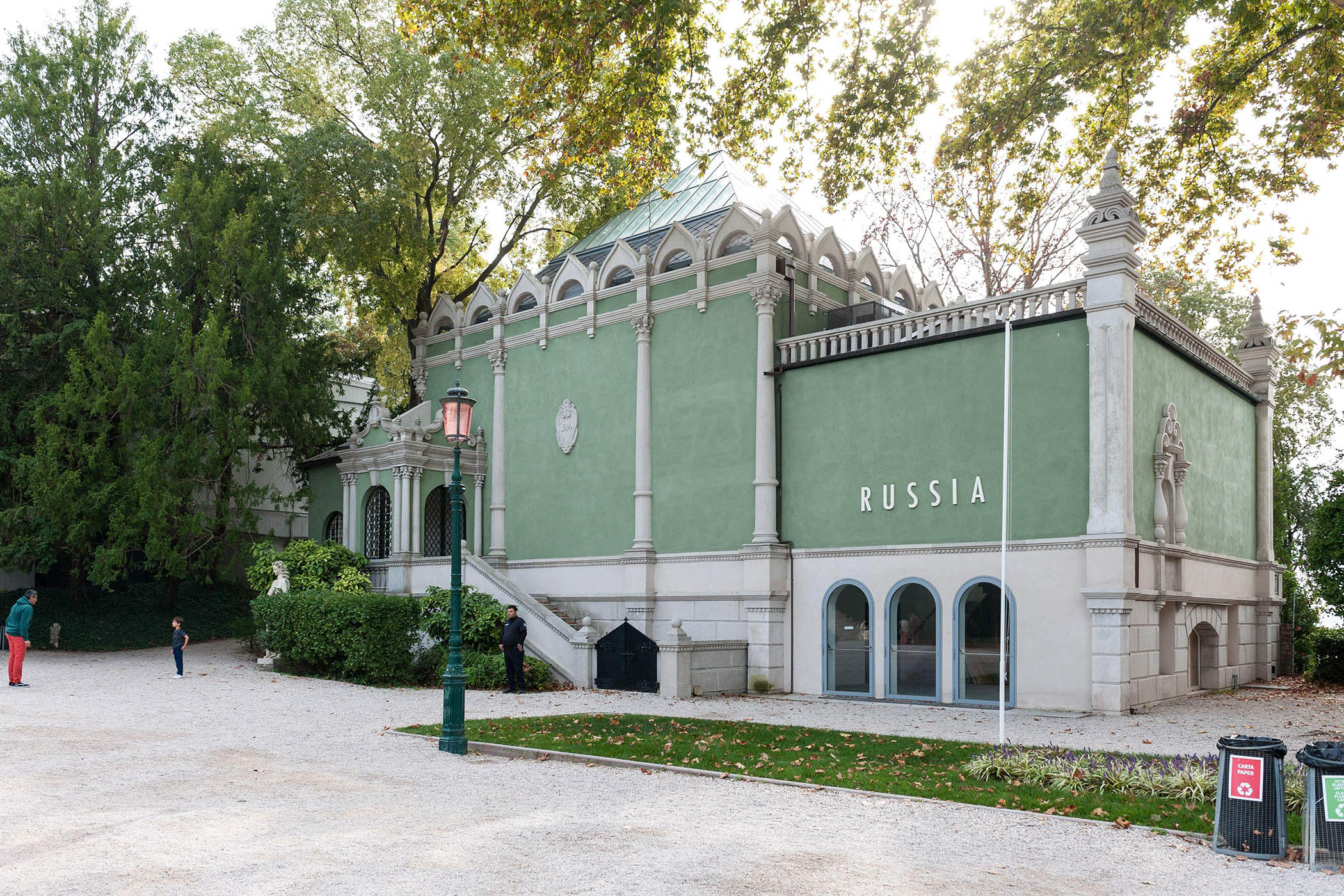
The Russian pavilion at the 59th Venice Biennale in 2022
Condemnation of the decision was swift. In a joint statement posted to X, the Ukrainian foreign minister Andrii Sybiha and culture minister Tetyana Berezhna wrote that the Biennale was “whitewashing the war crimes that Russia commits daily against the Ukrainian people and our cultural heritage”, noting that since 2022, Russian forces have destroyed or damaged more than 1,700 heritage sites in Ukraine and seized at least 35,482 museum artefacts, in violation of the 1954 Hague Convention, which protects cultural property in armed conflict.
One artwork rescued from Russian attacks will be the centrepiece of the nearby Ukrainian pavilion in Venice. A sculpture of a deer that had previously stood in a public park in Pokrovsk, in the Donetsk Oblast, was removed from its plinth and shipped to Italy before Russian forces captured the town in January.
“The Russians, in announcing their presence at the Venice Biennale, cynically claim that art exists outside of politics,” Ksenia Malykh, co-curator of the Ukrainian pavilion, told The Observer. “The deer sculpture is a direct rebuttal of this claim. Its very presence in Venice is a consequence of Russia’s use of culture as a weapon, an instrument of propaganda.”
An open letter criticising the Biennale’s decision has so far gathered nearly 8,000 signatures online. “The Biennale should remain a place where art does not conceal or concede to violence, but illuminates truth, memory, and responsibility,” it reads. The letter also lambasts Russia’s use of “decolonial” language to describe the exhibition, calling the inclusion of an artist from Mali, “a country terrorized by the infamous Wagner Group and other Russian mercenaries”, a “particularly cynical” move.
“Russia’s war on Ukraine is driven by an intent to destroy independent Ukrainian identity, including its art, language, and culture,” said Hugh Roberts, a literature professor at the University of Exeter who signed the letter. “The Venice Biennale’s decision to readmit state-sponsored Russian artists risks complicity in Russian war crimes.”
A letter addressed to Biennale foundation president Pietrangelo Buttafuoco and signed by 22 European ministers of culture and foreign affairs called on the institution to reconsider. The European Commission has threatened to suspend a €2m grant to the Biennale if Russia’s exhibition goes ahead.
Newsletters
Choose the newsletters you want to receive
View more
For information about how The Observer protects your data, read our Privacy Policy
So far, Buttafuoco has remained defiant, telling La Repubblica: “My Biennale will be the real truce.” Those words may ring hollow in Luhansk and Donetsk, where Ukrainian and Russian forces remain locked in a deadly stalemate.
A former rightwing journalist with no arts management experience, Buttafuoco was appointed to the Biennale presidency in 2024. Italian media speculated that his nomination signalled a wider assault by the government of Giorgia Meloni on left-leaning cultural institutions. In 2022, Alessandro Giuli, another rightwing journalist, was appointed to head Maxxi, Italy’s national museum of contemporary art, before being appointed culture minister two years later.
Publicly, however, Giuli has broken with Buttafuoco over the decision to readmit Russia to the Biennale. Through a spokesperson, Giuli said that the foundation had reached the decision independently “despite the Italian government’s opposition”. The state provides the lion’s share of public funds for the Biennale – thought to be about €19m – but would not say if it would follow the EC’s example and consider withholding them.
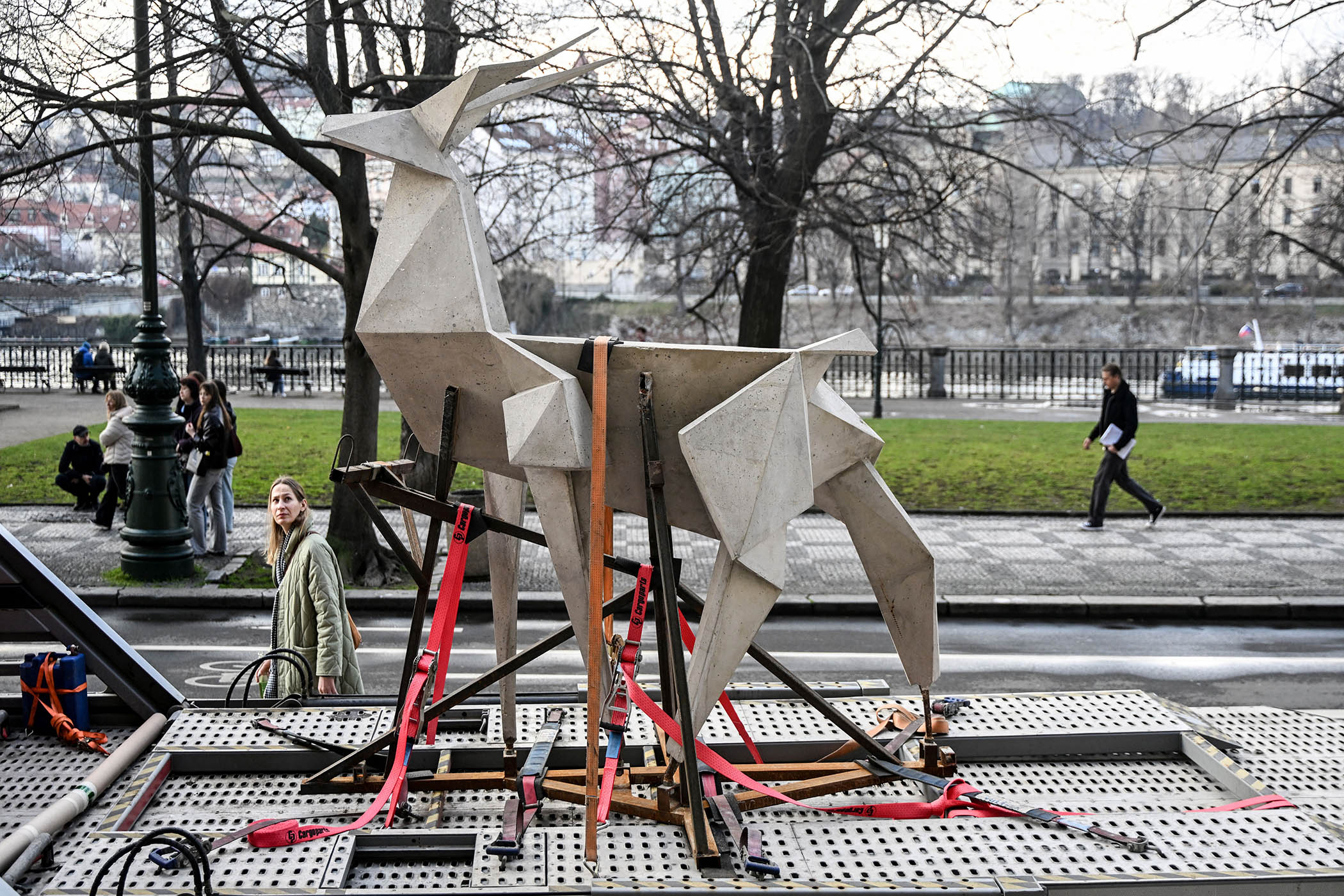
Origami Deer sculpture by Ukrainian artist Zhanna Kadyrova
Under Buttafuoco’s leadership, the Biennale has claimed to rise above politics. The foundation “rejects any form of exclusion or censorship of culture and art”, it said in a statement. “La Biennale, like the city of Venice, continues to be a place of dialogue, openness, and artistic freedom, encouraging connections between peoples and cultures, with enduring hope for the cessation of conflicts and suffering.”
This rhetoric stands in contrast to the foundation’s strong statement following Russia’s invasion in 2022. “For those who oppose the current regime in Russia there will always be a place in the exhibitions of La Biennale,” it said, but “as long as this situation persists, La Biennale rejects any form of collaboration with those who on the contrary have carried out or supported such a grievous act of aggression”.
Representatives for Buttafuoco did not respond when asked why the Biennale had changed its tune.
“A reversal without transparent reasoning risks weakening the credibility of the institution itself, as well as compromising each participant,” said Daniela Zyman, chief curator of Vienna’s Thyssen-Bornemisza Art Contemporary, and another signatory to the open letter. “Might we instead be witnessing political realignments that are being camouflaged as the freedom of art?”
Russia has been eager to wield soft power through cultural diplomacy in a bid to weaken crippling economic sanctions. With 99 national presentations planned this year, the Venice Biennale is art’s most prominent international stage.
Critics, meanwhile, have pointed out that a ban would not be unprecedented: apartheid South Africa was barred from participating in the Biennale for nearly 30 years.
All signs point to a Biennale more politicised than ever, whatever Buttafuoco might say. As the prosecco corks pop and the yachts glide in – including, perhaps, those owned by Russian oligarchs – some will likely be asking whether it’s time to sink the whole affair.
Photograph by Pascal Le Segretain/Getty Images, Johann Hinrichs/Alamy, Michal Cizek / AFP via Getty Images