
Only days ago, Donald Trump reportedly clashed with military chiefs in the White House situation room when his generals were unable to guarantee a quick, easy victory in Iran.
The president demanded options to decapitate the regime in Tehran akin to the operation that toppled Venezuelan despot Nicolás Maduro in January. The generals could give him no such assurances.
Despite those warnings, the US president has now launched a war with Iran, urging the Iranian people to rise up, declaring that “the hour of your freedom is at hand”.
“Now is the time to seize control of your destiny and to unleash the prosperous and glorious future that is close within your reach,” Trump said. “This is the moment for action. Do not let it pass.”
With Iranian missiles raining down across the Middle East on Saturday, however, Trump’s true objectives are still unclear. Re-elected on a promise to end American involvement in Middle East regime change and endless foreign wars, Trump has now embarked on a fresh conflict, fraught with risk, that could engulf the region – and his presidency.
Even some of those who support an attack on Iran are worried about Trump’s actions. “There’s always the danger that his short attention span leads him to decide there’ll be two or three days of strikes and then he’ll declare total victory and walk away,” said John Bolton, Trump’s former national security adviser, who has long supported an attack on Iran. “That’s not going to do the trick here.”
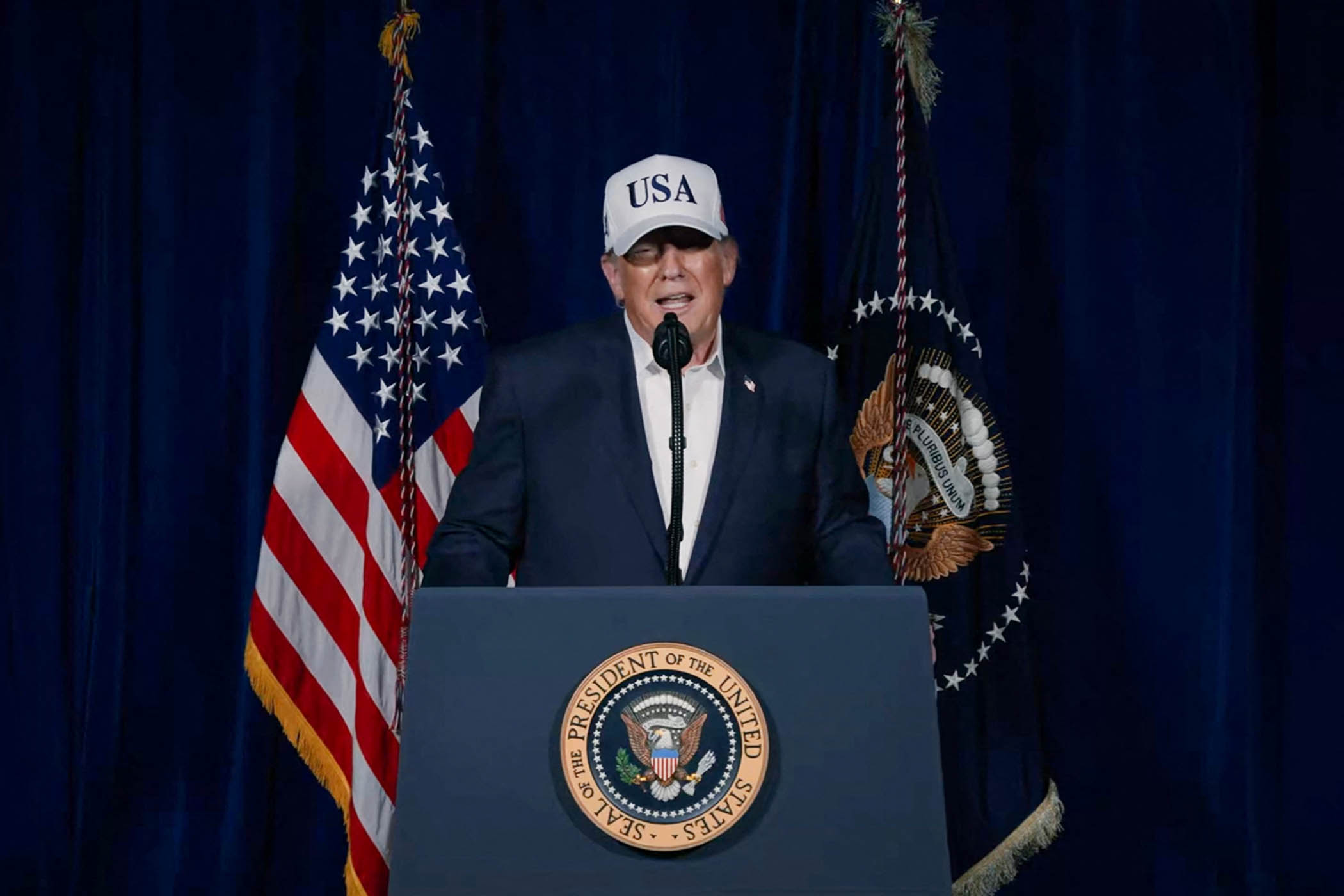
Trump’s recorded address announcing the “massive and ongoing” attack scarcely bothered to make the case for war. Amid the brinkmanship of recent weeks, there were none of the urgent justifications that preceded the 2003 invasion of Iraq. Instead, the president presented a litany of accusations dating back to the US hostage crisis after the Iranian revolution in 1979.
“He has a very strong belief in his ability to change reality,” said Alan Eyre, a former Iran policy expert and Persian-language spokesperson at the state department.
“The administration never really tried to negotiate. His demands had already exceeded Iranian red lines. He thought: ‘If we just keep adding more pressure, they’ll cave.’”
Calls for restraint from other regional allies, including Saudi Arabia and the United Arab Emirates – both members of Trump’s “board of peace” that met in Washington less than two weeks ago – have been ignored. So has Congress, which has the sole power to declare war under the US constitution.
Newsletters
Choose the newsletters you want to receive
View more
For information about how The Observer protects your data, read our Privacy Policy
The attack prompted condemnation from Democrats on Capitol Hill on Saturday. Jim Himes, a senior Democrat on the US House intelligence committee, denounced the operation as “a war of choice with no strategic endgame”.
Eyre said: “This is just another step forward in the increasingly Hobbesian nature of international relations under Trump.” He added: “This war is not just unconstitutional under US law. It violates international law. There’s been no effort to bring allies in beforehand, other than Israel.”
As the American military buildup in the region went on in recent days, Trump has insisted to White House staff that he must “look strong”, according to one source close to the administration.
“For many years, you have asked for America’s help, but you never got it,” Trump said on Saturday. “No president was willing to do what I am willing to do tonight.”
Having claimed that US strikes last year had “obliterated” Iran’s nuclear programme, however, sources close to the administration admitted that the president had “painted himself into a corner” as the standoff deepened. Trump has floated the possibility of limited airstrikes, forcing the regime in Tehran to concede, with the threat of a larger attack to follow.
“As [German chancellor Otto von] Bismarck once said: when you go to war, you’re rolling the iron dice,” said Bolton. “It's very hard to understand why, after four years in his first term saying he wasn’t going to do regime change in Iran, and then campaigning against endless wars, that now he has launched an attack.”
Since his first term, however, Trump’s Iran policy has been guided by personal grievance. In 2017, he followed through on his promise to withdraw from the Iran nuclear deal brokered by Barack Obama, declaring it “one of the worst and most one-sided transactions the United States has ever entered into”.
Without that framework in place, though, Trump has struggled to replace it with a coherent strategy towards Tehran, while the Israeli prime minister, Benjamin Netanyahu, backed by hawks in Washington, has nudged the president towards an all-out assault.
“Once he ripped up the nuclear deal, that set a floor for any agreement that he did with Iran that had to be appreciably better [than Obama’s],” said Eyre, who was closely involved in negotiations with Iran on the original accord.
“That is why he moved the red line to no enrichment, which is why there was talk of negotiating over missiles and proxies… We got to the point where Iran realised the US was probably going to strike, and thought that preferable to accepting maximalist American demands.”
The death of Iran’s Supreme Leader, Ayatollah Ali Khamenei, would be a heavy blow to the regime, if confirmed, and another stunning coup for Israeli intelligence. But US military and intelligence experts have cautioned that the 89-year-old cleric will likely be replaced by hardline figures in Iran’s Revolutionary Guard.
The regime has prepared for life after Khamenei for years. His death alone is unlikely to rekindle the popular uprising of late-December in light of the massacre that followed. Without a full-scale invasion, America’s scope to influence events on the ground is limited.
An attack on Iran does have widespread support in Washington, however, even among political opponents who fell out with Trump long ago.
“I tried to convince him to do it in the first term, and didn’t succeed. Maybe he read one of my old memos – I don't know,” said Bolton, who was sacked by Trump in his first term and indicted by the justice department last year. “You’ve got to keep your eyes on the prize here, and that’s what the right policy is, even if it’s Trump saying it.”
But Saturday’s attack, which comes only months before crucial November midterm elections, risks sweeping blowback from American voters. Trump’s approval rating has cratered in recent weeks, slumping below 40% as polls show mounting anger at his failure to tackle the economy and the rising cost of living.
The strikes on Iran’s nuclear sites last year divided his own Maga – Make America Great Again – movement, with prominent rightwing voices accusing the president of betraying the “America first” doctrine that helped get him elected. Traditional US support for Israel has become increasingly contentious even on the right. A poll last week found that American sympathies in the Middle East have shifted dramatically away from Israel during the war in Gaza.
“Everybody knows the only reason we’re having this war is because Israel wants it. This is their last chance,” conservative podcaster Tucker Carlson told his viewers on the eve of the attack, underscoring the rift among Trump supporters.
Hours later, the Iranian foreign minister, Abbas Araghchi, echoed that claim. “Trump has turned ‘America first’ into ‘Israel first’ – which always means: ‘America last,’” Araghchi tweeted.
But Trump has calculated that he can strongarm his base into line. As one Republican strategist noted on Saturday: “Maga is still whatever Trump says it is.” Lacking Trump’s powers of alchemy, however, Republican candidates could pay the price at the midterms if the US becomes enmeshed in another protracted foreign conflict. “If we’re still engaged militarily five or six weeks from now, looking for a new leadership in Tehran, and if we have a few dozen casualties or worse at that point, that is not an easy political situation for Trump,” said former US ambassador John Herbst, senior director of the Atlantic Council’s Eurasia Center.“This is not Maduro in Venezuela. Calling on the Iranian people to take power – that’s a very ambitious goal.”
Photograph by RealDonaldTrump/Truth Social/ AFP via Getty Images