

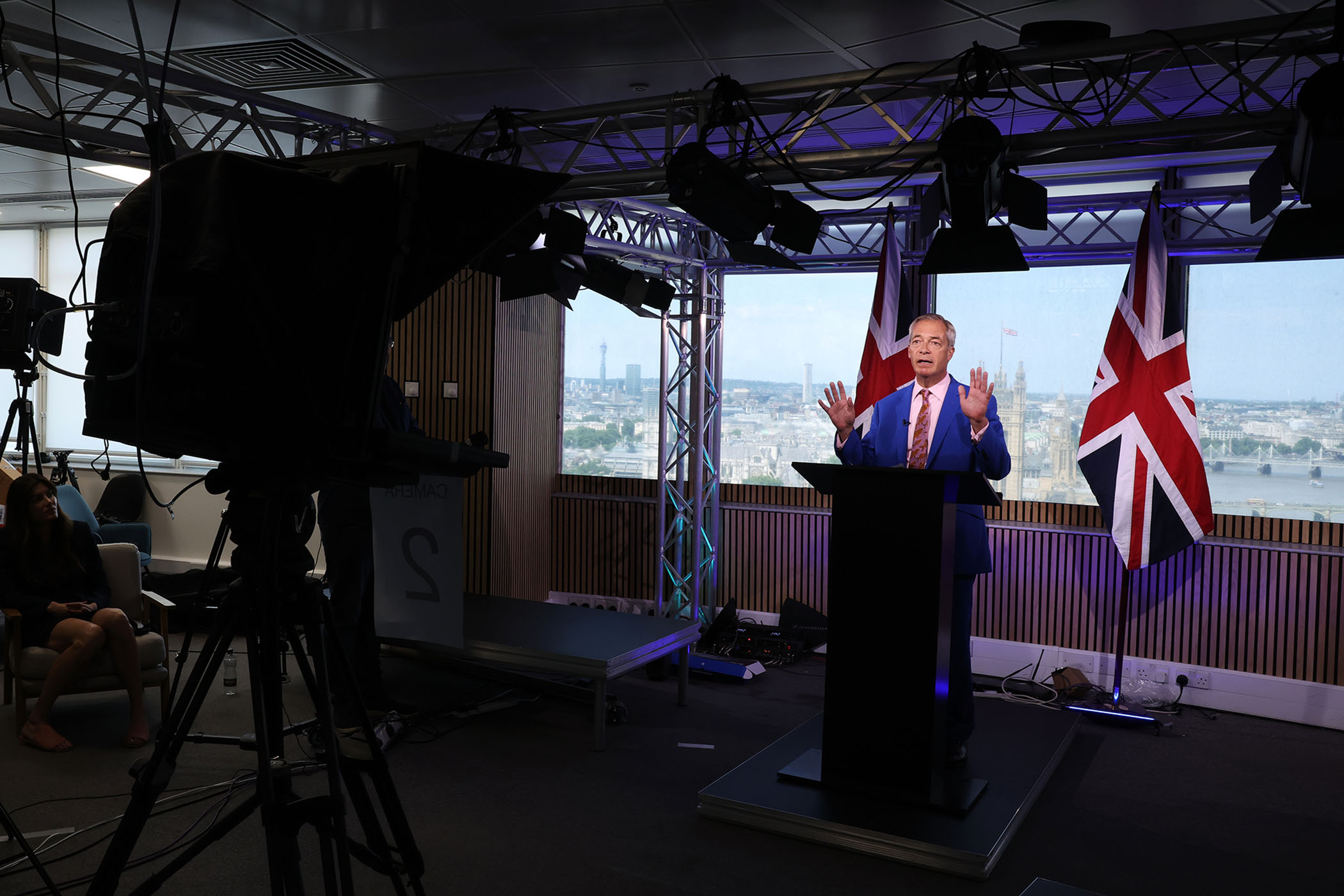
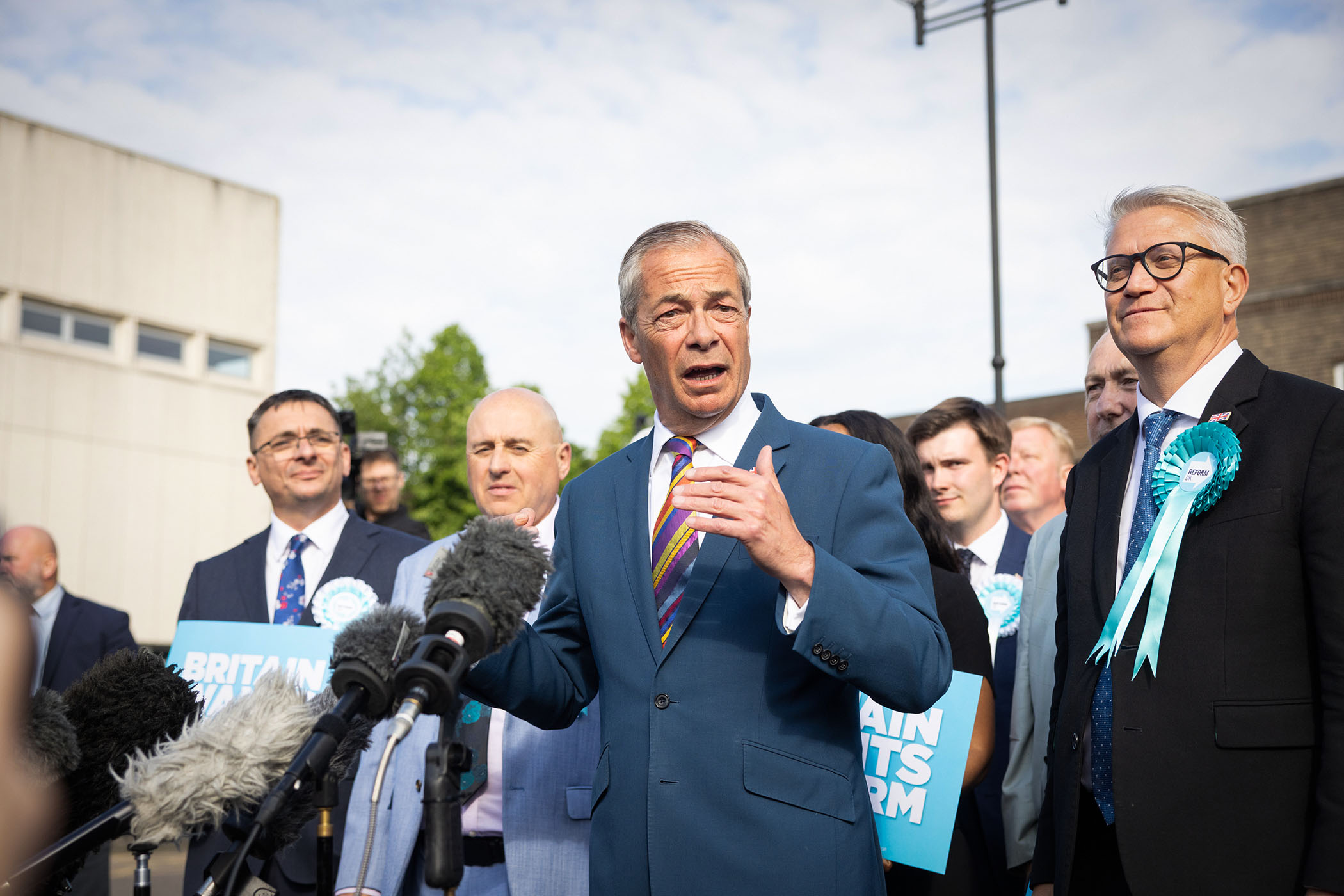
Photographs by Gary Calton for The Observer
Standing behind his butcher’s counter at Gorton market, cleaver in hand, George Wilsher wants to get back to work. He has, over the last couple of weeks, been filmed by several television crews and asked to pose by a variety of news photographers. The novelty has long since worn off. Still, he tries to be as helpful as possible. Would a larger cut of meat look better in the photograph, he asks? Should he hold a bigger knife?
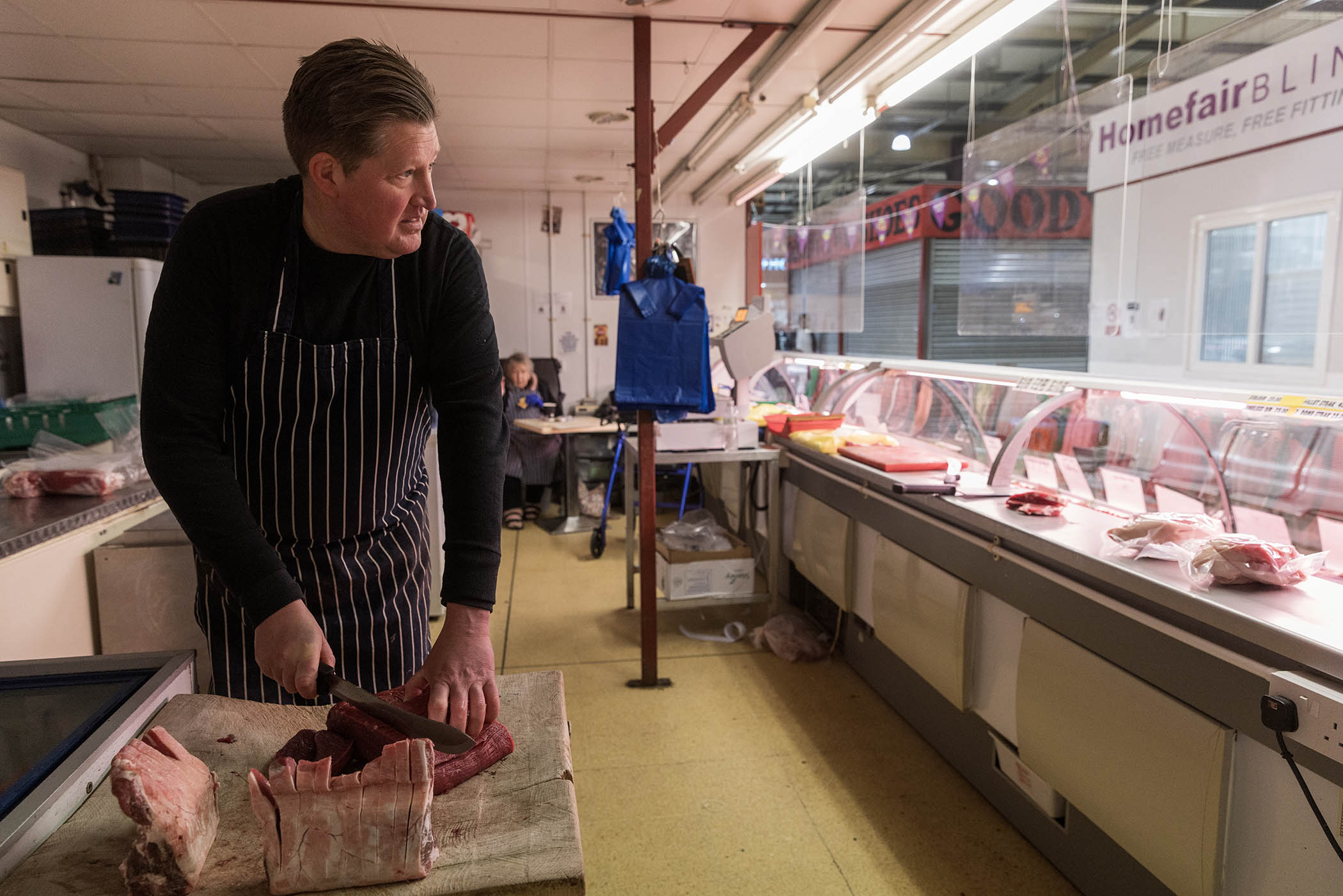
George Wilsher
He is not the only stallholder fatigued by the attention. Most do not want to offer their views on the looming Gorton and Denton byelection. “We have to stand here and serve people,” one says. “It’s no good giving our opinions.” Many query the sincerity of the questions. As another puts it: “Nobody cared about Gorton before, and they won’t care about Gorton again.”
That has not stopped people coming. As the election has drawn closer, the market has exerted an irresistible magnetism: the perfect place for the media to take the pulse of the community and the candidates to win its hearts. That sudden surge of attention has been a strange experience. Gorton is not especially used, Wilsher says, to feeling like “the centre of the universe”.
That it currently does has nothing to do with Gorton itself. The identity of the MP for Gorton and Denton – a new constituency, the shape of a wishbone, uneasily cobbled together for the last general election from sundry parts of east Manchester and Tameside – is not the only thing at stake on Thursday. It may not even be the main thing.
‘Reform say they have a solutionbut they never saywhat is going to pay for it’
‘Reform say they have a solutionbut they never saywhat is going to pay for it’
Gaynor Busch-Petersen
The byelection has been presented, instead, as a petri dish for any major issue you care to name. It is a referendum on everything from Keir Starmer’s premiership to the ongoing viability of Labour as a political force, beset on one side by the prime minister’s popularity and on the other by the scandal of Peter Mandelson’s involvement with Jeffrey Epstein.
It is a test of strength for Reform and a study of the Green party’s supercharged growth; a vital window into the extent to which the political consensus has splintered, a chance to pronounce the collapse of the broad churches offered by Labour and the Conservatives; a struggle to see whether immigration or the cost of living is the defining issue of the age. Everyone involved is approaching it not so much as a byelection but a battle for the soul of Britain.
It has not been a clean one. The campaign has been rife with allegations of dirty tricks: Labour has accused the Greens of spreading “misinformation” that only their resurgent party can beat Reform, based on “bogus bar charts”; Labour, in turn, has been reported to the electoral commission for “treating” voters with free meals.
Reform, too, has been reported to the police for posting a letter that purported to be from a local pensioner without labelling it as promotional material; its candidate, Matt Goodwin, a conservative commentator and former academic, has been asked to disavow members of his campaign found to have shared racist and antisemitic content online. The Labour MP Andrew Western has described Goodwin’s politics as “toxic” and “poisonous”.
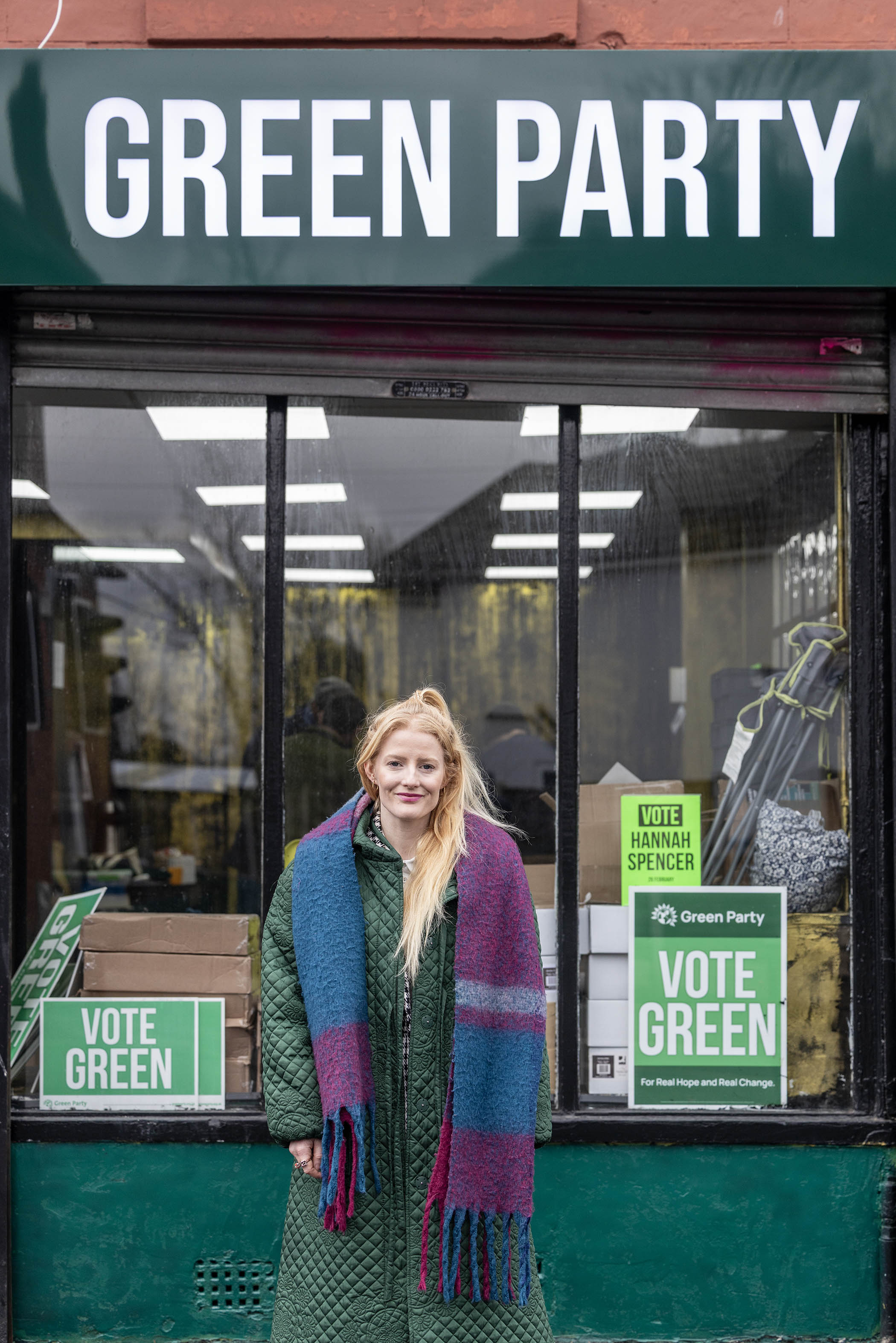
Green candidate Hannah Spencer
In the heart of that struggle are roving squadrons of canvassers, pounding the rain-soaked streets of Greater Manchester: fresh-faced, eager-eyed twentysomethings spilling out of the Green’s northern headquarters in Gorton to campaign for Hannah Spencer; their Reform counterparts, many of them equally youthful, clutching stacks of leaflets bearing the face of Goodwin.
Newsletters
Choose the newsletters you want to receive
View more
For information about how The Observer protects your data, read our Privacy Policy
Labour’s presence is minimal, limited to a few posters bearing the face of candidate Angeliki Stogia; one of them has been placed provocatively next to the Greens’ headquarters. The Conservatives and the Liberal Democrats may as well not be standing; judging by the signage, Manchester United will get more votes.
To make stereotyping nice and easy for outsiders, the constituency is bisected by the M60: on one side, Reform’s supposed terra firma of Denton, with its three-bed postwar semis and arid suburbia. Here, the party’s activists campaign in relaxed pairs.
On the other side, rapidly gentrifying Levenshulme, an integral part of urban Manchester, with its vanguard cicchetti bars and high-end bike shops, is a forest of Green placards; there, Reform’s campaigners tend to huddle together in groups of six or seven. Gorton, as so often, falls in between.
Perception, though, rarely aligns with reality. Like most people, the voters of Gorton and Denton do not fit into neatly assigned boxes. Denton does not, for example, feel like a frothing Reform stronghold; there are, at most, half a dozen houses proclaiming their intention to vote for Goodwin on the streets leading off Victoria Park.
In Dane Bank, an enclave of well-maintained bungalows on the other side of the M60, the volunteers at the community-run library– saved more than a decade ago from an attempt by the council to sell it off, and still funded entirely by donations – acknowledge that immigration will play a significant role in the election, but it is not what will drive their vote.
‘The main thing we noticed on the doorsteps was apathy’
‘The main thing we noticed on the doorsteps was apathy’
Steve Jeremiah
Christine Ingham, one of the library’s trustees, said the lingering bitterness over the offensive WhatsApp message scandal that brought down the former MP, Andrew Gwynne, will play an outsize role. “He was our MP for a long time,” she said. “A lot of people feel very let down by the Labour party here.” That is less pronounced in other parts of the constituency; Gwynne had only been their MP since the boundaries were redrawn.
That is the issue with drawing sweeping, national conclusions from what is primarily a local affair. Even the cut-and-shut nature of Gorton and Denton will also play its part. “What people will vote about [in Dane Bank] and what people will vote about in Gorton, or in Levenshulme, is different,” said Ingham’s colleague, Gaynor Busch-Petersen. “Reform promise everything but they never say how,” she said. “They say they have a solution but they never say what will pay for it. Not being in power is a very privileged position.” Her instinct is to vote Labour, as she always has.
“The main thing we noticed on the doorsteps was apathy,” said Steve Jeremiah, a member of the Broxtowe Alliance, a group of councillors in Nottinghamshire who have been drafted in, effectively, as crack troops in the struggle against Reform. They managed to beat Nigel Farage’s party in a council byelection late last year in which the Green candidate stood aside for them; they arrived in Manchester on Thursday morning, hoping to repeat the trick.
That disinterest is driving support to the Greens and to Reform: the belief, as Jeremiah said, that everyone in the Westminster bubble is exactly the same; that they have no interest in the area beyond its ability to take them to parliament; that neither Labour, nor the Conservatives,can make “their lives better”. In that stasis, there are three choices: go left, go right or give up.
It is not hard to understand why disaffection has taken root. Nobody, including the candidates, appears able to articulate a vision for change in the area. Gorton market is earmarked for development; there are plans to turn it into a bougie food market, similar to those in Altrincham and Stockport. Down the road but a world away, in Denton, Hatters Food & Drinks Hall is slated to open soon. Away from the buzz of national media attention, that’s as inspired as it gets: small plates and sourdough pizza.