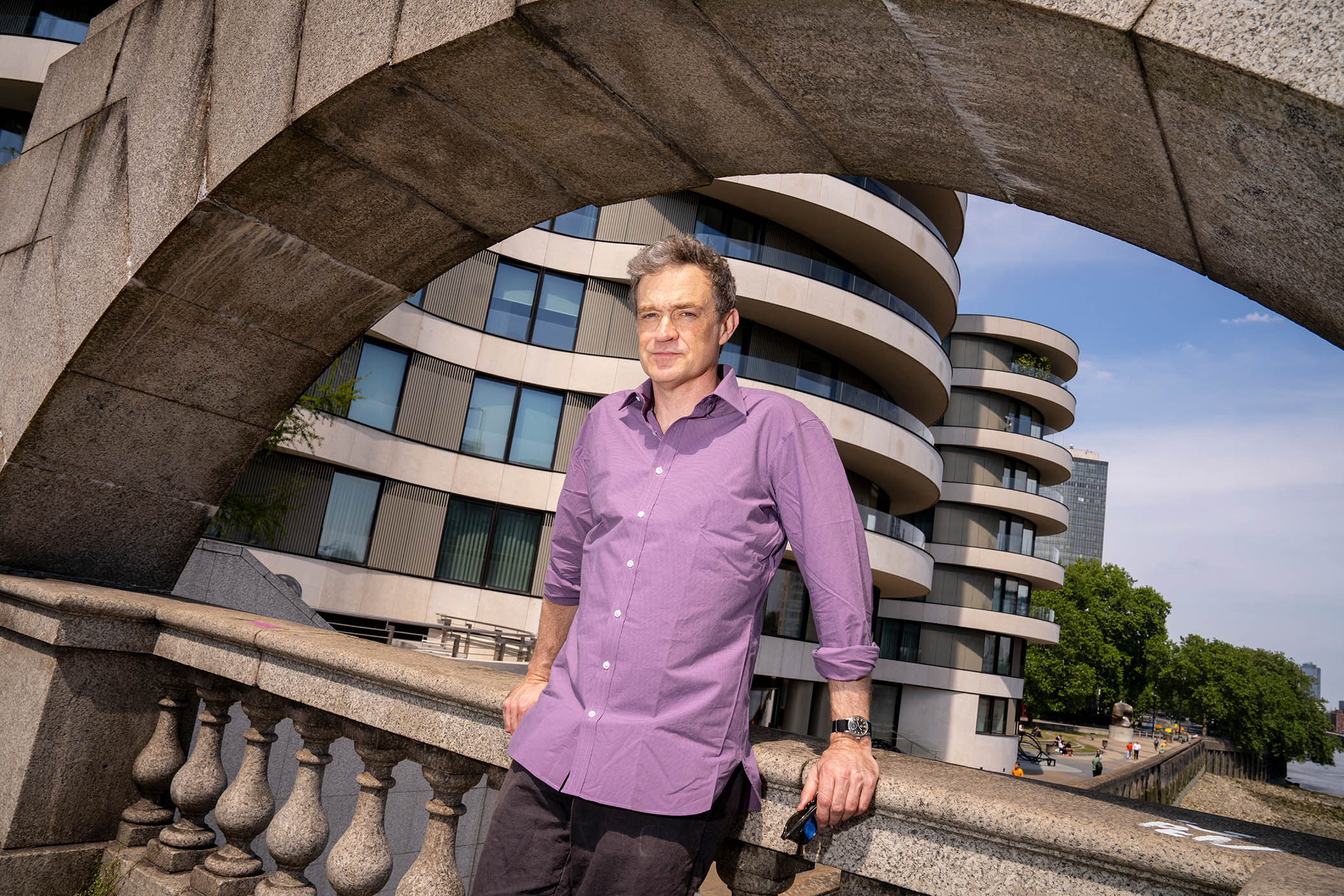


Portrait by Antonio Olmos for The Observer
Patrick Radden Keefe has been busy. The bestselling journalist and New Yorker writer’s new book, London Falling, has just been released and has gone straight to the top of the bestseller lists.
The reviews have been unanimous: it’s another master work by the man who took on the Troubles in Say Nothing and the billionaire Sackler family in Empire of Pain. He’s been on a multi-continental press tour, with a dizzying schedule of podcast appearances, interviews and packed events.
For an investigative journalist who spends a lot of time at home writing, or sitting in courtrooms scribbling notes, it’s a jarring shift to be so public, so visible. So when we meet on a warm afternoon, the blustery air thick with plane tree pollen and the parks full of lounging Londoners, our walk down the Thames Embankment feels like a momentary pause. On the shore opposite, mudlarkers search for treasures offered up by the low tide. We put on our sunglasses. Is he knackered? “A bit… overstimulated,” he replies. “But in a way that I feel very lucky for.”
Keefe has become one of the few magazine journalists since, maybe, Joan Didion to achieve genuine cultural celebrity, and it would be easy to assume that he sailed to this level of stardom. But it wasn’t always this way. Keefe grew up in Dorchester, a neighbourhood of Boston, Massachusetts. His wife, he tells me, jokes that he arrived into the world of adults with a chip on his shoulder.
“I applied to college and didn't get into the one I wanted to. So I took a year off and I studied, I worked two jobs, and then got in. I arrived at Columbia University a year after everybody else with a head of steam, because I had something to prove.”
He wrote a few essays for a legal journal and for Slate magazine. But, for a while, he became accustomed to repeated rounds of rejection. “I was rejected from the New Yorker again and again and again, over the course of seven years of pitching. That’s a true story. I have the rejection letters to show it.” Finally, in 2006, his investigation into Sister Ping, a middle-aged Fujianese woman responsible for a vast people-smuggling operation out of Manhattan’s Chinatown, was published in the magazine under the title “The Snakehead”.
A book of the same name was published three years later. Evident in those early works is the style Keefe is now celebrated for: unshowy but beautiful prose that reads with the momentum of an addictive thriller. Stories that feel irresistible but remain stitched so closely, so carefully, to the real world and the people – both powerful and powerless – who try to build a life in it.
Across his investigative work, Keefe has been praised for his outsider’s eye, in all “its exacting and terrifying lucidity”. Which is how we find ourselves at the start of our walk, outside a luxury apartment complex called Riverwalk, opposite the headquarters of Britain’s foreign intelligence agency, MI6, squinting up into the sun and counting balconies.
“ That was the balcony,” he says, pointing. “Three, four, five… Up there. I came almost right away after I’d heard the story.”
Newsletters
Choose the newsletters you want to receive
View more
For information about how The Observer protects your data, read our Privacy Policy
The balcony is where 19-year-old Zac Brettler fell to his death in 2019, and it is his story Keefe tells in his latest book. The body was found days later, at low tide, by a man crossing Vauxhall bridge. As Brettler’s parents, Matthew and Rachelle, tried to understand why their son died so suddenly, they learned he had been pretending to be the son of a Russian oligarch, a persona that had gained him entry to a layer of London that glitters on the outside but rots from within.
Keefe heard the story, by chance, while in London filming a TV adaption of his book Say Nothing. He had long been interested in the city – he’d written before about the flow of Russian money into the capital, and earlier, about a Metropolitan police unit made up of people with astounding abilities to recognise faces.
But this story had a different quality. It felt more intimate. After he met the Brettlers, who had until then been very private about the death of their son, a close relationship formed, and he began to investigate: why had Zac died? Keefe could soon see that Zac’s life – real and imagined – presented something of a parable. It was the story of a young man coming of age in an online world flooded with manosphere influencers chasing ostentatious wealth. The city he was living in had been built on old money – the riches of empire – but had now become hooked on new cash, dirty cash, flowing thick from Russia, the former Soviet Union and, more recently, the Gulf.
As we walk, the ideas that underpin Keefe’s book come, quite literally, into view. To our left, Tate Britain, the grand art gallery founded by Henry Tate, who made his fortune selling sugar cubes, an industry facilitated in the 17th and 18th centuries by the transatlantic slave trade. The current exhibition by the artist Hurvin Anderson, a British painter of Jamaican heritage, is funded by the Parker Foundation, set up by Sean Parker, the co-founder of Napster and the first president of Facebook.
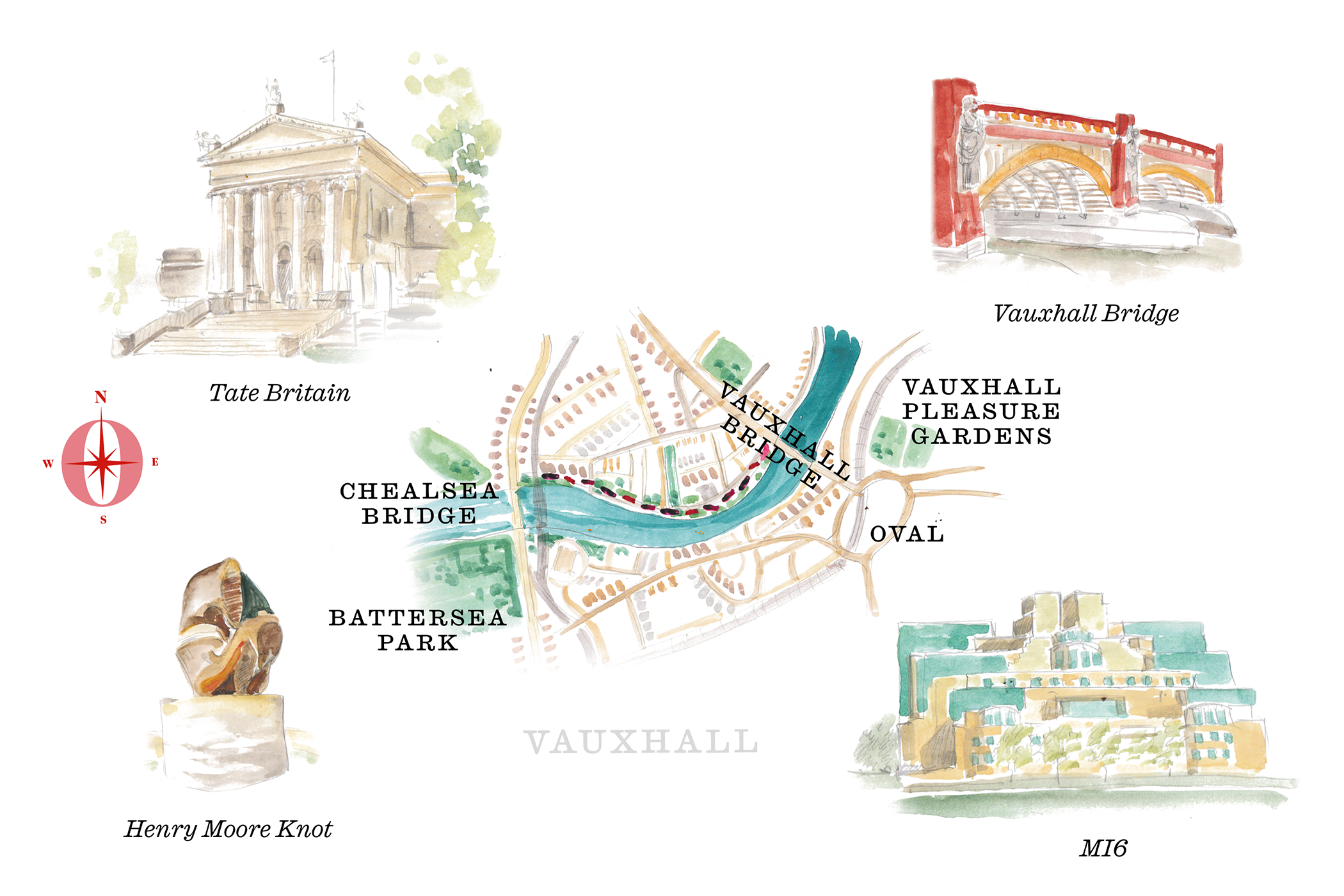
Beside it, Chelsea College of Art and Design, a once-prestigious art school, cowed by years of funding cuts, now deeply reliant on high-paying international students – many from China – to keep it going. In the river beside us, Uber boats – the branding large and ubiquitous – float along the waterway that built the capital; a river Joseph Conrad once described as delivering “the dreams of men, the seed of commonwealths, the germs of empires”.
London Falling is about corruptions of all flavours. The Brettlers sent Zac to Mill Hill, a private school established in 1807 on the outskirts of the city to protect young boys from its damaging influence. But in the 2010s, when Zac attended, those influences were no longer tied to physical geography; they were in the ether – online, on social media.
A haunting scene from London Falling describes Rachelle walking past her son’s room, late one night, as his behaviour becomes more difficult, more alienating. She sees his face illuminated by the glow of his phone. Reading it, it struck me that Keefe, also a parent of two teenage boys, must have felt acutely sensitive to the anxieties of the Brettlers.
“It’s the most intimate thing I’ve written because of the relationship that I’ve developed with this family,” he says. “But some of it, of course, was that I’m a parent myself. I’m a parent of two adolescent sons. There are different junctures in the story where I related to them quite intensely.”
What do you do when your son comes home praising Vladimir Putin, or obsessing about supercars? The Brettlers’ impulse, he explains, “was to express their disdain for those types of aspirations. But they also recognised that it’s part of what adolescence is – you define who you are as separate from your parents.” In the acknowledgments, Keefe says it clearly: as much as anything else, this is a book about parental love. He writes about how fiercely he loves his own boys, and how desperately he wants to “protect them from this world and prepare them for it”.
‘There’s now a nihilistic sense that we’re all hustlers and con artists, that’s all there is, and you’d be a fool not to try your hand’
‘There’s now a nihilistic sense that we’re all hustlers and con artists, that’s all there is, and you’d be a fool not to try your hand’
His closeness to the Brettler family has also reanimated an enduring suspicion about the kind of journalism Keefe has become known for. Reviewing his book in the New York Times, Jennifer Szalai writes that he “hews so closely” to the family’s point of view, and picks up on a line, also in the acknowledgments, in which he thanks the family for their trust and openness: “I hope I’ve written a book that feels commensurate with the magnitude of that gesture.”
Szalai seems to imply that perhaps the journalist went soft on them in exchange for the access they granted him. It would be easier to engage with this critique if London Falling were not full of astonishing, intimate details any family would think hard about revealing to the world – details of domestic disturbances, revealing internet histories, and of their son’s sexual curiosities.
But beneath this lies a more familiar, enduring question: can a journalist so closely enmeshed with their sources write objectively? And can a story that reads like a thriller really be trusted to be true?
“I’m hip to all these dilemmas,” he says, with an air of polite fatigue. “I’ve been thinking about these questions my entire career.” Keefe wanted the reader to learn the story the way Zac’s parents did: “There are all these things that you believe at different times that turn out not to be true, because you’re in their heads in that moment, and that’s what they believe.”
After Keefe finally got a job writing for the New Yorker, it wasn’t a straight ride to the place he now occupies in the world of non-fiction writing. His stories circled the underworld, but with a refreshing, sometimes complicated compassion. He wrote about El Chapo and the Mexican drug wars. He reported on a scientist who fatally shot three of her colleagues. He turned his attention to crooks, murderers, mafiosos and avengers; then, after the election of Donald Trump in 2016, to America in crisis.
It was while reading the obituary pages of the New York Times that Keefe stumbled on the story that he now credits with changing the trajectory of his career. The headline read: “Dolours Price, Defiant IRA Bomber, Dies at 61.” He pulled at the thread. It took him deep into the world of the Troubles in Northern Ireland, and into the barbed history of sectarianism, the people “disappeared” by paramilitaries, and to Gerry Adams, the leader of Sinn Féin who had, in the 1998 Good Friday agreement, been lauded as a bringer of peace.
Over four years, and seven trips to Northern Ireland, Keefe worked on telling the story of Price, her sister and the people swept up in the fight. “My working theory had been that nobody in the US would be interested in this book. It was about the Troubles, it’s another country, it’s long ago. Irish Americans, in my view, tend to have a pretty gauzy view of Gerry Adams, and would therefore take issue with the book.”
Here in the UK and Ireland, he expected a better reception. This is our history, after all. But on release in 2018 the book “just vanished”, he says. Few people bought it. This newspaper, Keefe happily reminds me, didn’t review it.
“Nobody seemed particularly interested in reading it, or having me talk about it. If you’d talked to me in December or January that year, I thought I would never write another book. I thought I was done.” The US release came a few months later – February 2019. It reached the top of the New York Times bestseller list within a month.
“It changed my life,” he recalls. “It showed that there was a viable and exciting career, it turned out, writing more books. And that people would read them. I don’t know if that will get old.” At signings, people now approach him to thank him. They tell him the ways in which his books have moved them: “‘I read the book and then I went to Northern Ireland’. Or ‘Empire of Pain was significant to me because I had a relative who struggled with addiction’.” It is, he says with a boyish, beaming smile, magic.
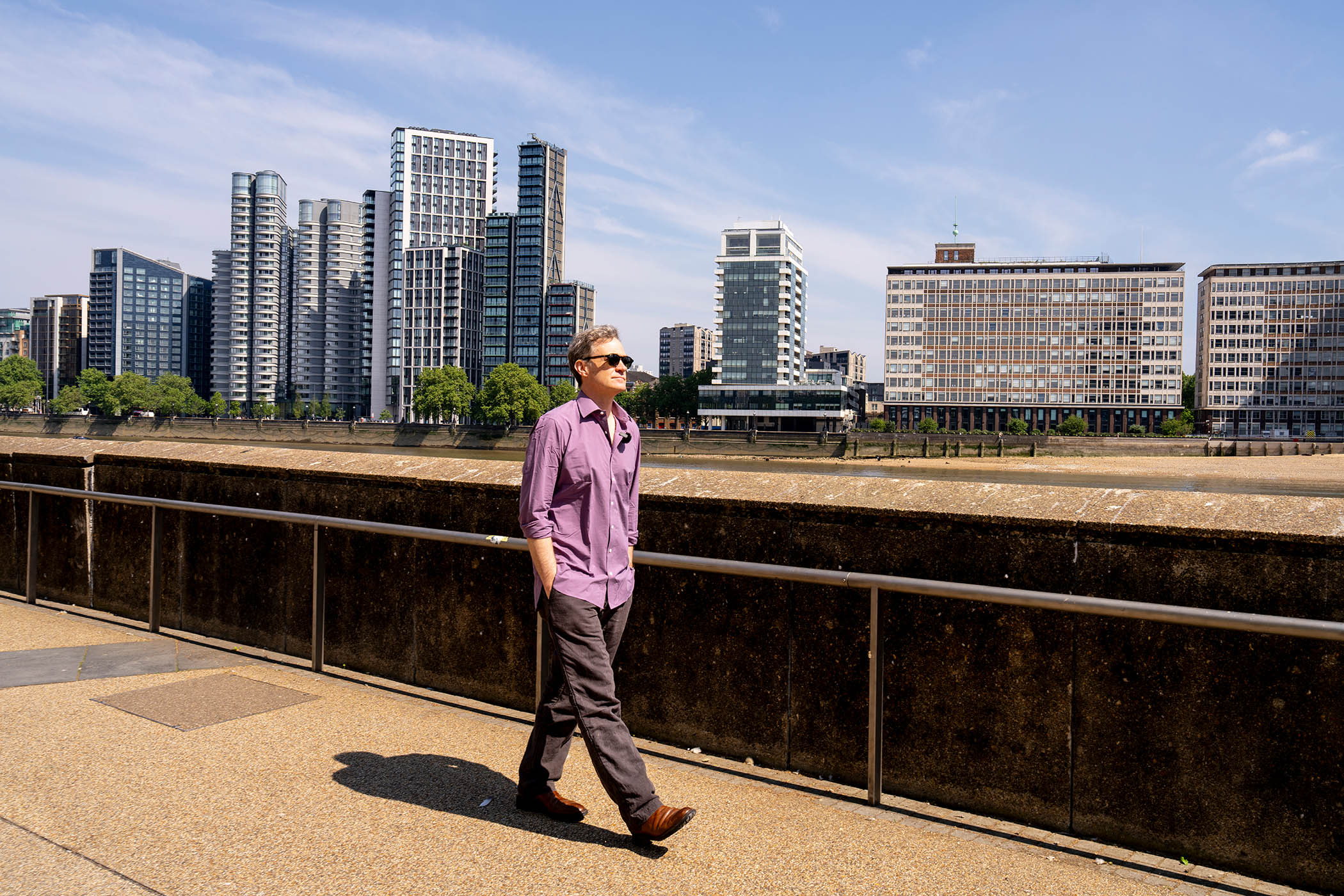
As we loop back to the building at the heart of his story, Riverwalk looms ahead of us, its curved, wavy facade gleaming in the sun. Designed by Stanton Williams, the Stirling award-winning architects, it was clearly conceived to be at one with the swirling, tidal water of the Thames at its feet. But it appears to me more defensive than that, more like an armadillo shell, armoured, shrouding its wealthy inhabitants from scrutiny.
Just two days before Keefe and I meet, the UK had held local elections and Reform, the rightwing populist party led by Nigel Farage, had been elected to more than 1,400 council seats across the country – a reshaping of the British political landscape. Nick Candy, the Reform party treasurer and billionaire property developer, had been a hero of Zac Brettler’s – Zac had pretended to live at One Hyde Park, a Candy development that once held the ludicrous title of the most expensive address in the world.
The new politics of wealth and its recent mutualism with hard-right politics is a subcurrent in London Falling. “You can look at Zac, who had this very recognisable world-view: male-coded, push all your chips into the centre of the table, fake it till you make it; a kind of amoral sense that you’re either gonna win it all or you’re gonna be a loser. And a sense that you should be contemptuous of the values of your parents, or people in their generation – to find a stable job, live a modest life, save money where you can. There’s a sense now that that’s for losers.”
Fakery, Keefe says, is now “the coin of the realm”. Just look at Donald Trump. “Undergirding all of this is a nihilistic sense that we’re all hustlers and con artists, that’s all there is, and you’d be a fool not to try your hand. You might lose, but at least you took your shot.” The election results, Keefe suggests, “would indicate that almost every bad trend” about London – its venality, its embrace of wealth no matter where from – would be “accentuated by” the politics of Reform.
Our time is up. Keefe has a book signing to get to, and is then off on another leg of his tour – in New Zealand. I ask what’s next, once all this ends and he can return to the bit he really loves – the reporting. “I haven’t figured out what the next thing is. The publicity tour stuff is… I feel so lucky. This is my sixth book. It hasn’t always been this way, and so I savour every minute of it.
“But in March, I spent about two and a half weeks in New Orleans covering a trial, just sitting on a hard bench in a federal courthouse with the other reporters and my notebook. It was heaven.” That’s the place he’s happiest, “being stuck in on a new thing”.
We walk to the front of Riverwalk, the building Keefe has so forensically dismantled in his latest work, and we scan the busy road for the car that has been sent to pick him up. A slick grey BMW swings into the driveway and parks up in front of the Riverwalk foyer, clearly expecting to pick up a resident. It’s for Keefe. He jumps in, and speeds off into the late afternoon London traffic.