
This article first appeared as part of the Rory Smith on Football newsletter – a guide to help understand what is happening on the pitch, off the pitch, and why all of it matters. To receive it in your inbox, sign up here.
It’s hard to choose, but the finger guns are probably the nadir. Character Limit, Ryan Mac and Kate Congler’s account of Elon Musk’s transformation of Twitter into a digital monument to his own ego, is a masterful piece of journalism: detailed, forensic, impeccably well-sourced. Through no fault of the authors, it also functions as a sort of litany of cringe. Reading it can, at times, be physically painful.
Some of the highlights – which is definitely not the right word – have long been in the public domain. There’s the part where Musk sets the share price at $54.20. Get it? And the bit where he walks into Twitter’s headquarters carrying a sink. Do you get it? It is possible nobody in the history of humanity has wanted to be thought of as cool quite so desperately or quite so unsuccessfully.
Somehow, though, Mac and Congler unearthed a slew of details that manage to be more skin-crawling. This is where the finger guns come in: accounts of a post-takeover meeting in which Musk tells his underlings that they should “shoot from the hip,” accompanied by that gesture. And not with one hand. With two. A double finger gun. Read it and wince.
His media strategy, by that very low bar, is not quite as bad. Still, it is pretty indicative. After Musk’s takeover, any journalist emailing Twitter’s standard communications address were met with a single autoresponse: an email that contained nothing but the poo emoji. A reminder: Elon Musk was, at this stage, almost 50. He was trying to convey his edgelord disdain for the LAMESTREAM – no but do you get it? – media. It was just a happy coincidence that it served to highlight not only how little he wanted to answer questions, but how absurd he found the idea that he should have to.
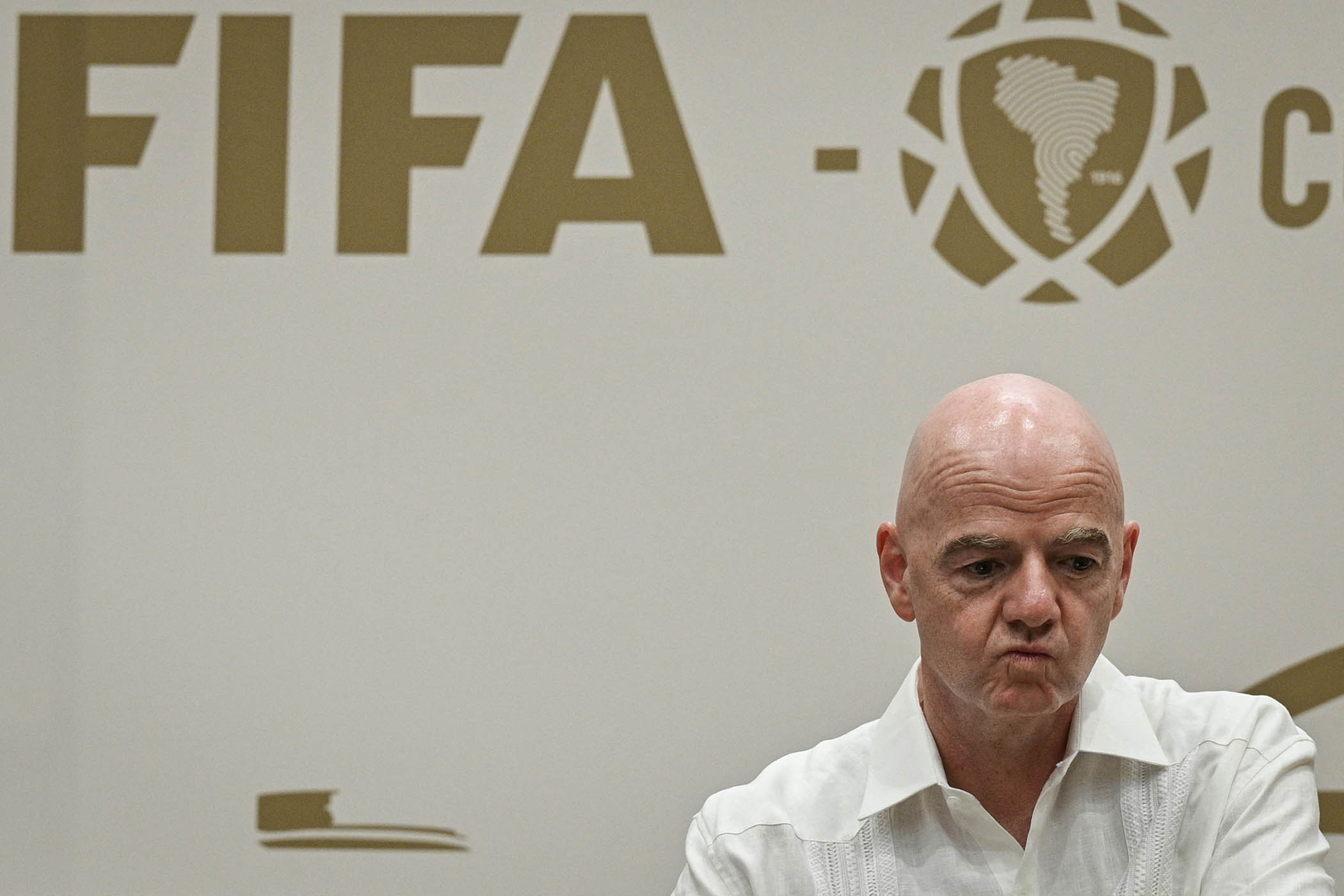
It is a small mercy, I suppose, that things have not yet got quite that bad at Fifa. World football’s governing body still retains a well-staffed and highly professional communications department. It is not their fault that sometimes it feels like they exist largely as a delayed caption service for the Instagram account of the organisation’s president, the ubiquitous, elusive Gianni Infantino.
Where Infantino’s Fifa and Musk’s Twitter find common ground, though, is in how resistant they appear to be to answer questions. Earlier this year, for example, Infantino was asked by Glenn Micallef – the member of the European Commission with responsibility for sport – if he could guarantee European fans’ safety when travelling to this summer’s World Cup. He is, he told Politico, still waiting for his follow-up.
Much the same happened to Nellie Pou, a member of the United States House of Representatives, and co-sponsor of a bill aimed at preventing agents from Immigration and Customs Enforcement (ICE) conducting raids in those cities hosting the World Cup. She had asked Fifa for clarification on what ICE would be allowed to do. She has not heard anything, either.
And then there is the endless screed of questions that – with only 70 days or so remaining before the World Cup actually starts – might be fairly described as pressing. They include, but are not limited to: can Fifa guarantee that fans will be safe at the stadium in Mexico City, where the tournament’s opening game will be held, after a fan died while watching a game there last week?
What plans are in place to ensure that the tournament can be held in Guadalajara, a city wracked by violence in February after Mexican security forces killed El Mencho, the head of the Jalisco Nuéva Generácion Cartel? Will supporters, officials and even players from those countries – including Senegal and Tunisia – be subject to the Trump administration’s visa bond program, meaning they have to put down up to $15,000 simply for the right to enter the United States?
Since we’re on the subject of money: Does it matter that several cities in the United States have stripped back their planned fan activities for the tournament because of a lack of funding, most of which they attribute to Fifa’s restrictive commercial policies? Can Fifa justify the ticket prices, which are so high that 70 members of Congress wrote to the organisation asking for reductions? Why did it not have guarantees in place over the cost of hotels and parking and public transport?
And then, of course, there is the matter of Iran, which is currently at actual war with the primary host of the tournament. We know that Fifa has decided against relocating Iran’s games to Mexico. But we have no idea at all whether Iran intends to play in the tournament, whether Iran will be allowed to play in the tournament, or whether Iran’s players and fans will be safe during the tournament.
On this one, Fifa is perhaps due a little understanding. As much as they like to pretend their showpiece event sits above politics, it does not. Fifa cannot control what either the Iranian or the American regimes will do between now and June 11th. Given the nature of both of those governments, it doesn’t seem especially reasonable to ask them to guess, either. What could they say?
All of the rest of it, though – the security and the logistics and the relentless, unapologetic gouging of the fans who will ultimately decide whether the event is a success or not – sits squarely in Fifa’s remit. It is being able to navigate these complex issues that establishes a leader’s worth. Infantino, despite spending so much of his time cosplaying as a world leader, has confronted none of them.
There are two explanations for this. The first is that he genuinely does not understand the problem, that he does not see an issue with the people who illuminate the event being milked for all they are worth, or being worried they might be caught up in a narcobloqueo (a narco blockade in Mexico). The second is that he does, buthe has become too closely aligned with Trump to do anything about it.
Either way, the impression is very much that Infantino’s vision of leadership is very much like Musk’s: a fragile populism in which any query is criticism, and any criticism is intolerable; in which the response to dissent and to doubt is to stick your fingers in your ears; in which all that matters is the projection of a Panglossian worldview. It is leadership by Instagram: glossy, curated, false.
And – more than anything – it is hollow. By tomorrow, all 48 teams will have qualified for the World Cup. It is less than three months away. It is easy to dismiss concerns as the work of cynics and detractors and haters now. It is easy to hope that a slick Instagram image will project strength, perfection. But they don’t actually solve the problems, do they?
Photograph by David Salazar / AFP via Getty Images
Newsletters
Choose the newsletters you want to receive
View more
For information about how The Observer protects your data, read our Privacy Policy