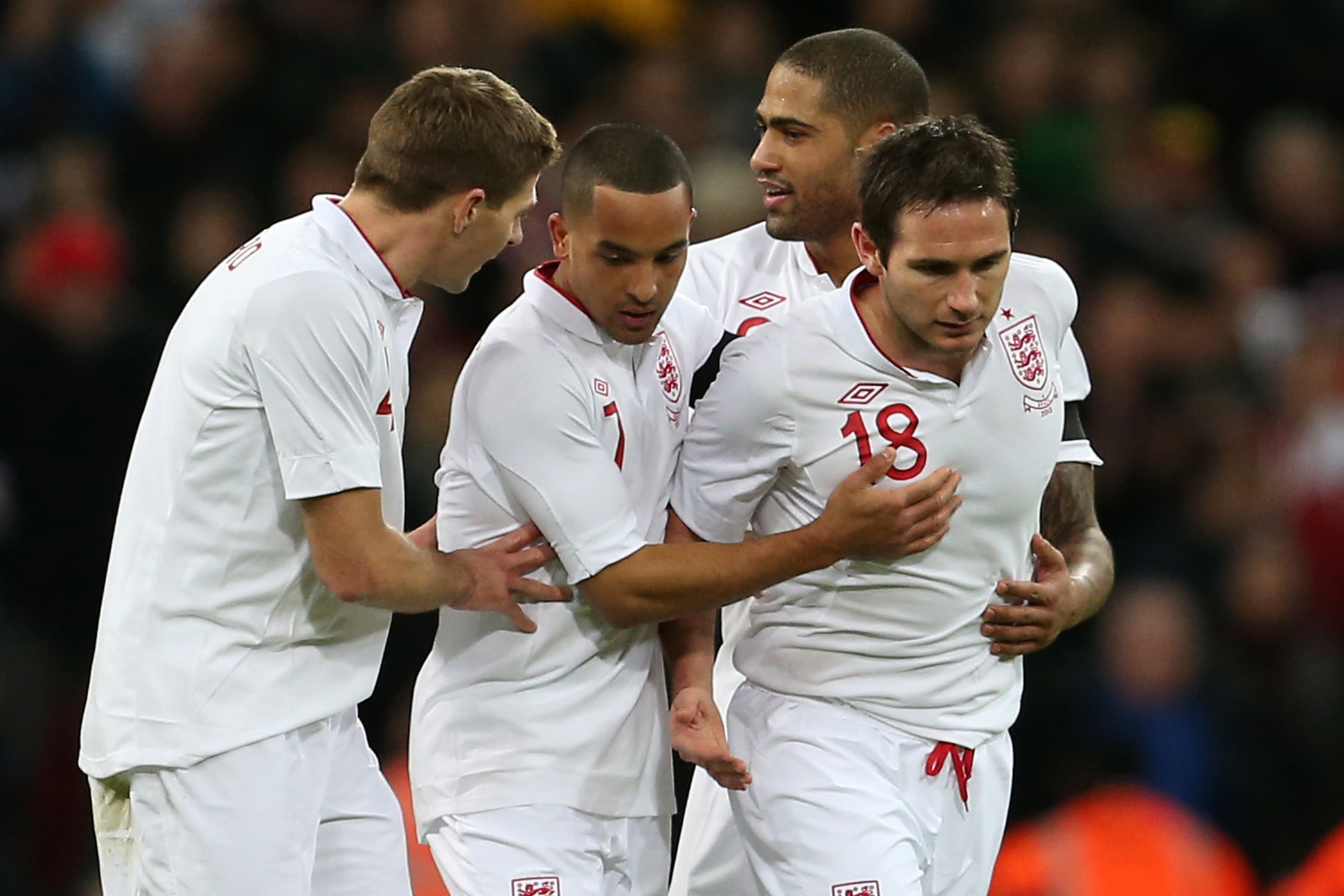


“We had Lampard, Stevie, JT, Rio, Becks, Wazza,” Glen Johnson says, reeling off an astonishing list of players he once called England teammates. “A lot of big characters. You were just surrounded by winners and leaders.
“That’s probably the only thing I think we’re missing with such a young England squad now. Obviously, fantastic players – but, blimey, those players that I just mentioned, in their prime, are getting into this team.”
You don’t hear so much from Johnson these days. For a spell in the early 2000s he was the hottest young right-back in England: the first signing of the Roman Abramovich era at Chelsea, a Premier League title winner under José Mourinho who later spent six years at Liverpool, where he lifted the League Cup.
After feeling the harsher glare of the spotlight for much of his young adulthood – and becoming regular tabloid fodder – he seemed content to slink away from it. But when he talks to The Observer now, he does so with remarkable candour and searing honesty about why England fail at major tournaments and what this current group lacks.
And he speaks from experience. He was the first-choice right-back at Euro 2012, when England topped a group containing France, Sweden and Ukraine before being knocked out by Italy on penalties. He also started in the disastrous 2014 World Cup campaign in Brazil, where defeats to Italy and Uruguay meant that England were already eliminated before Roy Hodgson fielded a second string in the disappointing goalless draw against Costa Rica.
England have started well at this World Cup – but England usually do. It is the knockout stages where they tend to struggle, certainly in the pre-Southgate era, although even his sides fell short in two finals. So what holds the national team back?
“From previous tournaments, I’d probably say the killer instinct,” Johnson says. “The lads, we’re so nice that we try and win every game playing beautiful football, where sometimes you’ve got to be a bit nasty and break some rules and just do whatever you need to do to win.
“So I think you kind of need to have that winner mentality, and the killer instinct, I think that’s the only thing holding us back.”
He picks out John Stones and Jordan Henderson as leaders in Thomas Tuchel’s group and likes the way goalkeeper Jordan Pickford “tries to dictate a little bit”. But they do not compare with the steely, aggressive warriors of his day, Johnson says.
“The game’s different now. If you were going into battle, then the names I mentioned, you want those boys next to you. You put your body on the line, we could nail a few people in tackles, you could really put your physical stamp on the game, but the lads can’t do that now.
Newsletters
Choose the newsletters you want to receive
View more
For information about how The Observer protects your data, read our Privacy Policy
“The players these days are a lot softer for sure, but that’s because the game’s evolved, the game’s changed. You’re not allowed to touch anyone now. These boys aren’t used to tackling any more.”
Another factor that Johnson believes held back his own generation was the way players were treated at the team base. He recalls feeling “very cooped up, locked away” and players were separated from their families. Southgate worked hard to give players more freedom in the intense environment of international tournaments and Tuchel has left that culture unchanged.
Johnson is itching to be out there playing, but is enjoying watching from the other side. He joined a community watch party at Chesham United’s Meadow ground for the opening match against Croatia – a thrilling encounter that showcased England’s attacking prowess but also their defensive uncertainty. He is not short of opinions on that particular defence.
Right-back has been a point of debate and a potential weak point for England, with Tuchel making a key decision to exclude Real Madrid defender Trent Alexander-Arnold from the squad.
“I would have taken him,” Johnson says. “But the manager, for whatever reason [didn’t pick him], whether it’s [because of] off-field stuff, that they might clash a little bit. Then the manager’s got a great bunch of players to pick from.
“He hasn’t been the Trent that was at Liverpool for a while, so it’s not the maddest surprise ever, but ability-wise he’s a fantastic player.”
Matters worsened before the first game when full-back Tino Livramento withdrew from the squad with a calf injury, placing more pressure on Tuchel’s first-choice right-back Reece James, whose talent is not in doubt, but his body is.
“It will be OK as long as he remains fit,” Johnson says. “Then it’s problem solved. He will definitely have to look after himself – his body hasn’t been too good to him over the years – so hopefully he can manage himself very well and get all the treatment that he needs.”
Djed Spence is the most likely backup, and while Ezri Konsa is more comfortable at centre-back, he could fill in if required. Tuchel surprised many by choosing Konsa to play alongside Stones in central defence against Croatia, relegating Marc Guéhi – one of the Premier League’s standout defenders last season – to the bench. “I would have started with Guéhi. Tuchel really likes Konsa, who is a good player, but I wouldn’t have picked Konsa from the beginning.”
Time will tell if Tuchel’s bold decisions and the squad on which the nation has pinned its hopes can go further than any other England side in 60 years – or if they will fall short like so many generations before them.
Photograph by AMA/Corbis via Getty Images