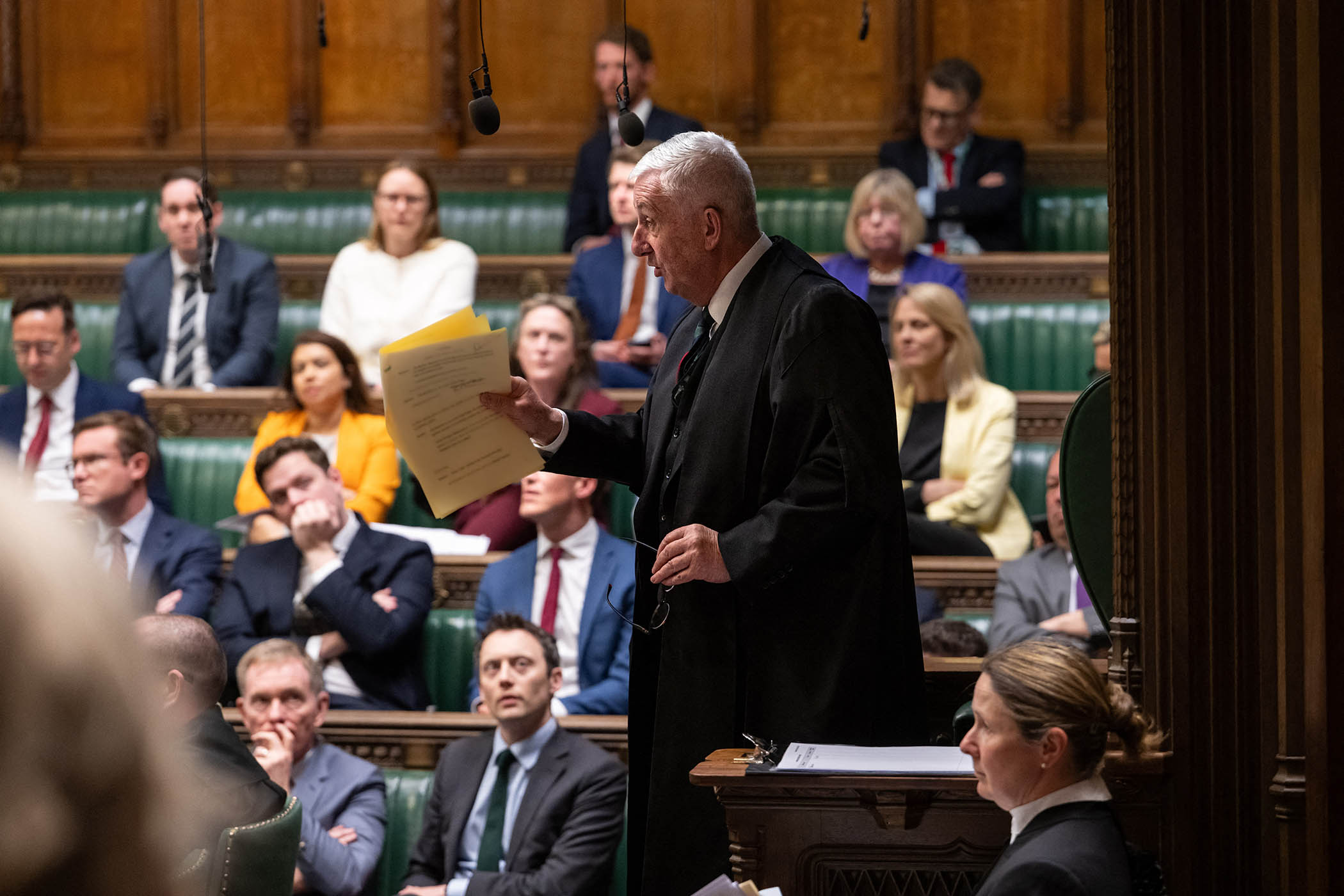


What is the way ahead for the assisted dying bill? (“MPs seek to revive assisted dying bill in face of Lords filibustering”, 26 April). The simple route is to await the ballot for private members bills in the hope that a highly placed member will choose to revive the bill and take it through the Commons a second time with the prospect of the Parliament Act being used to pass it into law.
There are drawbacks. It relies on chance to determine whether the House of Commons is given an opportunity to assert its primacy. Detailed scrutiny is bound to be sterile when the bill’s sponsor is likely to resist any amendments in order to preserve the prospect of presenting it for royal assent under the Parliament Act. The bill would not reach the Lords until late in the session, leaving them little time to conduct the productive scrutiny that many peers still desire. If the bill is then presented for royal assent under the Parliament Act, it would include acknowledged imperfections.
There is an alternative, which would acknowledge the public interest in maximum constructive parliamentary scrutiny of this bill. The government should allow a backbench procedural motion on to the Commons order paper, to provide for a prompt one-day debate on all stages of the bill, which could then be sent to the Lords in June, leaving ample time for scrutiny.
Sir David Natzler KCB, Clerk of the House of Commons 2015-2019,
London SE24
Tackle inequality
Ben Zaranko is somewhat blasé about UK wealth inequality (“Why we should mind the UK’s rising wealth gap”, 3 May).
Billionaire wealth increased 1,000% from 15 billionaires in 1990 to 165 in 2024 in the UK, according to the Sunday Times Rich List. In 2024 the richest 52 families in the UK had more wealth than the bottom half of the population.
This is dangerous because populism is fuelled by income and wealth inequality, and social cohesion is eroded. Wealth inequality also distributes political power unequally,enabling elites to use their wealth for influence.
Competition rather than collaboration dominates, increasing insecurity, isolation and chronic stress. Wealth and income inequality also lead to more discrimination and exclusion of people already in the margins, deepening their vulnerabilities.
Wealth inequality is even more intractable than income inequality because wealth can be passed down through generations and produces its own income through interest, capital gains, dividends and rent. It should be but isn’t sufficiently or progressively taxed.
Newsletters
Choose the newsletters you want to receive
View more
For information about how The Observer protects your data, read our Privacy Policy
Reducing inequality should be a priority, not an afterthought. Government needs a comprehensive, well-planned, strategically implemented and adequately budgeted, action plan. The wellbeing of people and planet long-term must be the aim of our economic system.
David Murray, Wallington, Sutton
UK’s dirty linen
The Magdalene Laundries in Ireland were a terrible scandal, but it is easy to overlook that the UK had its own version – the long-stay hospitals (“‘The ‘banal brutality’ of the Magdalene Laundries’”, 1 May).
The British system was not underpinned by the church, as in Ireland, but run by UK hospitals (ex-asylums) under the NHS and its predecessors. Unlike the laundries, which took only girls and women, the UK institutions incarcerated both genders.
Families would sometimes hand their children to the authorities, who were often held until old age.
As in Ireland, British young women were often held due to some perceived moral shortcoming. Sometimes girls and boys ended up in the institutions because of speech impediments or conditions like epilepsy, or through family circumstances such as poverty.
But there is a significant difference between Ireland and the UK. In Ireland, the laundries are well-known, while here the hospitals are a largely unacknowledged fact in our history.
Terry Philpot, Limpsfield, Surrey
Start EU talks now
While I support the UK rejoining the EU in principle (“Starmer must be bold on EU re-entry”, 3 May), the government must not repeat the mistake of asking the public to vote before terms have been agreed.
Both the EU and the UK will benefit from the UK rejoining. As it stands, the EU has an incentive to offer the UK favourable terms in order to encourage the electorate to vote to rejoin. However, if the UK were to vote to rejoin before terms were agreed, it would be forced to negotiate from a position of weakness, as it did after Brexit when the government was committed to leaving and the EU was incentivised to negotiate an unfavourable deal for the UK so as not to encourage others. Therefore, the government should start negotiations now and put it to the electorate after favourable terms have been agreed.
Robert Saunders, Balcombe, West Sussex
A frame of mind
I can understand people getting bored when Mark Allen and Wu Yize took an hour and 40 minutes playing one frame of snooker (“Cue boredom… Crucible crowd left yawning by snooker’s slowest frame”, 3 May).
It reminds me of a wonderful quote from the Guardian’s TV critic Nancy Banks-Smith that snooker was like “chess with balls”.
And it is!
That said, the final part of the match was riveting, as the 22-year-old Chinese player won on thelast frame.
David Reed, London NW3
Quelle surprise
I’m astonished that you have categorised as “important and surprising” the news that Nigel Farage failed to register a £5m donation from a crypto billionaire (Matrix, News, last week, print only). If ever a news item came as no surprise…
Anne Cowper, Swansea
Photograph by House of Commons / AFP via Getty Images