

The final moments of this year’s Eurovision song contest on Saturday were tense. Bulgaria’s entry, the club banger Bangaranga by Dara, won the jury’s favour before the popular vote unexpectedly vaulted Israel’s Noam Bettan into first place.
Boos erupted in the Wiener Stadthalle. Victoria Swarovski, the Austrian model co-hosting the broadcast, tried in vain to quiet them. “We’re moving on,” she said.
In the end, Dara secured a whopping 516 points – one of the highest scores in recent competition history – along with Bulgaria’s first-ever Eurovision win.
While the results may have come as a relief to some in the audience, they will almost certainly make things worse for Eurovision. The five-day finale was marred by protests over Israel’s participation as well as the largest boycott in the 70-year history of the world’s most-watched musical event.
Spain, Iceland, Ireland, the Netherlands, and Slovenia – all members of the European Broadcasting Union (EBU) which organises the event – refused to sponsor contestants or even air the program. Instead, Slovenia’s RTV showed a documentary series called Voices of Palestine. Ireland aired reruns of Father Ted. Although total viewer numbers have yet to be released for Saturday’s finale, they are expected to be well below the 166m who tuned in last year. The UK saw a drop of more than 22%.
Four protesters were dragged out of the auditorium last Tuesday after they interrupted Bettan’s performance with chants of “Stop, stop, stop the genocide!” On Friday, several hundred people gathered in Maria Theresa Square for an alternative concert featuring the Palestinian artist Ahmed Eid and the Austrian band Left Overs. There were also speeches for Nakba Day, which commemorates the 15 May 1948 expulsion of Palestinians from their land.
By Saturday, security at the Stadthalle was tighter than ever as a march shut down several busy streets in Vienna through the afternoon, though the protests remained peaceful.
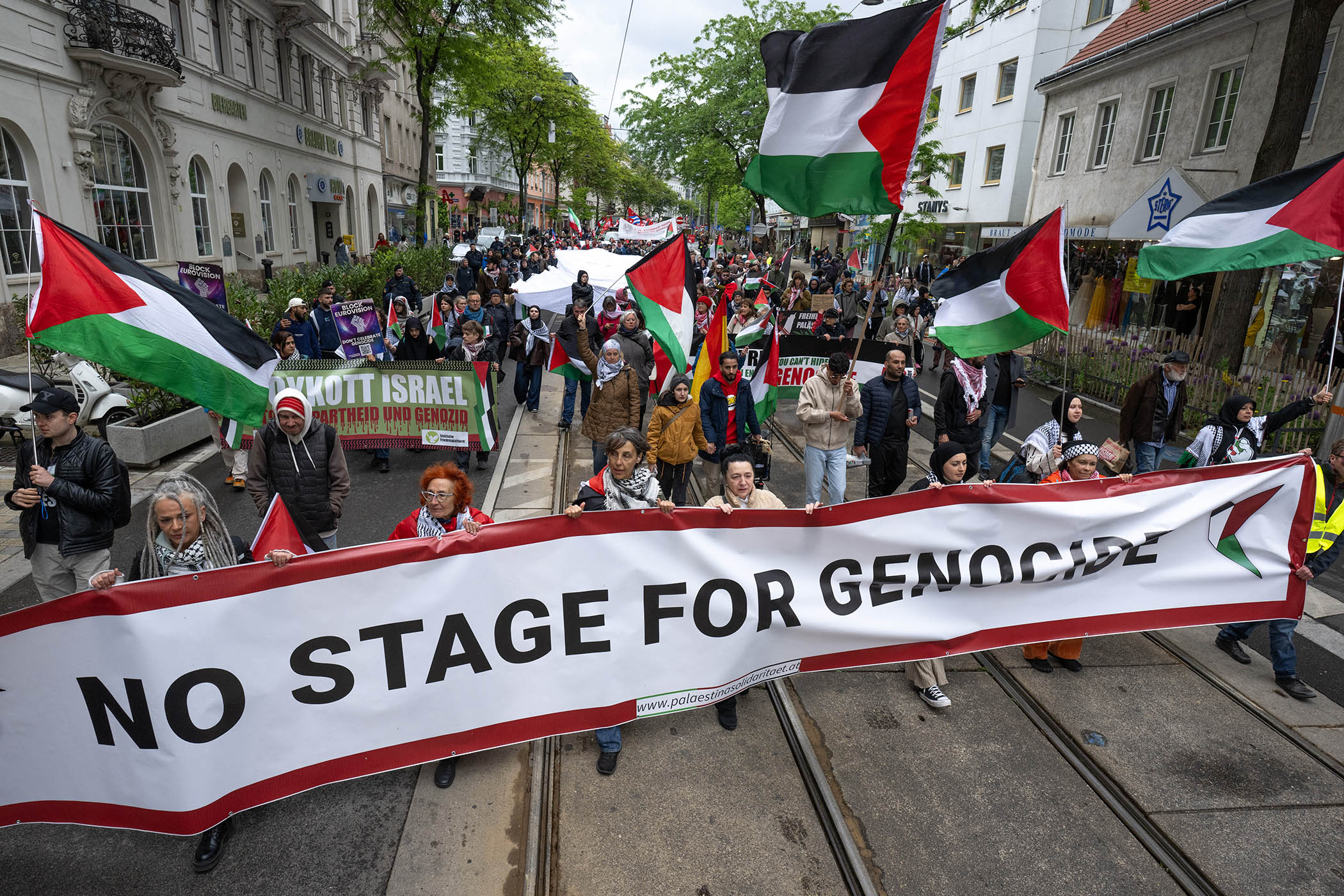
People take part in a demonstration against Israel’s participation in the Eurovision Song Contest, in Vienna, Austria
The discontent is not limited to the war in Gaza. Fans have also alleged that Israel has conducted a years-long vote-rigging campaign. A New York Times investigation revealed last week that since the 7 October attacks, senior Israeli officials have pressured the EBU to keep them in the running for Eurovision and spent at least $1m on advertising that urged fans to cast all their 20 votes in Israel’s favour. Israeli prime minister Benjamin Netanyahu personally shared the ad on Instagram. While public broadcasters fund Eurovision, governments are not supposed to interfere in the voting process. “The Israeli government has co-opted Eurovision,” Stefan Jon Hafstein, the chairman of Iceland’s public broadcaster, said.
Voting data suggests the ad spends may have made a difference: Israeli contestants won the popular vote for the two previous years in several countries where public perceptions of Israel are at historic lows. Yuval Raphael shocked judges by placing second last year after securing a majority vote share from Spain, which recalled its ambassador to Tel Aviv in March.
While Eurovision has not yet released voting data for this year, Noam Bettan’s second-place finish is unlikely to alleviate these suspicions. The Franco-Israeli singer’s Michelle, a French ballad about a toxic relationship that has been interpreted as a veiled jibe at Europe’s relationship with Israel, was not regarded as a top contender during semi-finals.
Newsletters
Choose the newsletters you want to receive
View more
For information about how The Observer protects your data, read our Privacy Policy
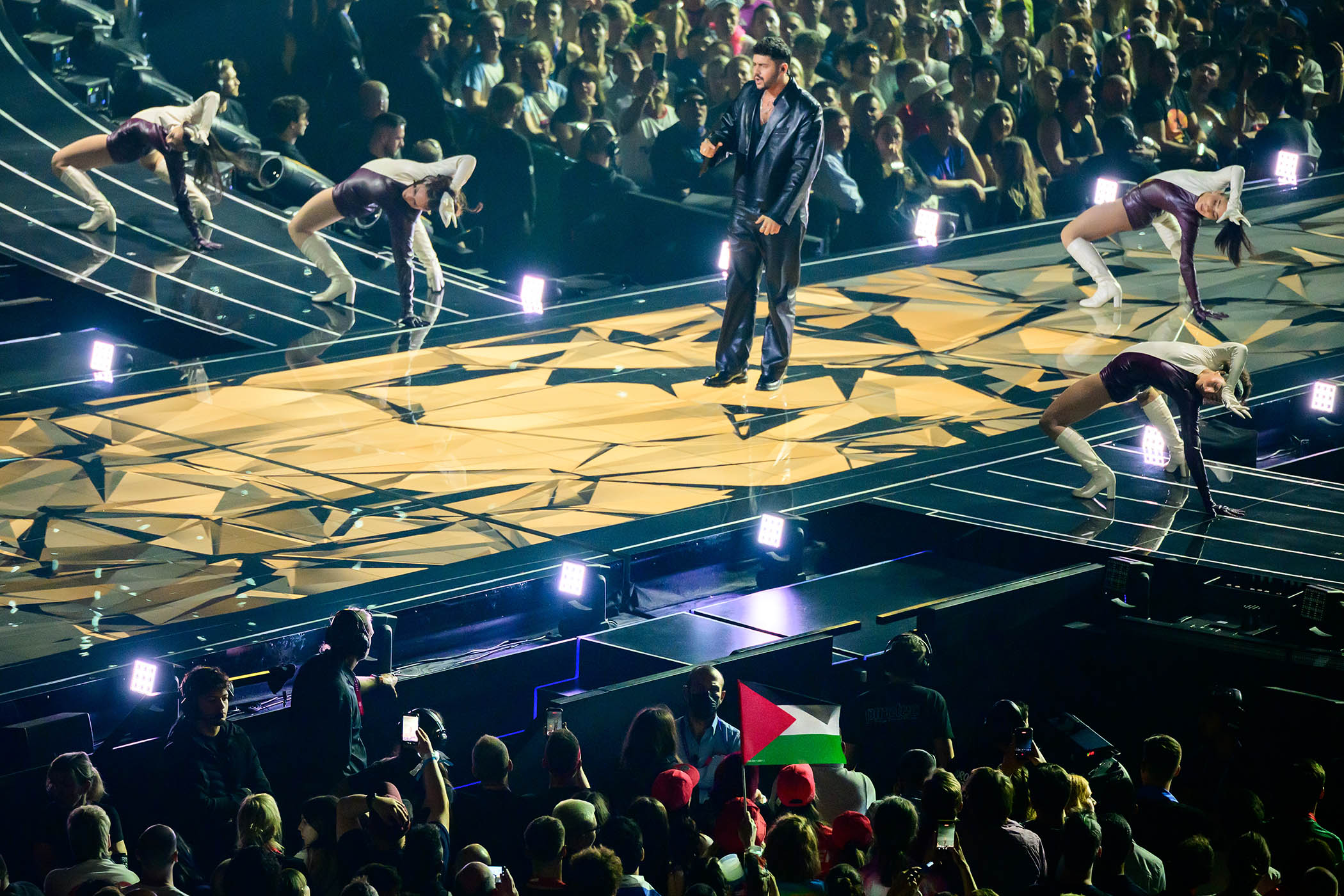
Spectators display a Palestine flag during the performance of Noam Bettan representing Israel
“Had we won, it would have broken Eurovision,” members of Bettan’s delegation told Ynet, an Israeli news outlet. “Second place is a win for us.”
Some may contend that Eurovision is already broken. The EBU stands to lose at least €515,000 in fees alone as a result of this year’s boycott. On X and Reddit, calls to review voting procedures delve into conspiracy theories about the Israeli company Moroccanoil, the lead sponsor of the song contest.
This is not the first time national broadcasters have sat out the competition. When Spain won in 1968, Austria refused to send a contestant to the final in Madrid in protest of the Franco dictatorship. After Turkey invaded Cyprus in 1975, Greece quit the contest; the following year, Turkey boycotted instead.
The EBU’s seven Arab and North African members have refused to field candidates ever since Israel first joined in 1973. Broadcasters from Algeria, Egypt, Jordan, Lebanon, Libya, Morocco and Tunisia customarily cut to advertising during Israeli performances. Télé Liban withdrew its lone contestant in 2005 after the EBU mandated that it air the entire competition, which would have broken Lebanese law.
Palestine has observer status in the EBU. In 2007 the Palestinian Broadcasting Corporation put in a bid to participate in the contest, but was rejected and has not tried again since. Australia, another observer, fielded its 11th contestant this year: Sydney-born pop star Deltra Goodrem, who came fourth on Saturday.
It may be a long time before Israel and its critics take the stage together. Michael Ostrowski, the finale co-host, seemed to acknowledge as much before the crowd in Vienna. “To the countries that didn’t participate,” he said, “we miss you – and we want you back.”
Photographs by Georg Hochmuth & Joe Klamar/AFP, Christian Bruna/Getty Images