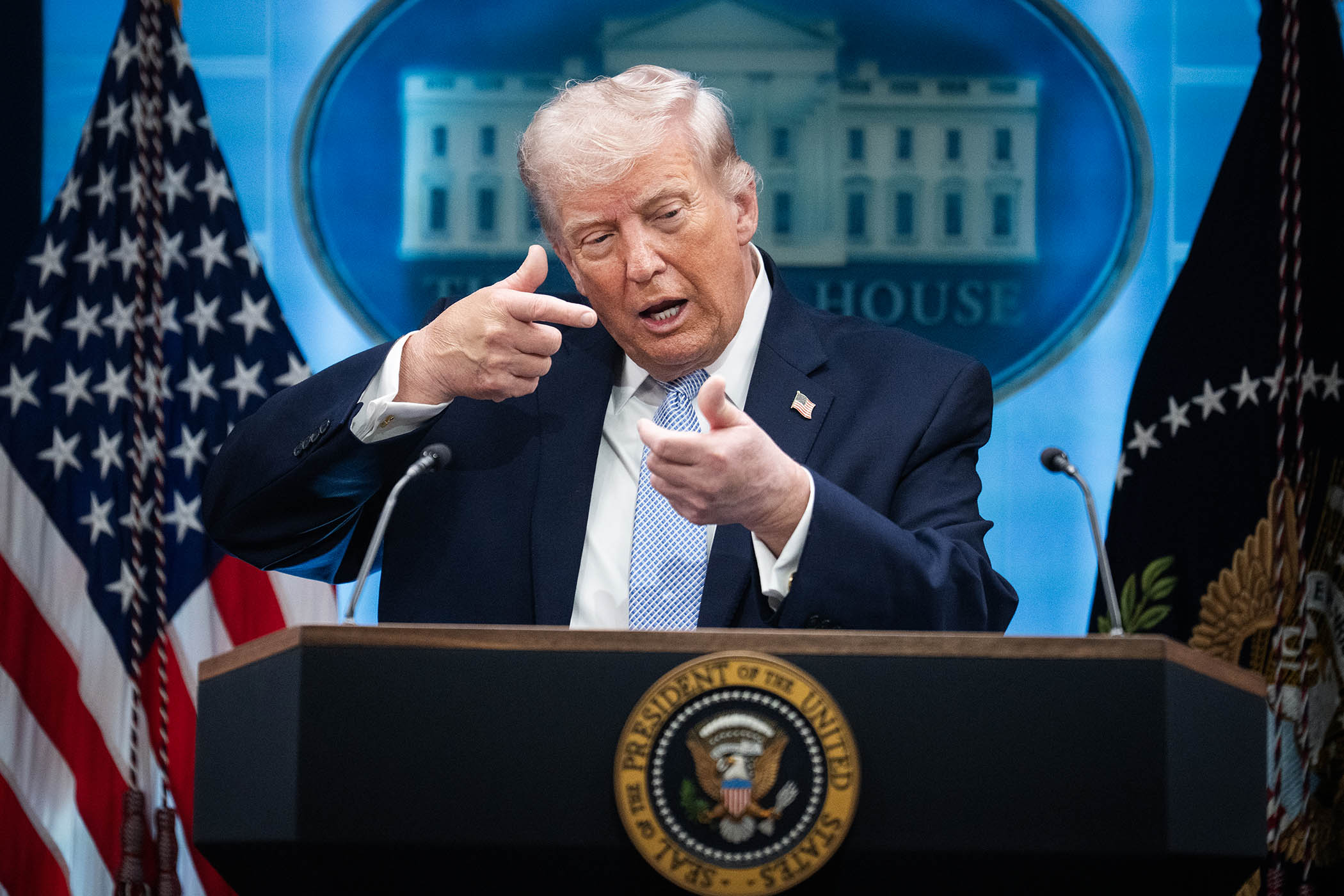

Geopolitics is often understood as a game of multi-dimensional chess in which players deploy simultaneous strategies to influence outcomes. Donald Trump prefers to see it as a high-stakes poker game. In his view, Ukraine “doesn’t have the cards”, the US has “much bigger and better cards” than China and it also has “every single” card in its trade dispute with Canada.
Yet ahead of Saturday’s peace summit in Islamabad to decide the future of the war in the Middle East, it is Iran that appears to have the stronger hand.
The regime has not only withstood more than a month of bombing but also discovered its ability to wreak havoc on the global economy in closing the Strait of Hormuz. Meanwhile, Trump’s bluffs have been exposed. Twice he has threatened to bomb Iran’s power plants and take the country “back to the stone ages” if the waterway remains closed. Twice he has climbed down.
This hasn’t stopped his administration from taking a victory lap since Tuesday’s ceasefire, which gives both sides two weeks to find a way to end the war. The Iranian regime, whose unconditional surrender Trump initially demanded, has put forward a 10-point proposal that includes war reparations and the withdrawal of US forces from the region. But defence secretary Pete Hegseth says the US has scored “a capital V military victory by any measure”.
The factors underlying the war are unresolved. The Iranian regime was decapitated but remains entrenched, more hardline than ever. It retains the ability to strike its neighbours – and also retains its stockpile of enriched uranium. Restarting tanker shipping through the Strait of Hormuz – which was open before the war – has become the main focus of American diplomacy. But few ships have been willing to risk the passage since the ceasefire was announced.
“It’s really difficult to tally up what has happened and portray it as any kind of victory,” said Michael Wahid Hanna, US programme director at the International Crisis Group. He notes that “there are no real answers” to the issues that were under discussion before the war, including Iran’s missile programme, its nuclear capabilities and its support for proxies.
Having played its trump card of overwhelming military force, “the US finds itself in a demonstrably weaker place today than when it began the conflict”, added Hanna.
The US position is not helped by the sense of chaos and uncertainty that has characterised the truce. Trump initially said that he had accepted Iran’s proposal as a “workable basis on which to negotiate”. A day later his spokeswoman said “it was literally thrown in the garbage”. The US has its own 15-point plan, which reportedly includes an end to Iran’s nuclear programme and a rigorous inspection regime. The US says Iran has agreed. Iran hasn’t.
It's not unusual for sides to lay down maximalist demands as the starting point for negotiations. But Iran, the US and Israel can’t agree on the parameters of their truce. Pakistan, which helped broker the ceasefire, said the deal included Lebanon. Israel claimed it didn’t and yesterday launched its biggest bombardment to date in its war against Hezbollah, killing at least 254 people. In the Gulf, Saudi Arabia, Kuwait, the UAE, Qatar and Bahrain all reported Iranian attacks after the truce.
To convincingly claim victory, Trump will have to get a better deal than the one achieved by Barack Obama in 2015. Under that agreement, Iran agreed to rip out most of its uranium centrifuges and surrendered 97% of its nuclear stockpile – without a war that has cost a billion dollars a day, killed thousands of civilians and used up precious American munitions.
The US negotiating team will be led by vice-president JD Vance, Trump’s special envoy, Steve Witkoff, and Trump’s son-in-law, Jared Kushner. Witkoff and Kushner led the talks with Iran that preceded the war. According to a New York Times report, they told Trump they could get some sort of a deal, but it would take months. Emboldened by the success of the special forces raid to snatch Venezuelan president Nicolás Maduro in January, the president chose the quick option of force, believing he could pummel Iran into making concessions.
He still might. Iran’s economy has been battered by the war, and there is the threat of further bombing if it doesn’t make a deal. But the negotiations are likely to be protracted. And it doesn’t help that thousands of experienced state department staffers have left the agency due to Trump’s cost-cutting drive, depriving US foreign policy of crucial expertise.
“I did nuclear negotiations with Iran and it took, from start to finish, five years,” said Alan Eyre, a former US diplomat who helped secure the 2015 deal. “Three of those years were a perfunctory and performative waste of time. About two years of that was actually real negotiating, and that was with experienced, technically savvy US negotiators.”
Eyre added: “I don't care whether it's Mr Witkoff, Mr Vance or Mr Kushner or vice president Vance. These are not guys who are going to stay in a room for weeks on end, thrashing out details or text about a comprehensive negotiation.”
Trump faces a choice: stick with the talks or twist, by escalating the bombing campaign. The third option is to fold, by declaring victory and walking away. This would leave the regime in de facto control of the Strait of Hormuz and in a stronger strategic position than before the war.
“I think President Trump just wants the problem to go away,” said Eyre. “By all indications, he’s bored with the topic. He wanted to solve this as a legacy issue, and it didn't happen.”
Photograph by Tom Williams/CQ-Roll Call Inc via Getty Images
Newsletters
Choose the newsletters you want to receive
View more
For information about how The Observer protects your data, read our Privacy Policy