
For many weeks past, hundreds of millions of people, including my wife and I, have gone to bed at night holding our breath, not in fear of what Russia or China or North Korea or Iran – our enemies – might do to us all, but instead of what new enormity the United States – our most cherished friend – might inflict on the world. We should not for a moment lose our sense of incredulity about this upending of history.
Dr Kori Schake of the American Enterprise Institute writes in a newly published paper for the International Institute of Strategic Studies (IISS): “Even if American power can withstand the Trump era, the harm the US is inflicting on itself and its allies will take a generation to repair, and we will be lucky to get through this period without an international economic collapse or a world war.”
Two weeks ago I was among a host of people sincerely frightened that President Trump might make good on his deranged rhetoric against Iran by unleashing a nuclear weapon. This did not happen. We were permitted a brief surge of relief, such as the world felt after Russia’s leader Nikita Khrushchev announced in October 1962 that he was withdrawing Soviet nuclear missiles from Cuba. Today, however, the on-off ceasefire between the US and Iran is again tottering amid the bewildering Hormuz blockade. It remains desperately uncertain where this story ends.
Discounting the unconvincing Lebanon ceasefire, President Trump appears to have licensed Israel to sustain its bombardments of Hamas and Hezbollah, together with Israeli settlers’ violent expansionism on the West Bank, until Benjamin Netanyahu is satisfied that 5 million Palestinians across the region have bowed the knee in submission to his country.
Meanwhile in Europe, Vice-President JD Vance strove in vain to preserve the elective dictatorship of Hungary’s Viktor Orbán, a friend of Russia and avowed foe of Ukraine, while making new attacks on the European Union. The Trump administration brands the EU as the enemy of the United States. Indeed, its rhetoric towards America’s traditional allies is consistently abusive, while Russia and its leader, Vladimir Putin, are treated as prospective partners. China is the object of fewer insults from Washington than Ukraine receives.
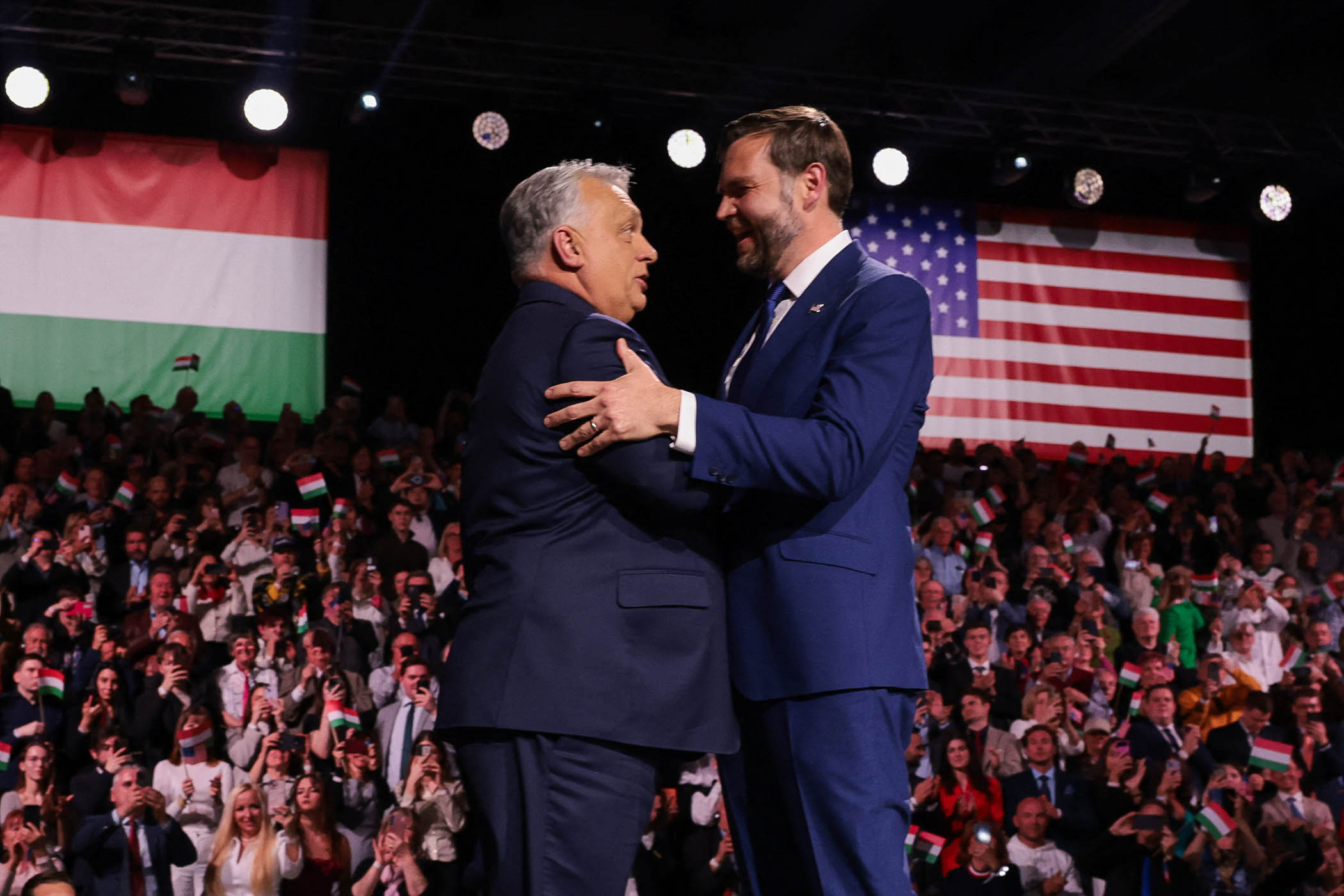
JD Vance joins Viktor Orbán for a “Day of Friendship” event in Budapest on 7 April
Trump has renewed threats to withdraw the US from Nato as a punishment for its European members’ refusal to join his assault on Iran. In truth, it scarcely seems to matter any longer whether American departure from the alliance is made explicit.
Almost nobody in Europe today supposes that if the Russians attack – for instance – the Baltic States, the US administration will lend succour. Europe has feared for many months that Trump will pull the plug on Ukraine, and that still seems a likely development.
Meanwhile hundreds of millions of people around the world are starving, people from whom the US has reduced aid or absolutely withdrawn it. Trump and his people do not even pretend to do compassion. He has ordered the US to withdraw from 31 United Nations bodies including the UN Democracy Fund and the Office of the Special Representative of the Secretary-General for Children and Armed Conflict. He has withdrawn support for measures against infectious diseases both at home and abroad.
Stripped of resources, humanitarian organisations are slashing staff and food aid, when 150 million people are estimated to be homeless worldwide and deaths from conflict violence are at an 18-year high. The huge crisis in Sudan, riven by civil war, is being met with only a fraction of the aid its people need.
Since January 2025 our world has been wantonly plunged into a maelstrom. Americans, for so long the perceived more-or-less good guys, have become the fount of economic crisis, military menaces and planned disorder such as Russia or Iran would be quite incapable of generating.
Newsletters
Choose the newsletters you want to receive
View more
For information about how The Observer protects your data, read our Privacy Policy
Civilised people through the centuries have applauded kindness as the greatest of human virtues. Yet this president and those around him are driven by hatred towards a range of chosen enemies that lengthens every day: immigrants and universities; media and US Democrats; the European Union and Iran; Cuba; armed forces leaders who disagree with him; judges who challenge his will; critics of his White House ballroom and Miami presidential library; foreigners who wish to curb the excesses of social media companies with which he has links; former aides who criticise him; Ukrainians who refuse to surrender territory; Palestinians unwilling to bow to the will of Israel; domestic racial minorities; advocates of action to mitigate climate change; and – most recently – the pope.
Most of us recognise the necessity for co-existence with people from whom we differ on public issues. No responsible person characterises political opponents as evil – enemies of the people – as does Trump. He did not create the climate of hate which now pervades the United States, but he has institutionalised it.
He appears to have no sense of the rival merits of good and evil. For all his pretensions to religious sentiment, and indeed to Messiah status, he is bereft of a moral compass. The keys to a survivable world are order and stability. These are what the giants of late 20th century US foreign policy-making, such great public servants as Dean Acheson, George Kennan and Averell Harriman, devoted their careers to advancing.
Walter Isaacson and Evan Thomas wrote in their 1986 book on these people, The Wise Men: “In their minds there was a link between free trade, free markets and free men. The fact that the US would be the prime beneficiary of a system of open global markets was clear to [them], but that did not make the goal any less sincere.
“Much of what they advocated was in fact largely selfless: the notion that Europe should be protected from Soviet domination had less to do with a desire for lucrative markets than with an affinity for the traditions and aspirations of Europeans.” The old post-1945 American elite were men of principle, understanding and courtesy.
Trump, Vance and their friends cannot understand that such people in successive US administrations not only built a rules-based post-second world war order that benefited the west and indeed the world, but one that also hugely profited the United States.
Trump in January 2025 inherited the richest and most successful nation in human history, and one that – for all its imperfections – commanded respect and affection in many countries. Those of us who live in different societies might not want to be like Americans – especially in their crazed obsession with guns – nor indeed to live in America. But we have been profoundly grateful for American leadership.
We regarded the nation’s stupendous wealth as a fair reward for what it has given to the rest of us, above all a measure of security in a dangerous world. It might not be true to brand the United States unequivocally as a Good society – think of Vietnam and Iraq. But we were in no doubt that it was a better one than either of the superpower alternatives.
Today, that is no longer true. Almost every opinion poll in a host of the countries shows that a majority of people hold a negative view of the US. We are running scared of what its more or less unhinged leader may do next, either by seeking to impose a dictatorship at home, or by unleashing further violence abroad.
We read serious American commentators who express fears that the Republicans will either seek to cancel November’s mid-term elections, or manipulate them to cling to congressional power. Amid speculation that Trump himself may not complete his term of office, it is scarcely reassuring to see JD Vance next in line, committed to the same pernicious policies, the same hate-filled agenda.
The world is perhaps most shocked by the apparent breakdown of the US constitutional system. Congress is supine, the US supreme court acquiescent, amidst presidential declarations of war, imprisonments of children, deportations to foreign concentration camps without due process, dismissals of armed forces chiefs, public profanity of a kind no European democratic leader would dare to indulge and expect to retain public office.
Many years ago when I lived in the US, I often heard it wryly said that if the 1787 Constitution was so marvellous, why had no other nation ever copied it? Now we know. It is dependent upon the conduct in power of reasonable people, recognising bounds of decency and discretion. In the absence of these things, there are no effective checks and balances.
The rest of us can only stand by and recognise the extraordinary, almost unbearable truth: the US is no longer our friend, and stands on the cusp of becoming our enemy. Dr Kori Schake concludes her IISS paper with a warning – penned before the assault on Iran – that Americans “may end up paired by historians with the collapse of the Soviet Union in the pace and significance of its self-destruction”.
This seems an overstatement, because whereas the Soviet Union was an economic and industrial basket case, within its own shores America remains an economic and technological power house. But Dr Schake must be right that on the world stage the range of nations that view the United States as a friend is shrinking with extraordinary rapidity.
Photographs by Timothy A Clary, Jonathan Ernst / POOL / AFP via Getty Images