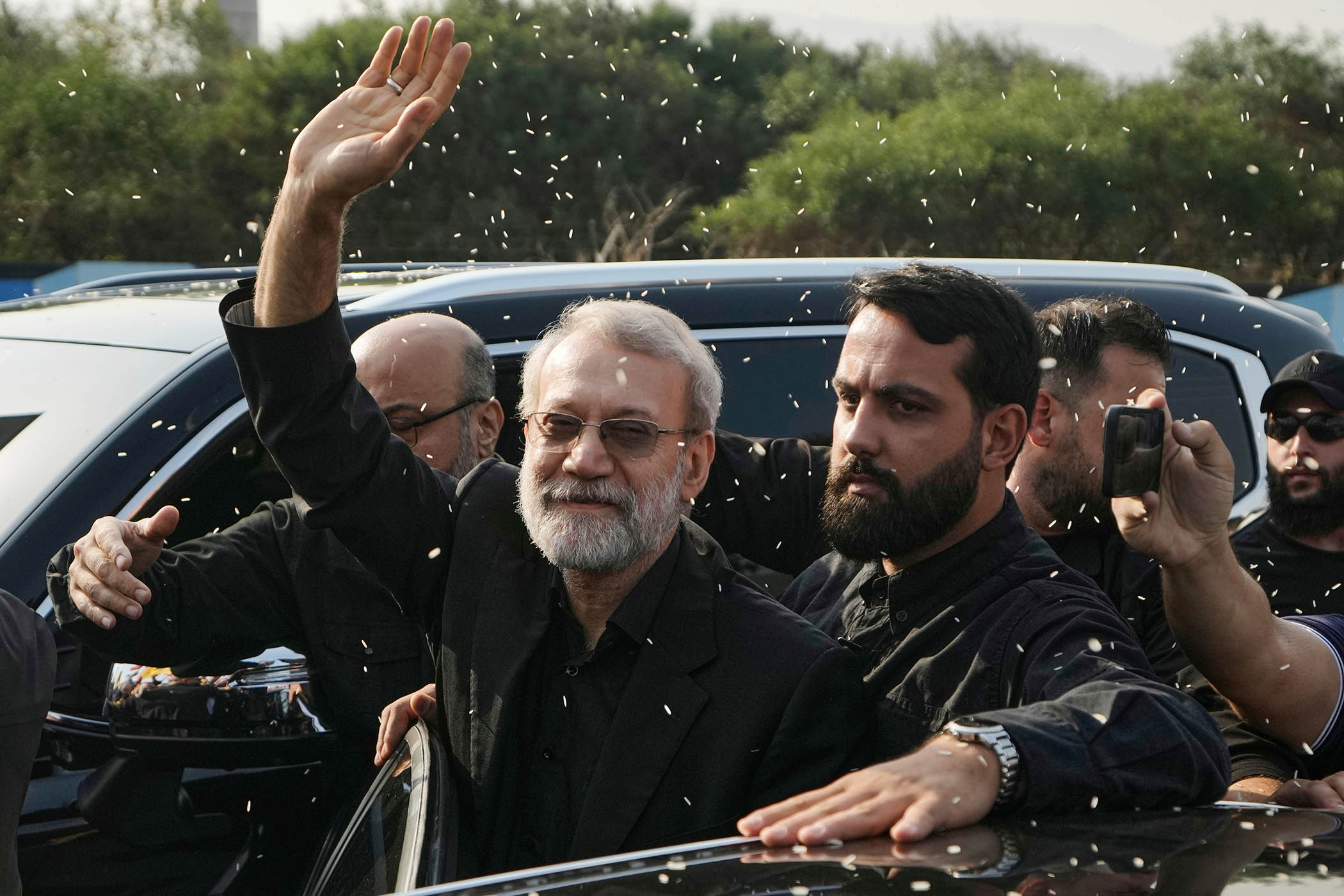
The morning after Iran's supreme leader Ayatollah Ali Khamenei was assassinated, Ali Larijani appeared on state television – marking himself as the face of regime continuity. Calmly and carefully, Iran's security chief described how the regime intended to fight back, while issuing a menacing warning against domestic dissent. When groups of regime loyalists took to the streets for the annual Quds day rally, Larijani walked among them unbowed in a black zip-up jacket, barely tilting his head to acknowledge the threat from the skies above. Five days later a coffin with Larijani's portrait on was paraded through the streets of Tehran for an elaborate state funeral after he was targeted by an Israeli airstrike.
Larijani has been called a powerful regime insider, a pragmatic force marked as a potential negotiator among other hardliners, and an essential bridge between the Iranian regime's sprawling security and civilian factions. Washington issued sanctions against him earlier this year, accusing him of "coordinating" the Iranian regime's bloody crackdown on anti-government protests: tens of thousands were shot in the streets according to the United Nations special rapporteur on Iran. As challenges to the regime surfaced from within before raining down from the skies above, decapitating its leadership and targeting swathes of its security forces, Larijani appeared ready to walk through the smouldering wreckage to ensure the survival of the system he gave his life to. His killing, instead, marks a turning point.
Iranian officials have long claimed that the loss of any single figure is irrelevant, and that even Ayatollah Ali Khamenei was ultimately replaceable. Still, his son and successor Mojtaba remains hidden from view while Larijani gave interviews and marched among the public. Foreign minister Abbas Aragchi denied that Larijani's killing – arguably the most consequential for Iran since the elder Khamenei was killed a little over two weeks ago – would be any more impactful in an interview with Al Jazeera. The Americans and Israelis striking to decapitate the uppermost levels of Iran's regime had simply failed to understand that others would fill their places within the web of security and political institutions, he claimed. "The presence or absence of a single individual does not affect this structure,” he said. In Aragchi's view the regime can and will endure, even after losing a man who had become one of the faces of its attempts to fight back.
Others said that while Larijani's position heading Iran's supreme national security council is easily filled, his specific blend of insider experience and reputation as a negotiator is tough to replicate. "In my view his killing is not game over, but it's a blow to the system," said Farzan Sabet, an expert on Iran at the Global Governance Centre within the Geneva Graduate Institute. "He was a versatile figure who could move between factions and had held many senior positions. He had extensive networks including within the Islamic Revolutionary Guard Corps [IRGC] and hardline political factions… I think these things can be quite damaging to the system in a moment of acute crisis such as this one."
Larijani's visibility, Sabet added, had proven essential during wartime as a way to signal the regime's endurance, particularly within a supreme leader yet to publicly surface since being appointed. "There are some who argue that everyone in Iran is replaceable, which is correct, but it is also a country of 90 million people which has to be governed," he said.
Maziyar Ghiabi, who heads the centre for Persian and Iranian Studies at the University of Exeter, pointed to Larijani's trajectory as a powerful servant of a repressive regime: a calculating career politician with a doctorate in philosophy, Larijani authored several books on the philosopher Immanuel Kant. Once an IRGC commander, Larijani hailed from an influential clerical family regarded as a political dynasty. As head of Iran's state broadcasting organisation, he introduced televised forced confessions – a practice tied to the execution of accused dissidents. A former nuclear negotiator with one unsuccessful presidential run and two other presidential bids blocked by regime institutions, Larijani was brought back into the fold after the 12 days of war between Iran and Israel last year.
“With Israel’s assassination of the head of supreme security council Ali Larijani, the Islamic Republic of Iran loses one of the old guard, charismatic figures who had been at the heart of state matters over the past four decades," said Ghiabi. Larijani, he added, was "a figure well-placed for negotiating and balancing various factions within Iran’s political landscape", one who could have proven essential to convince other powerful regime elements to negotiate when the time came.
Unsurprisingly, Larijani is likely to be replaced by someone even more hardline, further tipping the balance of power towards a core of extreme hardliners operating at the regime’s highest levels. Sabet said that despite Larijani's reputation as a negotiator, his public refusal to engage with Washington had led Israel and the US to add his name to the list of targets. But Israel's move to enact a similar model of decapitation of senior leadership as it has done against Hamas and Hezbollah – both non-state actors, unlike Iran – risked the emergence of a regime looking only to strike its enemies and with a permanent aversion to negotiations.
Larijani will be replaced but the sense of threat remains for Iran’s regime – and the people forced to live under it. His successor may be unwilling to walk the streets as the late security chief dared to do, but the regime still needs leaders willing to show their faces. Sabet said this spelled a dilemma for those who remain. "How can you run a country if you can't protect your top leaders?" he asked. "How can you protect the country if you can't protect yourself?"
Photograph by Bilal Hussein/AP
Newsletters
Choose the newsletters you want to receive
View more
For information about how The Observer protects your data, read our Privacy Policy