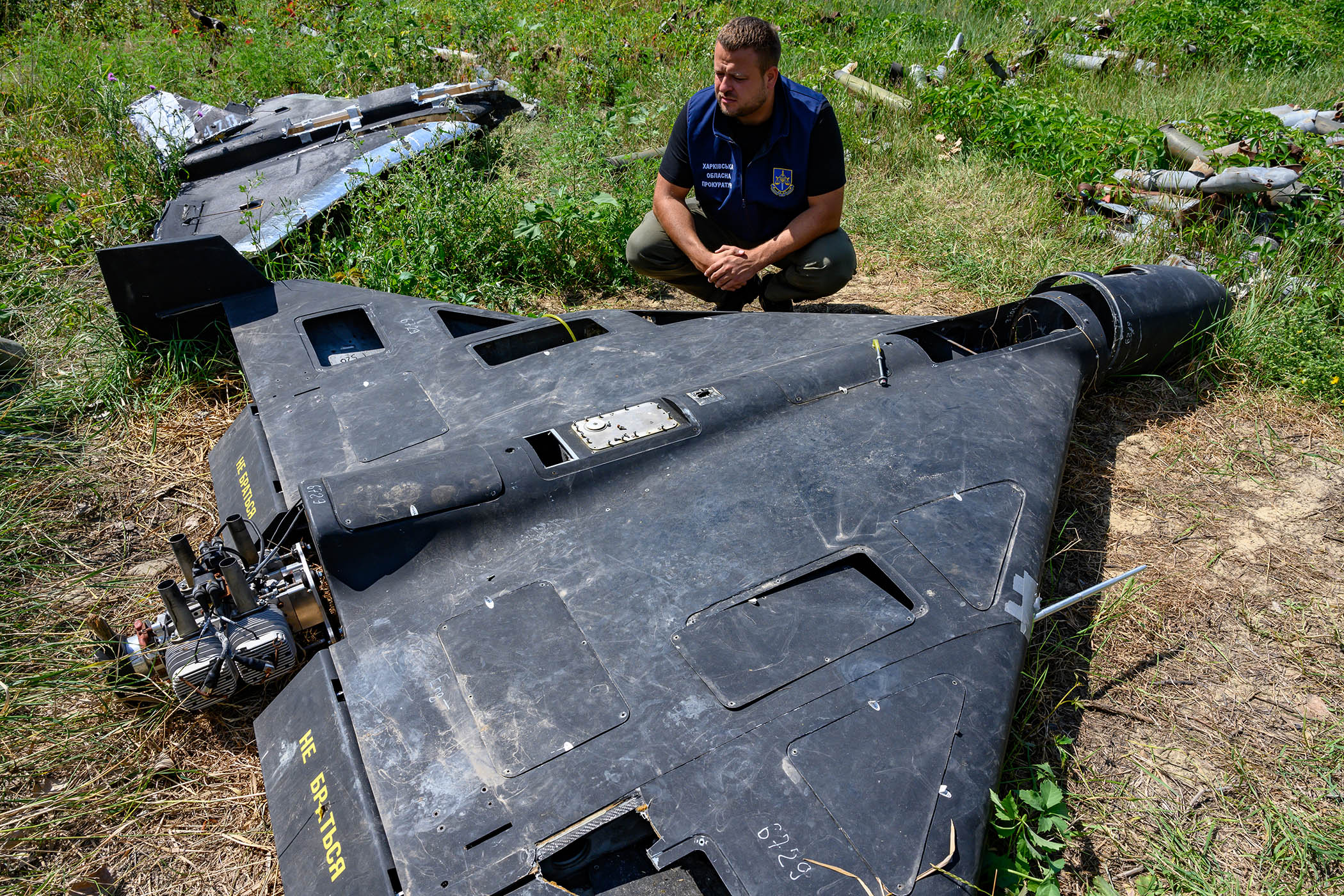
The drones fly in low, ducking radar detection as they home in on a target. Often you can hear the lawnmower-like noise of a Shahed drone’s engine before you see it swoop down and explode on impact.
For four years, Ukraine has grappled with the growing threat posed by the Iranian-designed drones that Russia throws at its stretched air defences night after night. Now Gulf Arab countries are confronting the same challenge for the first time as Iran unleashes hordes of Shahed drones across the region in response to the war the US and Israel started last Saturday.
In the first five days of the war, Iran launched more than 1,400 drones at the United Arab Emirates, Qatar, Bahrain, Saudi Arabia and Kuwait, along with cruise and ballistic missiles. In one video a drone is seen crashing into a radar dome at a US Navy base in Bahrain. A fire broke out near the US consulate in Dubai on Tuesday as a result of a drone attack. The president of Cyprus said a Shahed-type unmanned aerial vehicle was used in an attack on a British base on the island over the weekend.
The relatively cheap and easily produced drones have emerged as a cornerstone of Iran’s strategy of raising the costs of the war for the US, Israel and their allies. While Gulf countries have successfully shot down the majority of the drones, they are running down their stocks of precious interceptors in the process.
At an estimated $20,000 to $50,000 each, a Shahed drone costs a fraction of the interceptor missiles used to destroy it. Those can cost anywhere between several hundred thousand dollars for an anti-air missile to $1m for a Patriot missile and as much as $12m per interception for Thaad (Terminal High Altitude Area Defence) missiles.
“Over time the cost asymmetry really starts to bite,” said Steve Feldstein, a senior fellow at the Carnegie Endowment for International Peace in the Democracy, Conflict, and Governance Program. “This is just totally unsustainable.”
Beyond the costs, interceptors are scarce. Only 50-60 PAC-3 Patriot anti-ballistic missiles are produced per month by the US, Ukraine’s President Volodymyr Zelensky said.
“No Patriot air defence systems – even with as many batteries as the Middle East has – could withstand the number of Shaheds that Ukraine handles today. Why? There aren’t that many missiles,” said Zelensky. “Yes, Middle Eastern countries are wealthy, they have stockpiles, they have a lot, but eventually it all runs out.”
It is unclear how many Shahed drones Iran has stockpiled, or whether it can continue producing them under attack. But analysts say it may have tens of thousands still at its disposal.
The basic Iranian Shahed-136/131s appeared in Ukraine’s skies during the first year of Russia’s invasion. Iran had previously used them in attacks carried out by its proxies in the Middle East.
Newsletters
Choose the newsletters you want to receive
View more
For information about how The Observer protects your data, read our Privacy Policy
After reaching a deal with Tehran to import Shahed drones, Russia began producing them domestically and has since deployed them in increasing numbers against Kyiv and other cities. Russian engineers have also customised the Shahed to make it more resistant to electronic jamming and more powerful warheads to inflict greater damage.
With a warhead of 36-50kg, they are less destructive than a missile but can still cause considerable damage and overwhelm air defences in combination with missiles and other projectiles.
Ukraine’s defenders parry the drones with a combination of heavy machine guns and anti-aircraft artillery positioned on rooftops, as well as air-to-air missiles launched from fighter jets. Increasingly, however, domestically produced interceptor drones are being used to combat the threat.
Oleksandr Kamyshin, an advisor to Zelenksy on strategic affairs said Ukraine was intercepting around 90% of Russian-made Shahed drones on average — primarily using interceptor drones. Interceptor drones destroyed more than 1,500 Russian drones of different varieties last month alone, according to Ukraine’s army chief General Oleksandr Syrskiy.
The UAE’s Ministry of Defence said on Wednesday it had intercepted 876 of the 941 drones fired at its territory since the start of the war, as well as 175 out of 189 ballistic missiles. All eight cruise missiles it detected were shot down.
After speaking with Gulf leaders this week, Zelensky said Ukraine was considering options to help in a way that wouldn’t weaken its own defence. “Ukrainian experts will operate on-site, and teams are already coordinating these efforts,” he said.
The Financial Times reported today that the Pentagon and at least one Gulf government were in talks to buy Ukrainian-made interceptors.
Meanwhile, the US itself is applying lessons from Ukraine in its campaign against Iran. US Central Command confirmed its attack on Iran on Saturday involved the first combat use of its own new low-cost Unmanned Combat Attack System, or LUCAS drone.
“These low-cost drones, modelled after Iran’s Shahed drones, are now delivering American-made retribution,” it said.
More from The Observer
Photograph by Scott Peterson/Getty Images