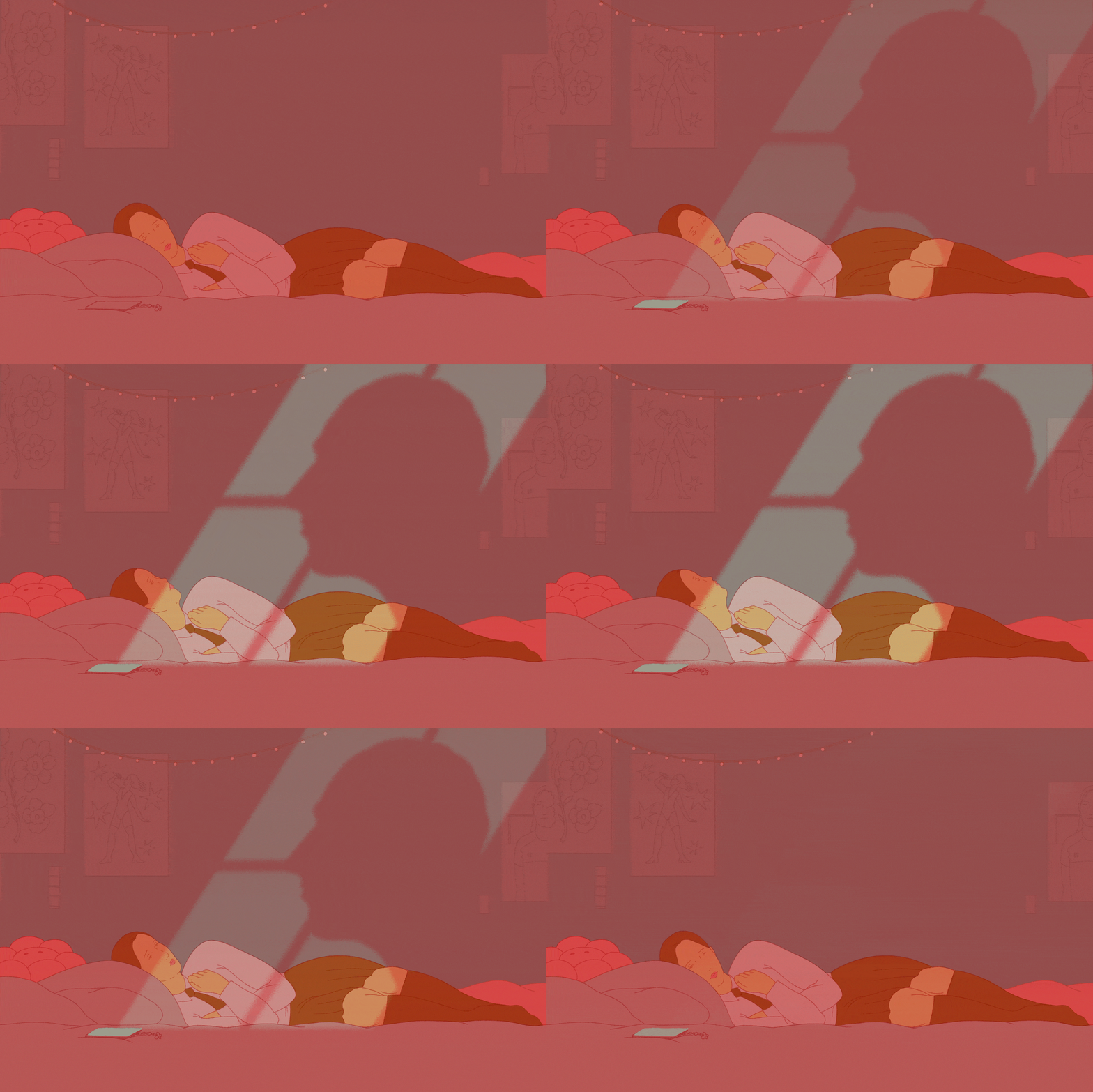


Jessie was 12 years old when she met someone new on Snapchat. She thought it was a 14-year-old local boy, and was flattered when he complimented her on her looks and admired her clothes. She started to spend more and more time on her phone communicating with her online friend. She felt they had a special bond.
Then, gradually, the conversation took a darker turn. The person persuaded her to share an intimate image of herself. Jessie was trapped. The nude photograph she had sent was used to blackmail her into taking more and more explicit pictures and videos.
The 12-year-old was told that if she didn’t do exactly as she was told, her family would be hurt and the images would be released. “It was used as a way of manipulating and coercing her to do more,” says her mother, Harriet. The messages became increasingly demanding and cruel. “If she didn’t respond in a certain time, or do things, he’d make her cut herself on the call. She’s got scars down her arms and on the inside of her legs.”
Jessie could not bring herself to tell her parents what was going on, but they noticed a change in their daughter’s character. She had been an excellent student who was in lots of sports teams and the school choir. Suddenly, Harriet says, “she didn’t want to go to school any more. She was getting into trouble all the time. She was angry. I kept saying: ‘Something’s not right. This isn’t the child we know.’”
Then another girl found the images on Jessie’s phone and sent them around the school. Jessie was mortified. She went into a meltdown, and lashed out at the pupil who had shared the material. Harriet, who is an accountant, and her husband, Richie, an electrician, were summoned to the school and informed that their daughter had been taking inappropriate photographs of herself. The designated safeguarding lead asked whether they would like to see the images. Horrified, they politely declined. “I was told by the school they were the worst they’d ever seen,” Harriet says. “They made Jessie out to be the problem, not the victim.”
Jessie was bullied relentlessly by the other girls at school, and was eventually excluded. When the police got involved, they listed the 12-year-old as a suspect in the case and accused her of sharing intimate images with another child. “There was a lot of: ‘It’s your own fault – you should have known better,’” Harriet says.
In fact, Jessie had been groomed in her bedroom in the north of England by a paedophile in Pennsylvania. A suspect has been arrested and is awaiting trial in the US. When she found out that her Snapchat friend was an adult, her first thought was for the wellbeing of her abuser. Her mother says Jessie asked: “What if they’ve got a family? What if they’re a dad?”
Jessie, who is now 17, is taking A-levels this summer and preparing to go to university, but it is hard to put the experience behind her completely because the images are still out there, and she has no idea when they will resurface. “It’s never-ending,” Harriet says. “You’re being abused by thinking about it all the time.” She blames the tech companies for failing to protect her daughter. “They’re putting profit before kids’ safety. The internet’s like the wild west for kids.”
In the coming week the government will announce that tech companies will be forced to install software that makes it impossible for children to take or share nude images. If businesses, including Apple and Google, do not comply, legislation will be introduced requiring the protection to be added to all phones and tablets sold in the UK.
The former safeguarding minister Jess Phillips, who in her letter last month resigning from the cabinet, cited the prime minister’s failure to introduce this reform, says the change is critical in order to protect children from a growing global threat. “The harms I have seen being perpetrated against children as young as eight by UK and global paedophiles online can finally be stopped if the government gets this over the line,” she says. “So often we are asked just to mend harms already caused, and instead this will stop children being harmed in the first place.”
Newsletters
Choose the newsletters you want to receive
View more
For information about how The Observer protects your data, read our Privacy Policy
Phillips says tackling online child sexual abuse became a “near singular mission” when she was safeguarding minister. “The scale is far greater than people realise, and it’s more international in its footprint than people realise,” she says. “Whether you’re in the West Midlands or West Virginia, your abusers are everywhere. One of the worst things I was ever told was that there is a specific global market for UK children because they wear school uniforms.”
The former chief constable of Norfolk, Simon Bailey, who for eight years was the national police lead on child protection, says technology has driven a “global pandemic” of online abuse and exploitation. An estimated 300 million children have been exposed to some form of online abuse or exploitation around the world, and there are “hundreds of thousands” of victims in the UK, according to Bailey.
“That online harm varies between an adult trying to engage with a child, and having wholly inappropriate conversations, to the extreme end of men directing the rape by proxy of a child on a screen and paying to be able to watch that abuse taking place,” he says. “One of the myths we have to bust is, ‘My child, my son or my daughter, is safe upstairs, in their bedroom’. The whole world potentially has access to them in their bedroom. One of the most harrowing videos in circulation is a child who is being forced to abuse herself by her exploiter, and on that video recording you can hear her mum call up from downstairs to say, ‘Darling, dinner’s nearly ready’.”
Bailey warns that artificial intelligence has accelerated the increase in material, with paedophiles able to generate increasingly depraved pictures and videos.
Last year the Internet Watch Foundation identified and removed more than 311,000 online child sexual abuse images. The number of AI-generated videos increased from fewer than 15 in 2024 to more than 3,400 in 2025. Almost two-thirds of the web pages containing the illegal material were hosted in the European Union.
There were 397 sextortion cases around the world, an increase of 127% on the previous year. In the UK in the year to June 2025, 104,345 child sexual abuse offences were recorded by police in England and Wales, up from 24,274 in the year to June 2013.
Matt Jukes, the deputy commissioner of the Metropolitan police, says the expert assessment is that about 750,000 people in the UK present a risk to the safety of children. “These online spaces seem quite distant sometimes,” he says. “We talk about the dark web, and the character of it is obviously very sinister, but in truth you can access some harmful material relatively quickly.” The police are now able to use technology that can “take over 600,000 images and categorise and prioritise those in the space of 30 minutes”, Jukes says. But it is still a battle to keep up.
Paedophiles are able to operate globally, and on an industrial scale, grooming thousands of children anywhere in the world. One of the worst offenders was Alexander McCartney, from Northern Ireland, who targeted an estimated 3,500 victims in 29 countries between 2015 and 2019. Creating fake accounts, he assumed the identity of a teenage girl and groomed children into sending indecent images, sometimes within minutes of first making contact. These photographs were then used to blackmail victims into sending more material. One 12-year-old girl from the US took her own life. In 2024, McCartney was convicted of 185 child sexual abuse offences, and manslaughter.
Phillips says there is also a growing element of “peer-on-peer” abuse. According to the National Police Chiefs’ Council, the average age of victims of child sexual abuse and exploitation in England and Wales is 13, and the average age of suspects is 15. ”If you look at child sexual abuse perpetrated in the UK where we know the age of the perpetrator, over half of that is perpetrated by somebody aged 10 to 17,” Phillips says. “In people’s heads, they’re seeing a slightly fat, older man in their mother’s basement. Not at all: the age is young. There is a cultural dynamic that has happened, whether it is social media, whether it is online pornography… You see people going through pornography, extreme pornography. Bestiality, children.”
In the year ending March 2025, the number of proven offences committed by children remained static, but there was an increase of 6% in sexual offences for the third consecutive year. About 1,500 under-18s were convicted of a sexual offence in England and Wales, of which 54% related to indecent or extreme pornographic images or videos and 32% were for rape or sexual assault.
An Ofsted survey found that some girls were being contacted by as many as 11 boys a night asking for nude images. The report said that nine in 10 girls believed sexist name-calling and being sent unwanted explicit photos or videos happened “a lot” or “sometimes” among their peers.
Research by Rachel de Souza, the children’s commission for England, revealed that the average age at which children were first seeing pornography was 13. They were, she warned, encountering violent and harmful material before they were old enough to understand what they were seeing.
Becky Foljambe, a GP and founder of the campaign group Health Professionals for Safer Screens, says doctors are treating growing numbers of children who have been sexually exploited or abused online. “We know how much child sexual abuse material is being created by children, shared by children,” she says. “Then they’re manipulating and coercing each other – by no fault of their own, because they don’t have the self-protective mechanisms to prevent this. It makes us so sad, as health professionals, to see young women trapped, contemplating suicide as their only escape because they shared an image that’s now been rapidly disseminated between their peers.”
Nina Vaaranen-Valkonen, executive director of the Finnish charity Protect Children, which supports young victims of sexual abuse, says the long-term negative consequences are devastating. “We see self-harming behaviour, suicide attempts, panic attacks, a huge amount of depression and anxiety,” she says. “There is a constant fear that somebody is recognising you or recognising your images if they have been shared online.”
Jessie is getting her life back on track. She wants to become a psychologist and help others like her, who have been groomed and exploited as children. “I don’t think people fully realise what’s happening online,” Harriet says. “Everybody thinks ‘My child is quite savvy. They’re streetwise. They wouldn’t do that.’ I would have been one of those parents. Jessie is really smart and quick-witted, but I think it can happen to any child, from any background. We’re just a normal, average family. We thought we’d done everything right in terms of safety, and had conversations with Jessie about these sorts of dangers, but it just wasn’t enough.”
Names have been changed
Listen to the full story on the Slow Newscast, Online grooming: A Mother’s Story, available from Tuesday 9 June, or from Monday 8 June for subscribers
Illustration by Sara Andreasson
Thank you for reading. Tell us what you think by writing to letters@observer.co.uk