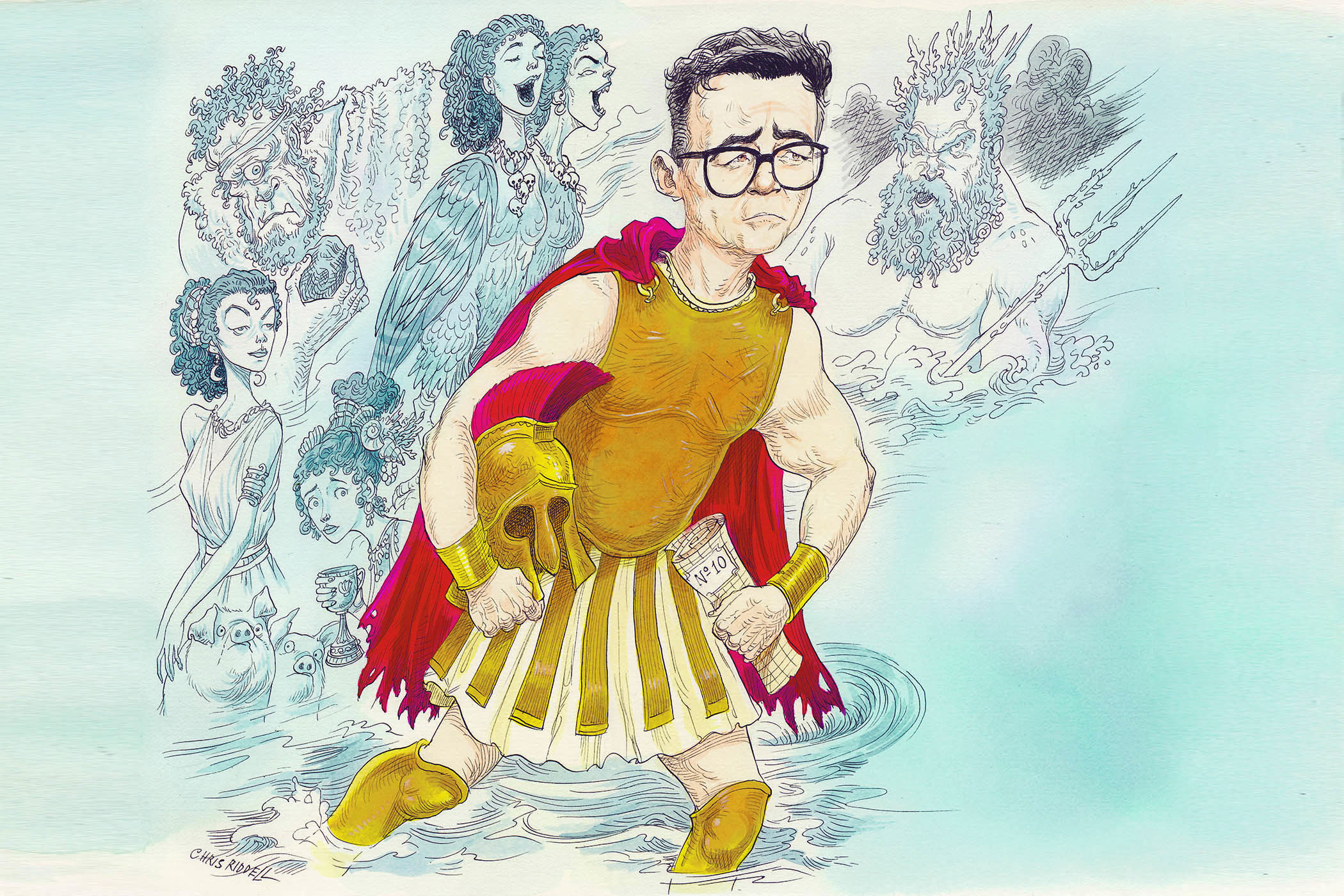

Illustration by Chris Riddell for The Observer
Andy Burnham grew up in what used to be known as south Lancashire, wedged between Liverpool and Manchester. He represented part of the area as MP for Leigh from 2001 to 2017, raised a family there with his wife, Frankie, lives there still, and will speak for it again as the member for Makerfield. In a sense, it is his Kansas, but he is not its Dorothy. There was no need for him to unmask the wizard of Oz to understand that “if I ever go looking for my heart’s desire again, I won’t look any further than my own back yard”. He seems to have been looking in his back yard all along.
Burnham talks insistently about bringing back the politics of place. Looked at another way, that south Lancashire home is the place of his politics, and all of us will feel its effects in the days to come.
What are we going to feel? The influence on the prime minister of a family, a culture, a church and a society that have been the making of him, and small lessons learned close to home that have been turned into skywriting.
“In his bones,” says David Blunkett, who gave Burnham his first leg up as a young MP in 2003, “Andy is a communitarian. He really cares for family, community, for neighbourhood, for that kind of engagement. It’s a great counterweight to the traditional Tory view that they are the party of family and community.”
Blunkett is wary of seeing only a reflection, not the man. But he does see a reflection: “There’s a romantic and sentimental streak in both of us. It’s our northern background. It’s where we came from, and I’m proud of it rather than embarrassed by it.”
The circumstances make it tempting to search for an individual or a moment that has changed him: a guru or an epiphany. There is not a single person who has moulded him, but there are people
The circumstances make it tempting to search for an individual or a moment that has changed him: a guru or an epiphany. There is not a single person who has moulded him, but there are people
As Burnham tells it, his family ended up in the prosperous village of Culcheth, near Warrington, almost by accident after his father spent a day working at the telephone exchange there and liked the feel of the place. Burnham was one when they moved from Aintree, the middle brother of three. None of them lives or works further than about 30 miles from the family home even today. One brother is head of a secondary school, the other of a sixth-form college.
Burnham describes his upbringing as modest, somewhere on the cusp between skilled working class and lower middle class – “we never had a family holiday abroad but we didn’t want for anything” – but the modesty comes with a mystery attached. The self-belief that compelled him to risk everything in Makerfield and unseat a prime minister has to have its origins somewhere, and the young Burnham is a puzzle.
On the one hand there is the still-fresh memory of his A-level English teacher, Stephen Harrington, who twisted his arm to get him to apply to Cambridge University. “He needed a lot of persuading because he felt that as a working-class boy, going off to Cambridge wasn’t for him. He didn’t believe in himself, but he did it,” Harrington has said. On the other hand, he met his future wife, Frankie, on her first night there – and, aged 19, told her he wanted to be an MP. They married in 2000 and their three children, a boy and two girls, are now in their 20s.
In a quickfire newspaper interview in 2009, Burnham gave his stock answer to the question of what matters in life, apart from his family: “Everton FC, the Labour party and the Catholic church – in that order. The reason I say that is, it all comes back to cultural identity.”
Newsletters
Choose the newsletters you want to receive
View more
For information about how The Observer protects your data, read our Privacy Policy
Today his identity is still wrapped up in football and politics, but his relationship with the church is more equivocal. Last October he gave a lecture on religion and society to the thinktank Theos. In the Q&A afterwards he acknowledged his debt to one of the great voices of liberal Catholic social teaching, the former Archbishop of Liverpool. “Derek Worlock was a big influence. I was an altar boy. I used to have to press the button on his tape-recorded messages in the church. And to me, that kind of church was always about speaking for people without power; those who needed to be built up.”
But in the lecture itself, Burnham mentioned Pope Francis just twice, Jesus and spirituality not at all, and devolution 14 times. It was an orthodox political text with no religious flavour and – through what it left out more than what it said – placed Burnham in the right pigeon hole: a cultural Catholic who “doesn’t do God”. Religion is a piece of the Burnham jigsaw but far from the whole picture.
There is a whisker of Schrödinger’s cat about the way Burnham has become prime minister. He appears to have sprung from nowhere and also been around for half a lifetime. The circumstances make it tempting to search for an individual or a moment that has changed him: a guru or an epiphany. There is not a single person who has moulded him, but there are people: the late Tessa Jowell, Paul Goggins the Christian socialist MP who died in 2014, David Blunkett. And if there was an epiphany, it too came close to home at Anfield, home of Liverpool FC, in 2009.
It was the 20th anniversary of the Hillsborough disaster and Burnham, the culture secretary at the time, had been sent to represent an unpopular government that, in the correct view of the thousands of men and women on the terraces in front of him, had not done enough to get to the bottom of the tragedy and its cover-up. As Burnham spoke, the crowd rose to their feet and interrupted him with a chant of “Justice for the 96”. It was a terrifying political moment, and at first Burnham looked frozen. But he rallied, seized the issue in cabinet the next day, and turned it into what he claims as one of the great lessons of his life.
Gavin Callaghan got to know him later when, as a Labour staffer, he helped run Burnham’s doomed campaign for the party leadership in 2015. He sees the Anfield moment as another piece in the jigsaw of Burnham’s self-belief. “On Hillsborough, on infected blood, on Covid, Andy was in the eye of the storm, leading the charge for the centre-left to expose how the state had operated for so long against the interests of the kind of kids he went to school with, went to the football with, went drinking with. In those big moments over the last 15 years, Andy Burnham has been part of that fight, and he’s been on the right side of history every time. That’s got to give you confidence that you’ve got something to offer.”
If you tell his friends that you are trying to assemble a picture of the man, they all say the same: look close to home
If you tell his friends that you are trying to assemble a picture of the man, they all say the same: look close to home
After that 2015 leadership bid – which Burnham was expected to win – even his supporters thought he was cooked. So when he became mayor of Greater Manchester in 2017 it seemed he had run for the fire escape, not found what has turned out to be a new ladder to the top.
The mayoralty has been another important piece in the Burnham puzzle, but if you tell his friends that you are trying to assemble a picture of the man, they all say the same: look close to home. A podcast he recorded in 2024 takes you there.
Burnham’s father had recently gone into residential care, and he talked movingly about trying to help his mother cope with his dementia while he was still at home. “The first time you see that change… I remember the shock of it, you know, realising that something was really changing within.” Alongside the humanising details – a crisis call from his mother while he was in London and could not go to help her – come some big lessons.
“In my dad’s case, something came through... that needs a political response, and it’s the whole question of a domiciliary care service that really is just not set up to do what it should do, and actually be preventative in terms of the support that it provides. And it’s this kind of 15-minute visit culture, isn’t it, and the rush?”
Burnham’s friends see that answer as characteristic in a way they admire. They watch him draw simple insights from close to home to write prescriptions for change that are often breathtakingly huge: a National Care Service, the rewiring of the British state, the end of 40 years of neoliberalism, proportional representation.
In that same answer there is an echo of a phrase Burnham uses time and again in speeches and interviews: “How can it be right that…?” It is a populist framing, rooted in “common sense” and more convincing when he genuinely does not know the answer than on the occasions when he surely must. And like any common sense question, it asks: how does a policy survive contact with all the complexities of governing?
In his book, Head North – part-memoir, part-manifesto, co-written by his friend and Liverpool mayor Steve Rotheram – Burnham remembers, mistily, how watching Alan Bleasdale’s 1980s TV drama about unemployment in Liverpool, Boys from the Blackstuff, changed him; how he turned round to find his mother in tears at the end of an episode called George’s Last Ride in which George, an ex-docker, rises from his wheelchair in the derelict, mud-filled Albert Docks where he used to work, to wheeze out his last words: “I can’t believe that there’s no hope!”
The words could be Burnham’s. So could another short speech George makes earlier: “I’m not the holy father. I don’t know everything, I hardly know bugger all. I just apply the little bit I know and what I learn to some useful purpose, that’s all.” If there is a creed of Burnhamism, that may be it.
What are your thoughts on this? Send us a letter to letters@observer.co.uk