People have emotional things to say about Anish Kapoor’s new work and in particular about the gory, spectacular exhibition he has opened on London’s South Bank. Many art critics left it elated and astounded. Just a few were confounded, though – impressed, but unsure of the intent behind all the visual drama.
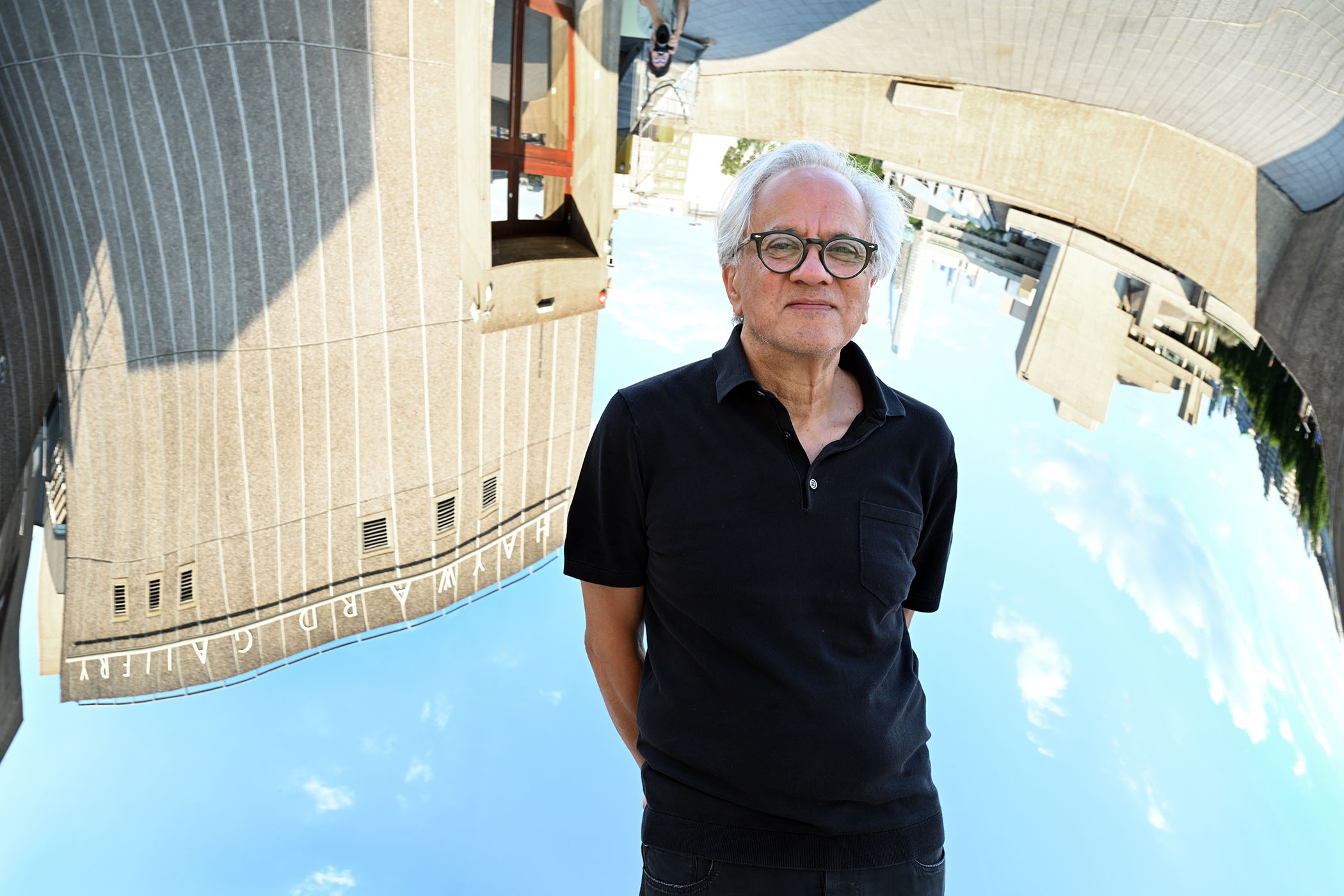
On a scorching London morning – one of the city’s hottest ever – visitors to the Hayward Gallery had the chance to stop and ask the man himself about its meaning as he walked me around the show and then along the river. Kapoor, slight and dressed in shorts and a T-shirt, must have seemed a heat illusion when he first materialised in front of them next to one of his gigantic red creations, competing with the optical stunts inside the exhibition.
“This is incredible, sir. Thank you so much,” said one middle-aged fan. “This stuff is amazing. I’m so happy to come here, then to see you. I’ve never asked this before, but do you think I could have a photograph?”
The landmark show is one of a series Kapoor is mounting across the world over the next couple of years. It represents the latest flowering of his sculpture, coupled with older paintings that he rarely exhibits. The new work was made in his studio in south London in collaboration with skilled metal technicians and scientists.
Dosed-up on iced coffee, we were only starting our stroll when we were first interrupted. As we went on, we were regularly accosted by excited people wanting to speak to the artist. One woman told him she had waited 20 years to see a solo show. Such a degree of attention must be fairly unusual for any contemporary artist and certainly for one such as Kapoor, who does not feature much on television or in the popular press.
The artist is gracious and grateful, deploying old-world gentility with each of them and telling me, whenever he can, how moved he was when he first came to the Southbank as a young man. “It is extraordinary and touching that this whole edifice was put together to celebrate culture, to give place to it,” he says. “There was real postwar utopian ambition and a sense we could build anew. And all the hippies too, with their sense of an unspoken ‘other’; you know, those spiritual undertones influenced pop music and all sorts. Sadly, that has gone. Utopian ideas no longer seem possible, which is a terrible thing.”
London was the big draw for the teenage Kapoor when he hitchhiked over from Istanbul with a friend and eventually enrolled at Hornsey College of Art in north London. He had initially been sent out to Israel from India by his parents, but quickly decided kibbutz life was not for him. So he escaped to England, running away from a period of serious mental illness and homesickness that still haunts him. “It has given me a deep connection with London,” he says, explaining his decision to stay in the city for 50 years, although he now also lives partly in Venice with his wife, the Moroccan writer Oumaima Boumoussaoui.
We will soon head towards another scene of triumph for the artist: Tate Modern, where his trumpet-like giant red sculpture Marsyas bloomed 23 years ago inside the Turbine Hall. But before that Kapoor wants me to look at his favourite work in the Hayward show, and possibly of all time, Descent into Limbo, which he made in 1992. It appears to be a round, dark mat on the floor, but is in fact a deep cavity. Or is it? He won’t say, telling me only it is blue paint, not black.
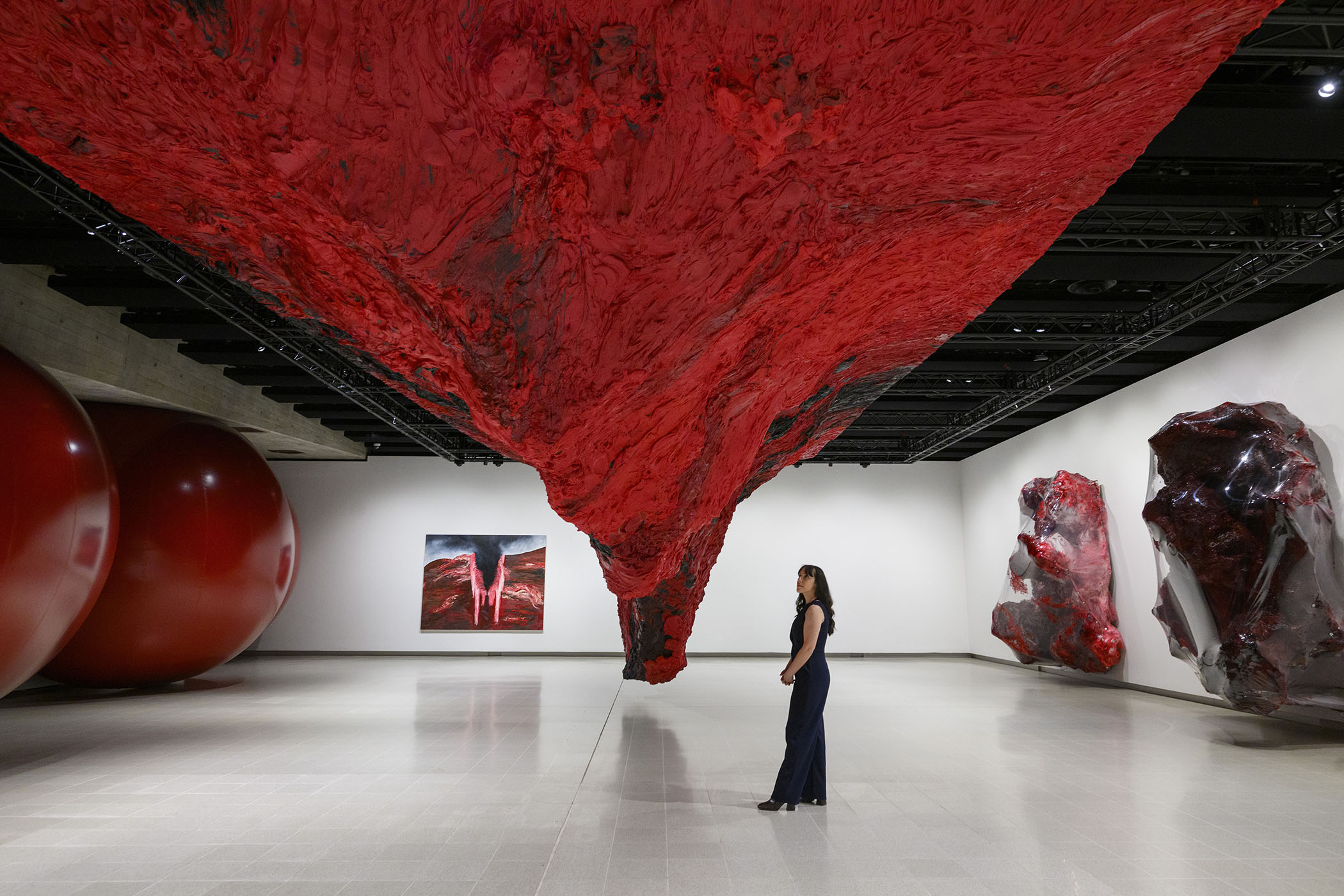
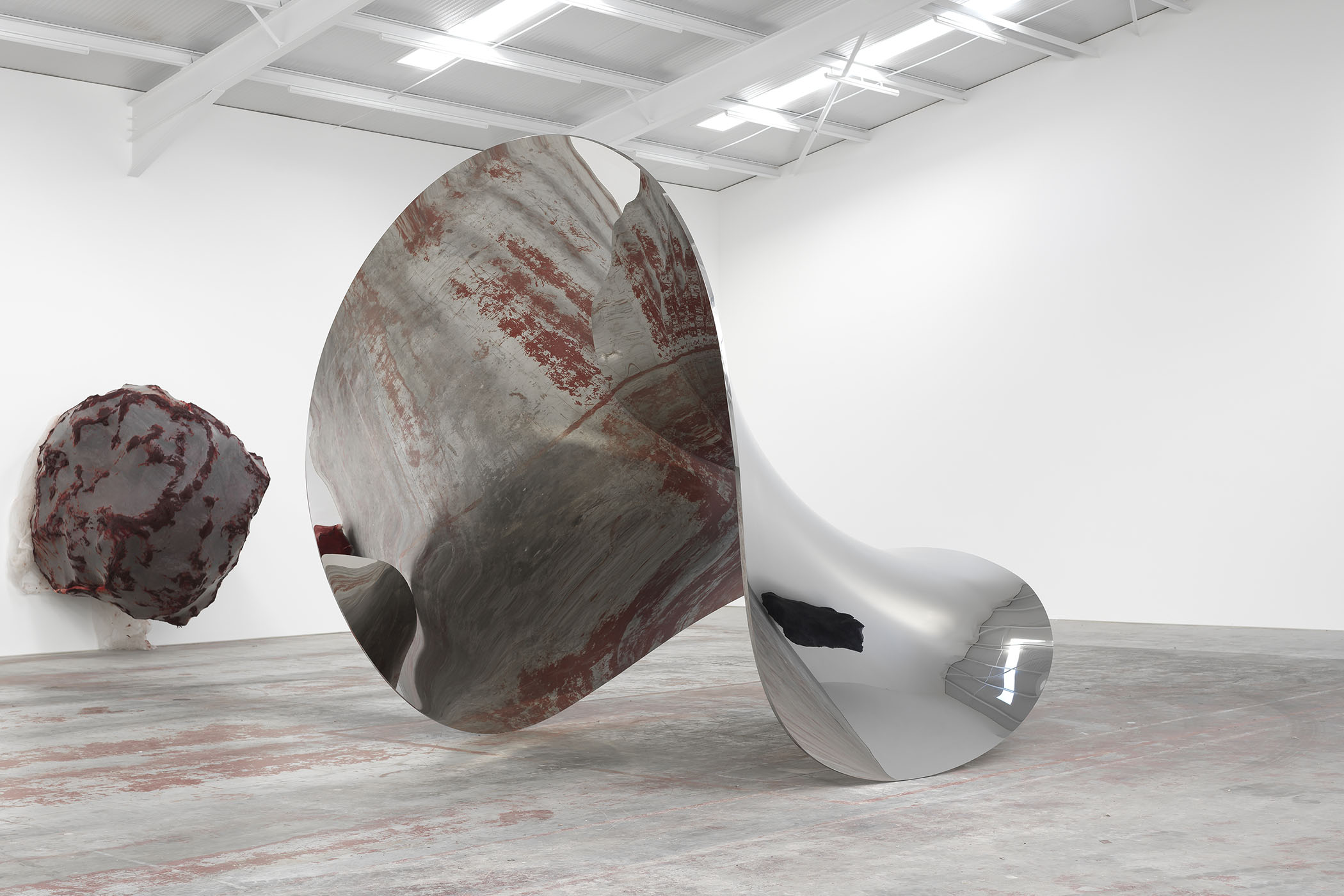
Put simply, for those who cannot go, his show is full of enormous vermilion structures: one like a vast expanding inner tube, one like molten viscera and one like a volcanic fortress. In other rooms Kapoor plays with non-reflective darkness. Shapes that may be flat or may be abyssal. The effect is often frightening or, in the case of his bags of dripping blood and guts, downright disturbing.
The artist assures me, however, he is not interested in horrifying his public. “I don’t particularly like horror or horror films. I don’t even think this is horrific.” Kapoor is focused instead, he tells me, on the essential substance of our bodies and also on how humans perceive empty space.
Newsletters
Choose the newsletters you want to receive
View more
For information about how The Observer protects your data, read our Privacy Policy
‘Art is the only place that’s left for the radical, in a world completely taken over by mega capitalism. The art world is completely consumed by it’
‘Art is the only place that’s left for the radical, in a world completely taken over by mega capitalism. The art world is completely consumed by it’
“At a basic level, sculpture has always been about objects and one of the things that I bumped into, not consciously, is the ‘non-object’; something that sits alongside the physical. The sculptor Wilhelm Lehmbruck, who worked at the beginning of the last century, made tall, elongated figures. But the best thing about them, to my mind, is that their eyes are closed. It’s as if they’re evoking inner space, turned inwards. They are physical objects that hold a negative vision and the implication of that, the thing I bumped into, is that the void is just as physical and as present as any object. We all know this, of course, because you only have to close your eyes to understand how huge that space is.” A great pleasure of art, Kapoor enthuses, is when it addresses something already known but not yet expressed.
As we pass children playing in the fountains outside the gallery, I ask him about a particularly enormous scary sculpture inside, inspired by the biblical story of Abraham’s sacrifice of his son. Kapoor says this theme has an “addictive” element for him and so I wonder if it is to do with a secret impulse to make a deal with God. Politely, he says this is an intriguing suggestion, but he balks at any such analysis of his motivations: “I’m not really interested, for myself, in art with a message. It gets in the way. Art is the only place that’s left for the radical, in a world completely taken over by mega-capitalism. The art world is completely consumed by it.”
Kapoor, 72, may not readily discuss the meaning of his art, but he does, he reveals, submit himself to analysis: privately, on the psychoanalyst’s couch. “I see a classic Freudian, or let’s say a modern Freudian. So there is a lot of reflection on my past. It’s a weird process, or cycle. At one level there is great depth to it, and at another level I sometimes feel, ‘Oh, I’m bloody fed-up doing this. I don’t want to do this any more’. That feeling comes round every now and then.”
The artist tells me all this after he bats away a question about the impact of his fame: “I don’t see it that way. I do what I do and, thankfully, there are people who respond to it, who feel strongly about it. And that’s very touching. But in the end I still have to go back to the studio and carry on. I mean, I’m also not naive. I know what the context is. I do understand that the art world sees itself as filled with ‘names’.”
He is, he adds, “studio-obsessed” and needs what he describes as his “boring 9-to-5 routine” there every day. It is rather like his psychoanalysis, he claims, as we climb down one of architect Denys Lasdun’s stark, spiral staircases. “If you keep going, something will emerge. I started psychoanalysis because I felt homeless and lost and I now find it very important, actually. It’s a huge privilege to be able to reflect on my own inner life and repeat that process. And that’s not so different from what happens in the studio. The same questions arise: about purpose, about content, about meaning and colour.”
We look back up at a terrace where one of his shiny mirror-metal forms, Tsunami, beams back at the sun. I say it is sleek but slightly threatening. “Good,” he says, but is then distracted by a huge banner bearing his name hanging down the concrete wall beside it.
“That’s weird for me to see my name there like that. Am I allowed to take a quick picture?” As I wait I watch buses crossing Waterloo Bridge and hope there are people on the top deck looking over thinking “Strange, there’s Anish Kapoor taking a photograph of his own name.”
His name has recently been the subject of an art world tussle after the artist Stuart Semple was enraged by the exclusive rights Kapoor acquired to an industrial coating called Vantablack and briefly changed his own name to Anish Kapoor. I ask the real Kapoor if rumours of a rapprochement between the pair are accurate. “Well, no, but Semple wrote a silly note to me which said, ‘There’s no animosity at all.’ I didn’t respond. I don’t have anything to do with it. It’s his business. I don’t care.”
Aside from this fuss about the use of “the blackest black” known to humankind, other artists have also suggested Kapoor’s work is produced by teams of underlings. He disputes this, telling me he has some assistants and admin people, but that every swirl of red paint on his sculptures has been directed by him.
We turn to look over the shimmering brown Thames at the skyline. Kapoor is a bit sad, he says, about the Americanisation of the panorama. “It looks ordinary now, although I have always rather liked the Shard. Otherwise, it seems to be about square footage and not new visions. So it becomes an extension of capitalism.” In contrast, the Southbank is a monument to free culture. Before Chris Smith, the New Labour culture minister, he says, that kind of thing was available only to the richer classes. “Now it’s so wonderful that anyone can go to a museum. Economic realities don’t play a role.
“From that point of view, it’s also wonderful there’s been a skateboarding park here for the last 25 years. And the trees are gorgeous and the book stalls under the bridge are fantastic. It’s almost like walking by the Seine.”
A bulbous red lifebuoy hooked up by the riverbank is reminiscent of Kapoor’s own work. Would he consider creating a big public sculpture here? In Paris the artist JR has just erected a kind of tented cave over the Pont Neuf, I remind him. “The answer’s yes, I would,” replies Kapoor. “There is lovely public space in London, but not enough public art.”
In Chicago he has his gleaming Cloud Gate structure, nicknamed “The Bean”, and in east London, of course, the ArcelorMittal Orbit in the Olympic Park, although he admits he is not too keen on that one. “It’s OK. Orbit’s been turned into an attraction. I guess that’s fine. But, can I be straightforward and perfectly honest? It’s not my best work. Its engineering is more present than I would like.”
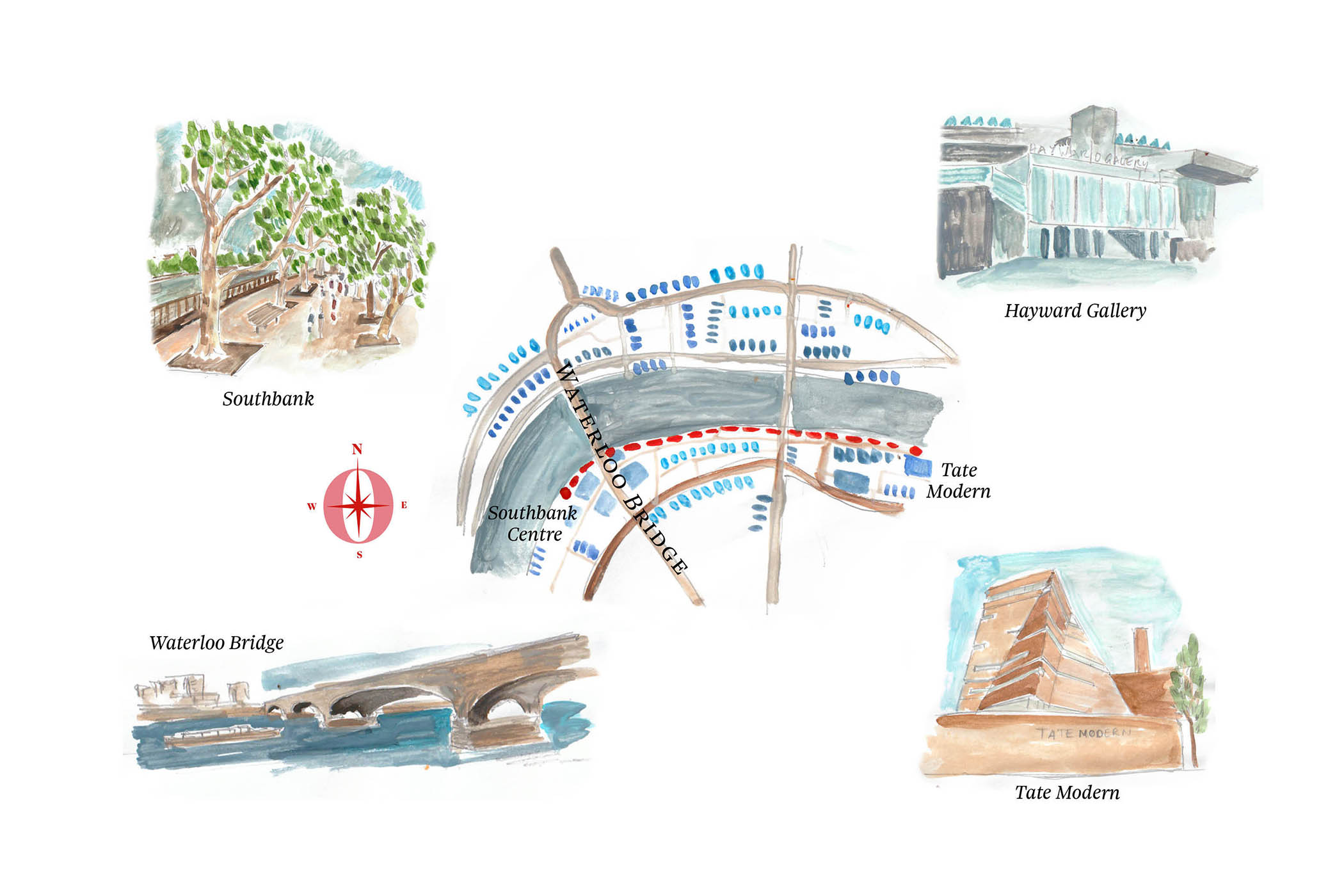
Someone has left a heart-shaped shrine of stones on the steps down to the grey sand uncovered at low tide. Ahead, we can now see Tate Modern, where the current Frida Kahlo exhibition features similar ad hoc shrines made to the late Mexican artist. Has he been to see that show?
“Well, Kahlo is a perfectly interesting artist, for sure, but also just an ordinary painter who did her thing with great panache and care. She happened to have a complicated romantic life. But Hollywood and the rest have now turned her into something else.”
‘There was a time we had vision and the creative industries were acknowledged as second only to banking. Come on! We have to get back to that’
‘There was a time we had vision and the creative industries were acknowledged as second only to banking. Come on! We have to get back to that’
He resents the way Kahlo is sold to us, he says, confessing at the same time that his work too has been turned into merchandise for which he receives a small royalty. “I can’t bear the idea. But, yes, there are tea towels, I’m afraid. But I understand that it makes money for the gallery.”
The Kahlo show at Tate – and the hit Tracey Emin show there before it – include several explicitly graphic depictions of abortions and other operations. The public were forewarned about the content. But Kapoor’s show depicts much more organic viscera, pound for pound. Did the Hayward consider putting up a “trigger warning”? “No. Why would they ever do that?” he wonders, exasperated. “The whole point of art is confrontation. It is about letting the viewer look at the visceral, the physical. I don’t think it helps to be overprotective.”
For Sir Anish, creativity and the body have become closely entwined. In fact he believes the two were conjoined. The theories of his friend Chris Knight, the British anthropologist, are right, he thinks. “The first acts of culture came from blood, in other words from menstruation. Paintings in the earliest anthropological sites were made with mixed blood and ochre earth. They were trying to express something, these women who lived in tribal proximity.”
Tate Modern now looms over us: that new temple to the creativity that started in prehistoric blood and soil. Kapoor attended the opening night party with the great and the good more than a quarter of a century ago. “It was extraordinary. Of course, the world was a very different place then. It is much more confusing now.”
But the artist already knows what he would tell Andy Burnham, likely next leader of the nation, to do. “We must get back to that notion, to that moment. Do it properly, Mr Burnham! There was a time we had vision and the creative industries were acknowledged as second only to banking. Come on! We have to get back to that, because it speaks to our youth, to their sense of adventure and to the inventiveness of the population. Mr Burnham, make it happen! Otherwise, we will be trapped by that orange monster in Washington and his kind, and everything becomes one big golf course.”
Photographs by Anne-Katrin Purkiss, Anadolu, Dave Morgan