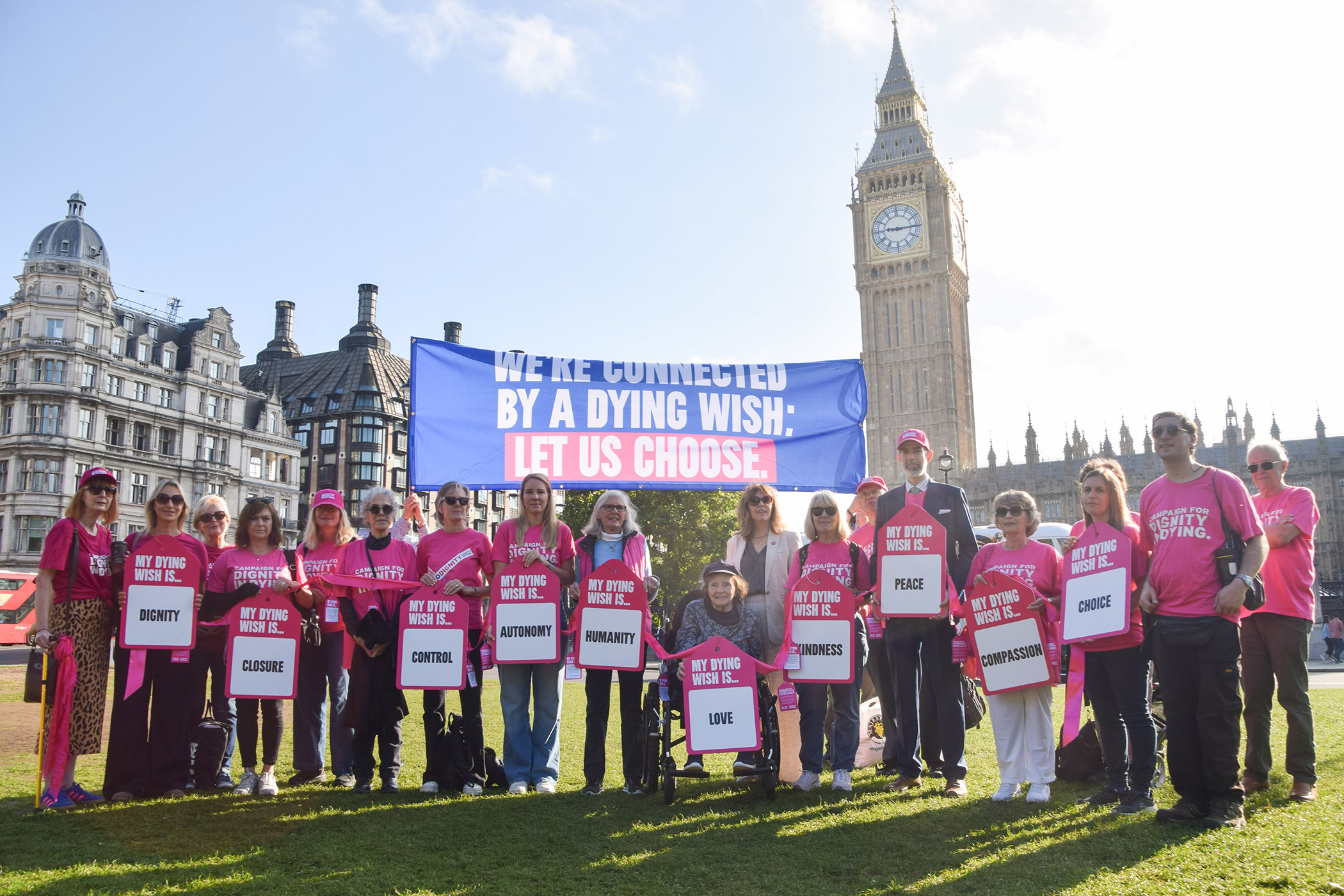


Second chances are rare in Westminster. From referendums to free votes, politicians usually get one shot to meet the moment. If they fail, the opportunity is lost for a generation.A year ago, the House of Commons handed the House of Lords a clear, solemn mandate. Having voted in favour of the assisted dying bill by an absolute majority, MPs asked us to scrutinise the legislation, improve it and finally grant terminally ill adults the dignity of choice and compassion.
We failed spectacularly. We reduced ourselves to an irrelevant talking shop. We held no votes, making just three minor changes agreed without division. Instead of meaningful revision, we waded through a mire of nearly 1,300 amendments.
While some peers made eloquent, deeply felt cases for improvement, others ranged from the absurd to the cruel. One amendment proposed recording every impairment a person has, a bureaucratic nightmare that would technically include minor ailments such as scabies and ingrown toenails. Most punitive was a proposal to inflate the assessment process from two independent doctors to five. For a terminally ill person with fewer than six months to live, navigating such an administrative maze would be impossible. I have not always supported assisted dying. But over the years, as I heard arguments unfold, a simple truth struck me: I could not vote to deny other people a choice that I would want for myself.
Many years ago, a close friend was dying of motor neurone disease. He was no longer able to speak but, using the only form of communication left to him, he tapped out a message on a keyboard. It was a passionate, urgent plea from a man robbed of his voice: support the change in the law to permit assisted dying. I promised I would do that.
That moment moved me enormously. It is clear to see the anxieties. People are uncomfortable about the potential for coercive pressure. But we must confront the reality of the status quo. Right now, there are no safeguards for any British citizen who can afford the airfare to Switzerland. A robustly regulated bill would improve protections by bringing the practice out of the shadows and into a strict legal framework.
As a humanist, I believe this is the one life we have. We should live it to the fullest, but life must be measured by quality, not quantity. The desire to prevent unnecessary suffering is the ultimate act of compassion.
The bill has now returned to the Commons and I hope MPs vote in favour once more. This is also a moment for the Lords to redeem itself. We can offer genuine scrutiny and attempt to strike the balance between safeguards and the practicalities of navigating any system when terminally ill. If we fail to do the job a second time, cries for reform will become deafening. How can we continue when we didn’t even vote against assisted dying, we just let dirty tricks finish it off? What would that mean for public trust in politics?
We have been handed a lifeline to prove our worth. For the sake of those facing agonising deaths, we must not fail them again.
Lord Dubs, House of Lords, London SW1A
Newsletters
Choose the newsletters you want to receive
View more
For information about how The Observer protects your data, read our Privacy Policy
Bullet points for Burnham
Andrew Rawnsley questions Andy Burnham’s policy of giving power away (“No 10 in the North isn’t such a bad idea, so long as Burnham is willing to do battle with No 11”, 5 July). In their 2024 Head North plan, Burnham and his co-author Steve Rotheram clearly state: “Each point involves a transfer of power to people and places [that] are intended to create the conditions for a more functional and fairer country.” As Nye Bevan once said, “The purpose of getting power is to be able to give it away”, not hoarding it. At least Burnham and Rotheram were on the same page as “the father of the NHS”.
Austen Lynch, Garstang, Lancashire
I welcome the news that a cross-party group of MPs have written to Andy Burnham urging him to commit to introducing proportional representation before the next election. The incoming prime minster has in the past expressed his support for PR. However, will he risk introducing it before the next election? It would open up Labour and the Tories to a parliament that could be reflective of how people actually voted. It could also rule out either party having a large majority, as Labour does now, and benefit smaller parties, such as the Lib Dems, Greens and SNP, by giving them a fairer representation in parliament.
Burnham’s spokesperson has said the new PM would “seek to persuade the Labour party of the need for a commitment to electoral reform in its next manifesto”. But once in power, parties may drop pledges.
Stuart Finegan, Lewes, East Sussex
If Andy Burnham’s government will consider constitutional reform (“Burnham’s No 10 set for radical transformation in drive to make government more effective”, 11 July), might I suggest the inclusion of representation for British citizens living abroad?
Nicola Turc, Rochefort sur Loire, France
Snub the snus
Your article on snus and nicotine pouches (“Regulators accused of stubbing out Sweden’s ‘solution’ to smoking’”, 12 July) featured individuals and arguments linked to big tobacco.
Sweden’s smoking reductions since 1990 coincide with the implementation of strong tobacco control policies, including ad bans, smoke-free laws, increased taxes and cessation services. While daily smoking rates are low, total tobacco/nicotine use is increasing. In 2025, 30% of the population used cigarettes, e-cigarettes or snus/nicotine pouches, rising to 44% among 17- to 29-year-olds.
Following targeted marketing, increases among women and youth drive this trend. Daily snus/pouch use was higher among women aged 16-29 in 2024 than daily smoking in 2004. After pouches were commercialised in 2016, uptake accelerated among 15- and 17-year-olds.
Global sales growth is being driven by aggressive industry marketing targeting new customers while encouraging existing customers to use pouches and other tobacco and nicotine products. Our recent report notes industry executives say these “poly-users” are more profitable. There is also a lack of evidence around long-term risks of these products or whether they can help smokers quit.
Jorge Alday, Director, STOP, New York
Green equals growth
Sound economic policies can support our global home (“The ‘economy or the planet’ is a false choice: without a healthy Earth, business cannot flourish”, 12 July).
A recent CBI report found the green transition one of the largest drivers of industrial job creation in the economy, supporting over a million jobs, many in the north-east, with average wages and productivity significantly above the national average. And the Climate Change Committee has found that for every £1 of public money spent on net zero, the benefits outweigh this by 2.2 to 4.1 times.
Sound green policies would also help address inflation. Britain’s 2022-23 inflation shock was fundamentally a supply-side energy hit driven by UK dependence on imported fossil fuels, mainly gas. Since the Second World War, energy price spikes have coincided with eight of the 10 episodes in which inflation was near or above 5%.
Investment in cheap domestic renewable energy, electricity networks, home insulation and industrial decarbonisation, which would reduce exposure to volatile global gas prices, is the only long-term solution. A more resilient, less inflation-prone economy should also strengthen rather than weaken confidence in UK government bonds.
David Murray, Wallington, Greater London
The art of good science
James Tapper’s survey of how we get scientific discoveries (“The science of serendipity”, 10 July) mentions the importance of creating the environment where scientists from different disciplines can talk to one another, and tools to enable scientists to look at the world in a new way. But what helps scientists to think out of the box is imagination, and art is the way to nurture this skill. Leonardo da Vinci and Richard Feynman both embraced art and science.
Kartar Uppal, Sutton Coldfield, West Midlands
Restored by nature
Thank you to Fintan O’Toole, for such a gripping review of Communion (“JD Vance’s test of faith”, 8 July). I admire the skilful way he outlined the extent of Donald Trump’s mendaciousness and his vice president’s hypocrisy.
However, I felt somewhat restored by the last section of Robert Macfarlane’s book Is a River Alive? (New Review, 2 May), in which we are reminded that nature is ultimately more powerful than all our attempts to control her. Allow me to quote from Gerard Manley Hopkins in his poem God’s Grandeur: “…nature is never spent;/ There lives the dearest freshness deep down things”.
Joyce Gunn Cairns, Edinburgh
Have subs gone Gaga?
Kitty Empire lists pop stars “Dua, Kylie, Beyoncé, Gaga, Charli and Twigs” as “mononymous, or near-mononymous” (“With Confessions II, Madonna dances in the middle of the road”, 2 July). Of those, surely only Beyoncé Knowles and Kylie Minogue are routinely, and slightly gratingly, referred to by one name alone. The others are likelier to get abbreviated by subeditors short of space.
Francis Harvey, Bristol
Tall stories
I would think Trump would prefer you refer to him as the tallest living US president, ( In the frame, Forum, 12 July, print only) rather than third tallest after Lincoln and Johnson.
Jude Carr, London SE7
Taking the Mick
Damien Morris asks “Can we agree that the Stones were never an album act?” (“Albums of the week”, 11 July). No, Exile on Main Street. ’Nuff said.
Mike Coogan, Abbeystead, Lancashire
Photograph by Vuk Valcic/Getty Images