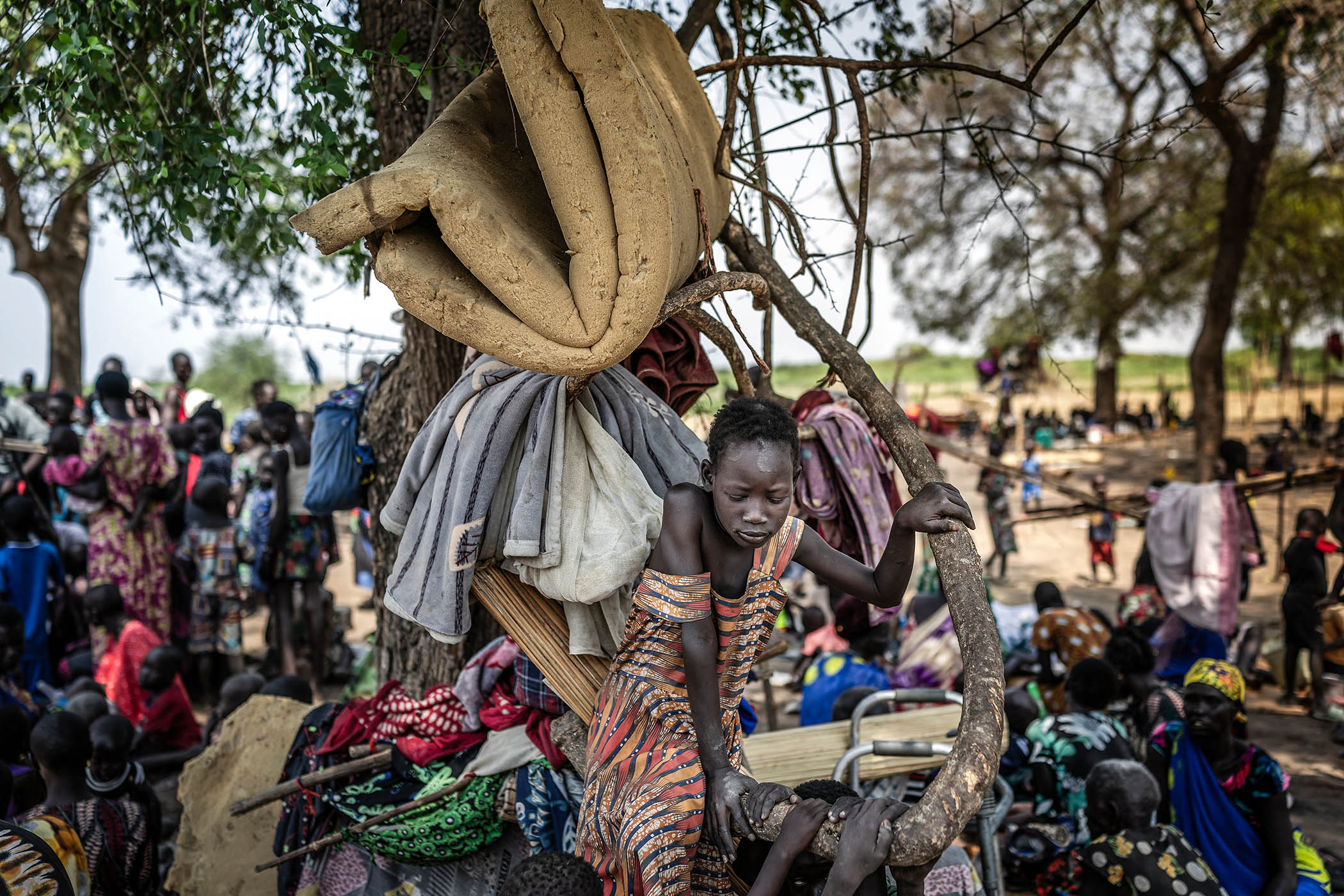
“The forgotten war” captured the cover of last week’s Observer. The war in question is Ukraine’s defence against Russian invasion. “Forgotten”? Hardly. What about Sudan? According to Halima Begum, former head of Oxfam, this is “the worst humanitarian crisis of all”. As at April 2025, 12.7 million people were displaced – a third of Sudan’s population. It is the global south, particularly Africa, that is truly forgotten.
The focus of the richest industrialised countries has shifted away from global concern and modest aid budgets to increased arms spending and traditional national security. It is as if Africa has fallen off the map. Our government made it clear that the money from aid cuts would be devoted to defence spending. Failure to stop the wars in the Middle East and Ukraine is bad enough, but it is a huge mistake to focus on one or two wars.
As a result we look away from conflicts in countries of the south and skimp on hard-to-fund peacekeeping operations, conflict prevention and post-conflict reconstruction. We cut aid, neglect health and climate security.
Much more is being forgotten than the war in Ukraine.
Roger Williamson, Ashington, West Sussex
Making the grade
Dennis Sherwood argues that certificates for exams completed should state that the grade awarded is “reliable, at best, only to one grade either way” because of the uncertainty in marking (“A single exam result can change a pupil’s life – but grading in England is a lottery”, 7 June). This is less of an issue if numerical marks are shown on the certificate. Then one can see if one student is about the same as another, or if they are miles apart within the same grade. The uncertainty in marking can never be eliminated, but the marking error is less significant.
Kartar Uppal, Sutton Coldfield, West Midlands
Dennis Sherwood skewers the shambles that is Ofqual. Consideration should focus on the academic background and the teaching experience of assistant examiners. During my examining career of 20 years, I would casually elicit that information from my colleagues when we attended the assistant examiners’ meeting. Most had no qualification in either history or politics (my subjects) and often had never taught. Supplied with a checklist, they were given about 300 scripts. Had the students read around the subject, sat at the feet of teachers who went outside the syllabus – ie taught properly – they found themselves penalised, as their work received no credit, given that it did not appear on said list. The current system is indefensible.
Andrew Cobb, Bath
Newsletters
Choose the newsletters you want to receive
View more
For information about how The Observer protects your data, read our Privacy Policy
X-rated politics
Wes Streeting is right to say that Elon Musk’s behaviour is a “threat to democracy” (“I don’t want Farage walking into No 10 on my conscience”, 7 June ). It is therefore confusing why he and so many others continue to use X, thus driving traffic to the toxic social media platform, which actively promotes division, hatred and misinformation.
Many of us stopped using X after Musk’s intentions became clear. The time has long since passed for anyone who cares about truth, humanity and democracy to follow – particularly those who aspire to lead.
Robert Saunders Balcombe, West Sussex
Plus ça change
I enjoyed your facsimile front page from 31 July 1966 (insert, print only, last week), particularly the non World Cup news. I was intrigued to read with reference to restrictions on pay rises (“Freeze was toughened to satisfy LBJ”) that the then minister of health was “acutely distressed at the way the second instalment of the doctors’ promised (pay) increase will now be withheld”. He had been heavily involved in “the tortuous, bitterly contested negotiations which nearly broke up the NHS”.
Jo Cownie, Bristol
To move or not move
To encourage downsizing, ensure more bungalows are built. (“Downsizing isn’t yet in Richard’s interest. That needs to change”, 7 June). Many folk, like me, would downsize but not to terraced houses with stairs to fall down. In the 60s modern estates included a variety of homes. Give more thought to the needs of us boomers and we will up sticks.
Sally Bates, Cotgrave, Notts
I confess, I am a Richard. I am sorry and I do feel guilty. But does Ben know that two of the most stressful things in life are the death of your loved one of many years and moving house? Being old does not help. If a person has no family nearby to help, the idea of moving becomes daunting.
Diana Lyon, Chesterfield
Concerning conveniences
Eva Wiseman (“‘Lavatory deserts’ mean we are all likely to be caught short”, 3 June) might have advanced the suggestion that all publicly-provided toilets should be designed for disabled people, no matter their gender. Building these in much greater numbers would solve several problems at once.
John Starbuck, Huddersfield, West Yorkshire
Reading last week about George Michael’s cruising grounds (“The Observer Walk: Sathnam Sanghera”, 4 June) and Eva Wiseman’s musings on the dearth of public toilets, I was reminded of the 1960s poem Few, by Pete Brown (abridged):
Alone, tired, half-drunk, hopeful
I staggered into the bogs at Green Park Station
And found 30 written on the wall.
Appalled
I lurched out into the… neon Piccadilly Night
Thinking surely…
There must be more of us than this
A statistic that needs updating…perhaps along with the toilets (if they still exist).
Nicola Lack, Pardaillan, France
Photograph by Luis Tato / AFP via Getty Images