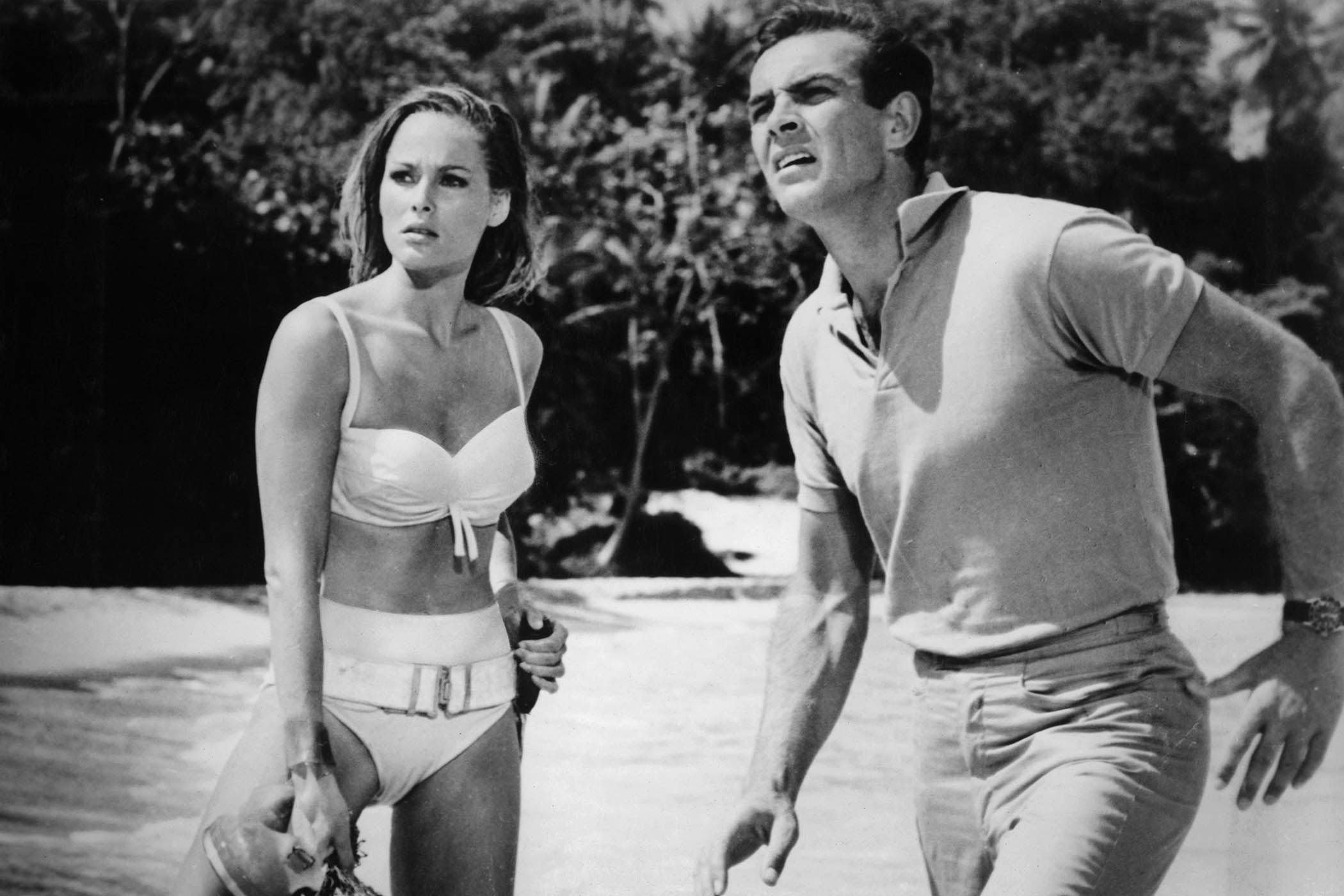


Last month, part of a recently discovered archive from the Elstree film studios was put up for sale in Edinburgh. The archive included extensive readers’ reports on novels that had been submitted to the Hertfordshire studios – then mostly run by Warner Brothers – for screen adaptation. Among the items were previously unseen reports on Ian Fleming’s James Bond books. The files came from the late 1950s and early 1960s, before the first 007 film, Dr No, came out in 1962.
Without exception, the careful readers at Elstree in their six- and eight-page typewritten reports found little to love and saw no future in adapting Fleming’s books.
In each case they recommended that the studio not go near them. This was perhaps not the best commercial decision the studio made. With adjustments for inflation, the Bond franchise, eventually made by ‘Cubby’ Broccoli’s Eon Productions, has taken $119bn at the box office.
Reading the comments that those tastemakers offered now, with the benefit of hindsight, however, one thing is strikingly clear: it is hard not to agree with almost every line of their judgements.
This for, example, is the summing up in a 1960 report on Dr No, two years before Broccoli raised $1m to make that first Bond film (which has grossed $720m in today’s money): “In spite of its modern trimmings – ballistic missiles, naked girls, etc. – this is really basically very old-fashioned Fu Manchu stuff. It has the merit of a lovely West Indian setting, but I did not find the hero’s adventures convincing and I fear that the story trembles too much on the edge of the ridiculous to make a worthwhile screen plot.”
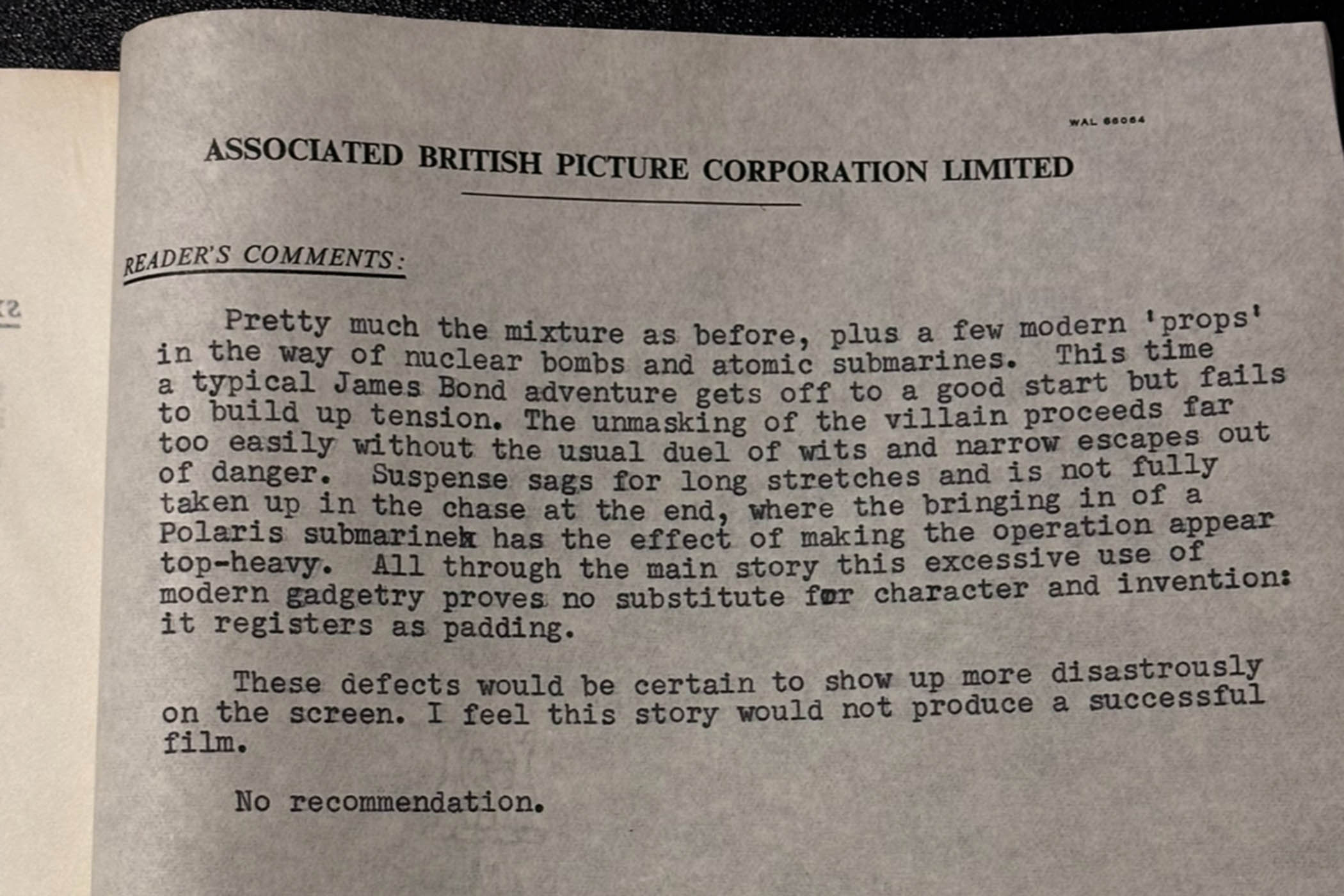
The pass note for Ian Fleming's Thunderball
And this is the verdict on Thunderball, which became the fourth movie of the franchise (takings of roughly $1.3bn): “A few modern ‘props’ in the way of nuclear bombs and atomic submarines... Suspense sags for long stretches... All through the main story this excessive use of modern gadgetry proves no substitute for character and invention: it registers as padding. These defects would be certain to show up more disastrously on the screen."
Put yourself in the position of one of those chain-smoking readers in some draughty Nissen hut on the corner of a home counties film lot, watching the clock and slogging through the next book on your pile – Diamonds are Forever – on a wet Tuesday afternoon. Could you honestly say that you wouldn’t suggest that “this type of story will no longer pack audiences into the cinema” or that “these stories do not seem useful movie material. The plots and main situation are fantastic and improbable … only Mr Bond’s style saves [them] - [this] reader does not think that any single one of these stories is good enough for film use”?
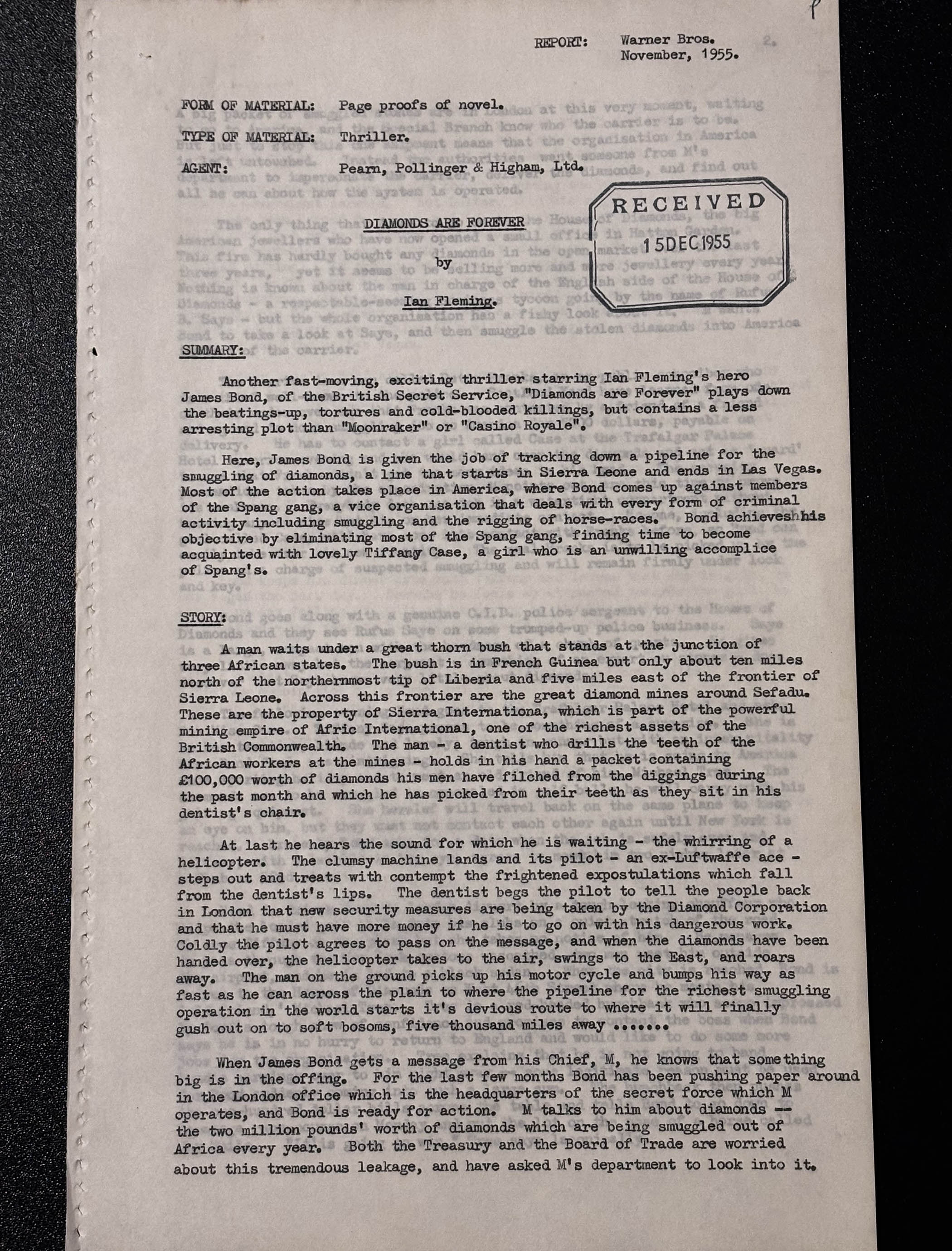
The reader's report for Diamonds are Forever
The antiquarian book dealers who sold the bond manuscripts – Carter Rare Books and Neil Pearson Rare Books – for a five-figure sum have access to an archive that runs from the 1940s to the 1970s and consists of thousands of individual reports on everyone from Agatha Christie to Roald Dahl to JRR Tolkien (you can imagine the rejections in advance: “not another country house”; “dislikeable kids in a sweet factory?”; “too many elves”). The fact is that, as the great screenwriter William Goldman famously asserted, “Nobody knows anything... Not one person in the entire motion picture field knows for a certainty what's going to work. Every time out it's a guess and, if you're lucky, an educated one.”
That point has been repeatedly proven by some of the other films that were bluntly dismissed out of hand and went on to bankroll studios for decades: Star Wars struggled for years to find a backer; Indiana Jones was deemed too risky; the hit factory at Tristar noted of Quentin Tarantino’s Pulp Fiction: “This is the worst thing ever written. It makes no sense. Someone’s dead and then they’re alive. It’s too long, violent, and unfilmable.” Columbia’s verdict on Back to the Future was that it was a “really nice, cute, warm film, but not sexual enough.” The same studio dismissed ET, as “a wimpy Walt Disney movie”. It went on to make more than $1bn in merchandising deals alone, on an original budget of $10m.
Inevitably, given this risible track record, studios are increasingly turning to data-driven decision making and AI to produce their hits. Hollywood is full of start-ups whispering about killer algorithms that cross reference historical box office data with deep-dive information about social media themes and moneyball talent and optimum script arcs. The consultancy Cinelytic for example offers producers the chance to run infinite different combinations of actors through its algorithm on any given project in an attempt to discover the perfect cast. (If nothing else it sounds like the script for a straight-to Netflix movie.)
Will any of that help – or will it just produce ever diminishing returns of things we’ve seen before? Could an algorithm have come up with this year’s Oscar shortlist of best films? I can well imagine early alarm bells sounding for my two favourites on that list: “Marty Supreme is an overlong film about a ping pong player who loses a dog”, “The Secret Agent is set in a Brazilian missing persons’ office; we wait for three hours to find out what happens and then don’t”. Great movies are dependent on a million variables, not the least of which are luck and heart (a John Barry theme tune helps). The abiding genius of them is that none of us really has the first clue what new thing we want to watch until we sit in the dark for a couple of hours to find out.
Photograph by United Artist/Getty Images
More from The Observer
Newsletters
Choose the newsletters you want to receive
View more
For information about how The Observer protects your data, read our Privacy Policy