
Football had been everything for Andriy. Growing up, he’d kicked a ball around the streets of his hometown in Ukraine, before his parents persuaded him to join a local team. He was 14 years old when Russia launched its full-scale invasion, and Andriy’s world quickly contracted. His football club closed down. He got into boxing, then the boxing club shut too.
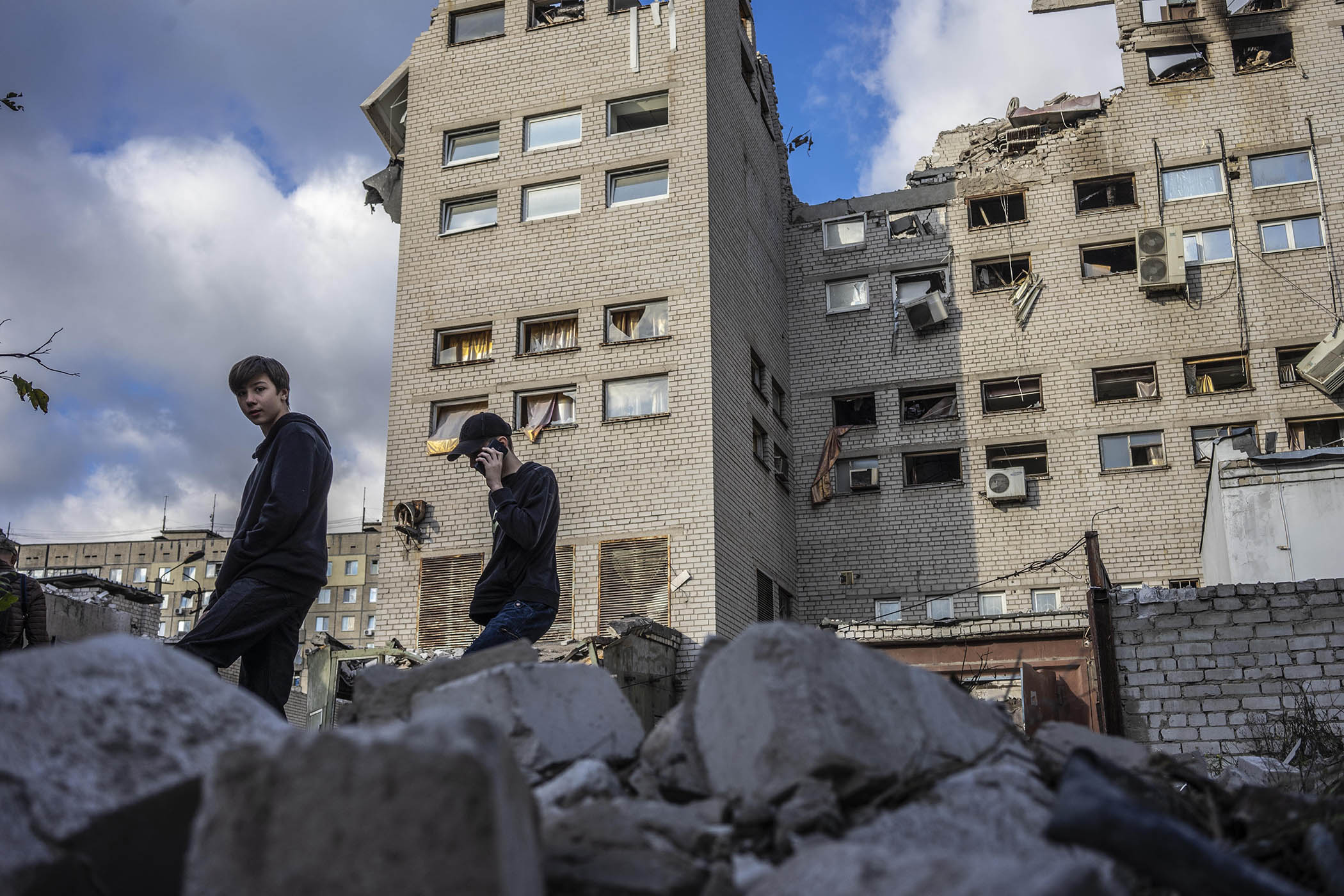
His parents did everything in their power to keep things stable, but as the war progressed they moved from a city-centre apartment to a suburban house for safety. War had been ever-present in Andriy’s life – the family live in the Donetsk region, which Russia first invaded and partially occupied in 2014.
His parents didn’t worry that it might have affected him. “There were no red flags,” says his father, Serhii. “He was a normal kid, doing normal things.” But when Andriy was 16, a close relative grew sick. In August 2024, medical tests confirmed it was cancer. Serhii says it had a heavy impact on Andriy.
Desperate to find work so he could help towards the cost of treatment, Andriy started asking around for odd jobs doing household repairs or deliveries, and even offered local Ukrainian soldiers help to dig trenches. When he got nowhere, he turned to Telegram, where he joined a chat about local vacancies.
Users were posting adverts for unspecified casual work for good money and with no skills or experience required. Andriy sent one a direct message – and that’s when the manipulation started. The user did not identify themselves beyond a handle that was a collection of seemingly random letters and numbers.
What Andriy didn’t know was that he was speaking to Russian intelligence.
“It wasn’t obvious they were asking him to commit a crime,” Serhii says. “It’s so well planned that even adults wouldn’t understand something was wrong.”
Within a week, Andriy had set fire to his first Ukrainian military car. Over the next three days he set fire to three more, before he was arrested in Donetsk. Now 18, he is halfway through a suspended sentence for obstructing the armed forces and committing arson.
Sabotage is becoming an increasingly common tactic in a war that is now in its fifth year. Both sides use it to disrupt the other, stretch security forces and create uncertainty. It is cheap and low-risk, and over time has proven effective at tying up resources, spreading fear and undermining morale, without the need to commit large forces. Ukraine and Russia have relied on it more as the conflict has dragged on.
Both sides have accused the other of manipulating vulnerable people, including children, into committing acts of violence. Ukraine’s security service, the SBU, told The Observer that it has, alongside police, identified more than 1,000 people involved in crimes related to sabotage, arson and what it called “terrorist attacks” on the country.
Newsletters
Choose the newsletters you want to receive
View more
For information about how The Observer protects your data, read our Privacy Policy
Many of the perpetrators were minors. Most were detained before they managed to commit a crime, but some, like Andriy, slip through the net. As well as arson, there have been cases of children being manipulated into transporting explosive substances, damaging infrastructure, sharing sensitive intelligence and even making bombs. The youngest child the SBU has identified was just 11.
‘It wasn’t obvious they were asking him to commit a crime. It’s so well planned that even adults wouldn’t understand something was wrong’
‘It wasn’t obvious they were asking him to commit a crime. It’s so well planned that even adults wouldn’t understand something was wrong’
Serhii, Andriy’s father
Andriy was promised $1,500 for each car he destroyed. He was asked to look around his hometown for cars belonging to the Ukrainian army – identifiable by the camouflage paint – and send photos of them to his handlers. If they approved, he was told he should pour petrol on the bonnet and set it alight. In the end, though, he received payment for just one, and in cryptocurrency, which agents use because it makes the source of funding hard to trace.
“I don’t know if that was because he was arrested before they could pay the rest, but maybe they planned it like this,” Serhii says. “My son is now starting out on life with a criminal record and my hair turned grey over the stress.”
Serhii and Andriy’s names have been changed and details of their lives obscured to protect them against any backlash.
Russia is increasingly using hybrid methods of warfare that include the exploitation of vulnerable groups, according to the SBU. Teenagers, the elderly and people with debt or addiction issues are all being targeted. In 2023, according to the SBU, Moscow launched Diversion Noise, a plan to increase sabotage and terrorist attacks that it said is sanctioned directly by Russia’s president Vladimir Putin.
Recruiters search for teenagers from disadvantaged or single-parent families who are in difficult financial circumstances. Recruitment usually takes place via social media, often Telegram and other messaging apps, or online games, and begins with an offer of quick money. After establishing contact, what Russian intelligence calls the “disposable agent” is given a test task that appears simple and harmless, such as posting leaflets, spraying graffiti or taking a photo of a specific object. The handlers gradually increase the demands.
“Children are easy to manipulate because they trust adults and may not understand the consequences of their actions,” said Iryna Pushchyk, director of operations at Dignity Online, a Ukrainian NGO focused on protecting children online. “They have threatened to kill some children’s parents. There are also cases where the children have cross-border family connections, where a trusted family member on the other side encourages the child to participate.”
Pushchyk said Russia employs psychologists to develop systems to tactically manipulate vulnerable people.
Some children end up making bombs, and law enforcement says that the ingredients are available in DIY stores to make them at home. The agents give them instructions and tell them to keep it a secret.
In March last year, a 14-year-old girl was detained while preparing an attack in Ternopil, western Ukraine. Russian agents found her on Telegram, hacked her phone and used personal photos to blackmail her into making a homemade explosive device. She hid it in a backpack and left it near a police building, but was caught by the authorities.
Russian spies are increasingly recruiting Ukrainians to carry out acts of sabotage in Europe in an attempt to disrupt public opinion, according to the Royal United Services Institute. There were 34 incidents of Russia-linked arson and serious sabotage across Europe in 2024, up from 12 the previous year. There were just two incidents in 2022. Money is a key motivator.
“The methods used to recruit and task saboteurs have shifted from cold-war-era reliance on trained intelligence operatives to a model characterised by remote, freelance and highly deniable assignments: the ‘gig-economy era’ of Russian sabotage,” the report said.
Trials of alleged saboteurs recently began in Poland and Germany. In Warsaw, five men are accused of sending parcels of cosmetics and massage cushions that contain liquid explosives to the UK and Poland. The aim, according to the prosecution, was to start fires on cargo flights and intimidate civilians. Meanwhile, in Stuttgart, three Ukrainians went on trial on 17 March accused of taking part in a suspected operation to test arson attacks by sending explosive parcels to Ukraine.
In late February, three explosions targeted Ukrainian police officers in different cities across the country over the course of 48 hours.
The Kremlin has previously denied western allegations of a growing campaign of sabotage and other hybrid hostilities. Russian courts have prosecuted and convicted large numbers of teenagers on sabotage and terrorism charges linked to the war in Ukraine, with some as young as 14 facing lengthy prison sentences.
In recent weeks, Moscow brought forward a move to restrict Telegram, partly due to security fears, as officials claimed the app has been used to recruit or coordinate people for “sabotage and terrorist actions”.
The psychological impact on children caught in the crossfire is significant. Many children don’t fully understand the severity of their actions, and the result is a criminal record and damaging social stigma. In Ukraine, efforts are made to handle cases gently, and suspended sentences are often used rather than harsh punishment.
Serhii says that Andriy didn’t do what he did because he supported Russia or had changed his position on the war, or even because the war influenced him. He simply wanted to help his family member get surgery, and for that he is paying a heavy price.
News reports of his trial were met with comments online from people who accused him of betraying Ukraine, a burden he must now live with. He is confined to his home under the rules of his sentence and is liable to pay damages and make a public apology.
The ordeal has forced him to grow up a lot, says Serhii, and Andriy now better understands that he is responsible for his actions. He has also learned to speak to his parents about things that are worrying him.
Andriy’s beloved family member continues cancer treatment.
“My biggest fear was that I wouldn’t see my son as the same person again, that he would be changed – and it has changed him,” says Serhii. “This war has no mercy, even for children.”
Photograph by Jose Colon/Anadolu Agency via Getty Images