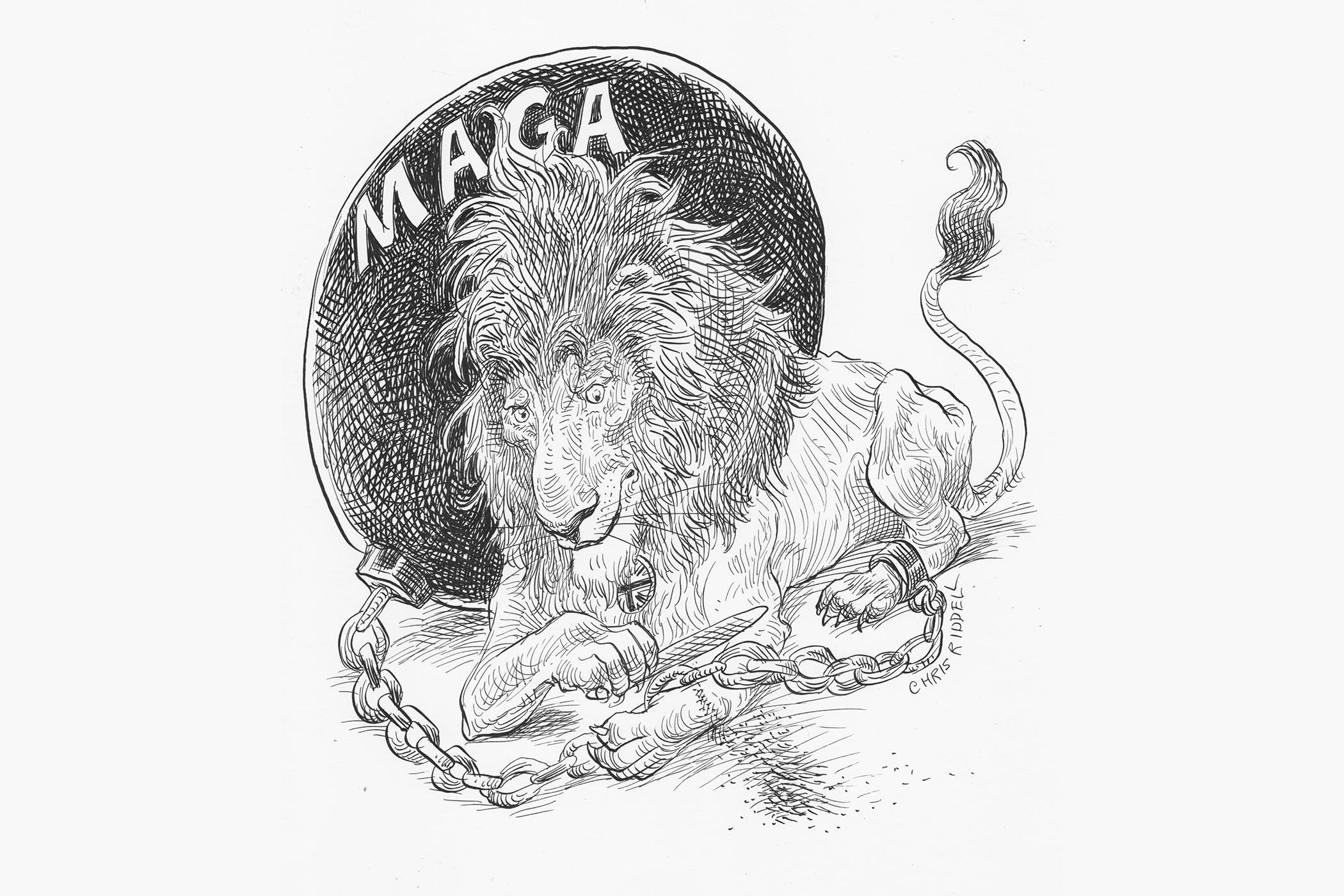


Illustration by Chris Riddell for The Observer
If Keir Starmer keeps a list of people who have kiboshed his efforts to govern calmly and revive the UK, it presumably includes Andy Burnham, Angela Rayner, Wes Streeting and now John Healey and Al Carns. He should add Donald Trump to the list.
Trump has pulled the rug from under the Starmer project in four distinct but interlocking ways, to such destructive effect that anyone who didn’t know the president better might think it was all planned.
First, Trump torched the green shoots of economic recovery. The UK economy grew by half a percentage point in February, faster than expected and much faster than the average of the previous nine months. Inflation was under control. Interest rates were ticking down. Then Trump approved the US-Israeli bombardment of Iran, and Tehran responded by blocking the Strait of Hormuz. World oil and gas prices spiked. So did UK inflation, when forecasters and rate-setters had been expecting it to fall. Three and a half months on, the strait remains closed. World oil prices are still nearly 30% above prewar levels and the green shoots narrative is not plausible on the doorsteps of Makerfield where Thursday’s byelection could shape the future of the country. In fact, it’s risible.
Second, in the meantime, Trump has contrived to split the Labour party over Gaza. His backing for Israel’s onslaught on the Strip with the loss of nearly 73,000 Palestinian lives has tested to destruction the third rail of British foreign policy in the age of Brexit – the transatlantic alliance. In public, Starmer has maintained cabinet unity behind his tortured expressions of support for Israel’s right to self-defence. But last month’s local elections showed Labour is haemorrhaging support to the Greens, not over net zero but because of their unqualified support for Palestine.
Third, Team Trump has been a gleeful combatant in Britain’s culture wars. Using the web as a giant surveillance tool, Vice President JD Vance and his friend Elon Musk have seized on every chance to turn Britons against themselves. Vance finds time in his vice-presidential schedule to pick a fight with the Hampshire constabulary over the death of Henry Nowak. Musk’s X amplifies his complaint and thugs take to the streets of Southampton.
When Stephen Ogilvie was stabbed by a Sudanese refugee in Belfast last week, Musk himself played the role of arsonist, reposting egregiously wrong and racist comments from among his 240 million followers on X. Musk is not on Trump’s payroll – he seems to have other sources of income – but he and other Maga meddlers are helping to achieve the Trump administration’s goal of supporting what it calls Europe’s “patriotic” parties. In Britain that means Reform and Restore.
Finally, Trump has forced on Starmer a spending commitment he can’t afford and which now looks likely to precipitate his exit from No 10. The terms of the UK’s defence debate, which led to the resignations of Healey and Carns, have been set by Trump’s demand for 5% of GDP to be earmarked for defence as a condition of America’s commitment to Nato. But Starmer has to deal with realities that don’t allow it except as a vague goal. The result is deep gloom in Downing Street, where a week ago Starmer was plotting a determined fightback.
It would be consoling if on America’s 250th birthday the so-called special relationship were a source of stability. It turns out to be a source of instability. The lesson for Britain is not to fetishise independence but to embrace interdependence; to take seriously this country’s vital relationships with Nato, Europe and, yes, the United States. Nato for security when China threatens Taiwan and Russia threatens all its neighbours. Europe for prosperity and the defence of shared values – democracy, free markets, human rights and the rule of law. And the US as an unstoppable engine of innovation. America on its birthday is still much more than Trump, who one way or another will be history soon.
Britain’s good fortune is to sit at the intersection of these three great systems. Brexit was a grumpy repudiation of this reality. But reality bites, and that’s not a bad thing.
Newsletters
Choose the newsletters you want to receive
View more
For information about how The Observer protects your data, read our Privacy Policy
Thank you for reading. Tell us what you think by writing to letters@observer.co.uk